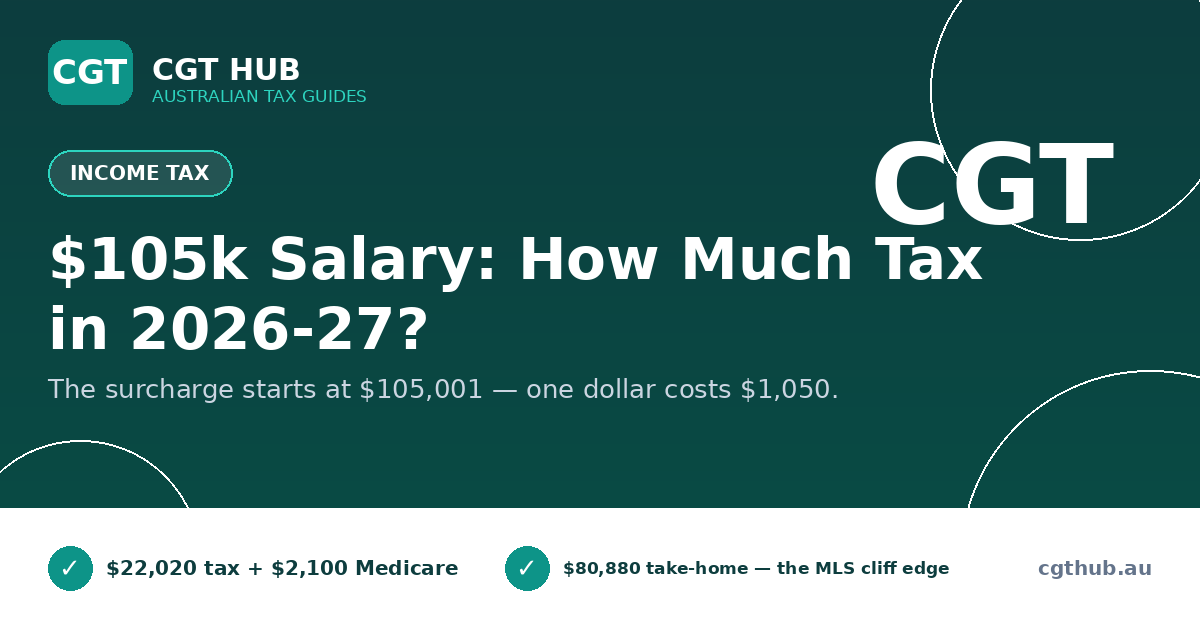
On a $105,000 salary in the 2026–27 financial year, an Australian resident pays $22,020 in income tax plus $2,100 in Medicare levy — $24,120 in total — leaving $80,880 take-home for the year. That works out to $6,740 a month, $3,110.77 a fortnight and $1,555.38 a week, at an effective tax rate of 23.0%.
Those figures assume a single resident claiming the tax-free threshold, with no deductions, no HELP debt and private hospital cover held all year. Change any of those and the number moves — and there is also a second correct answer to this question: $81,200, thanks to the brand-new $1,000 standard deduction that starts this year. But the number is not the most interesting thing about $105,000. This salary sits on the exact line where the Medicare levy surcharge begins. At $105,000 you pay $0 surcharge. Earn $105,001 and you owe 1% of your entire income — $1,050.01 — if you hold no hospital cover. No other rung in our salary ladder has a cliff like that. The rest of this guide shows the full working, the surcharge trap in dollars, the HELP overlay, and two legal ways to keep more of it. Every figure below is calculated at the verified 2026–27 ATO rates.
The short answer
$105,000 gross. $22,020 income tax. $2,100 Medicare levy. $80,880 in your pocket. Your marginal rate is 30% (32% once the levy is counted), which means every extra dollar you earn from here costs 32 cents — but only the dollars above $45,000 are taxed at that rate. The first $18,200 is tax-free, the next $26,800 is taxed at just 15%, and that is why your effective rate is 23.0% even though your top rate is 30%.
If you have a HELP debt, subtract another $5,320.80 and your take-home falls to $75,559.20. If you claim the new $1,000 standard deduction instead, your take-home rises to $81,200. And if you are not an Australian resident for tax purposes, the answer is different again: $73,500.
One more thing makes $105,000 special: it is the last salary in the ladder that escapes the Medicare levy surcharge entirely. A $5,000 pay rise to $110,000 without hospital cover does not just cost you 32% on the extra dollars — it adds a $1,100 surcharge on your whole salary, so you keep only $2,300 of the $5,000. That is the trap this guide works through in dollars.
How the tax on $105,000 is worked out
Australia taxes income in slices, not at one flat rate. Your $105,000 is cut into three slices, and each slice is taxed at its own rate:
| Slice of income | Rate | Tax |
|---|---|---|
| $0 – $18,200 (tax-free threshold) | 0% | $0 |
| $18,201 – $45,000 ($26,800) | 15% | $4,020 |
| $45,001 – $105,000 ($60,000) | 30% | $18,000 |
| Total income tax | $22,020 |
Then the Medicare levy: 2% of your taxable income, which is $2,100. Add them together and your total bill is $24,120. Subtract that from $105,000 and you get $80,880.
The 15% rate on the second slice is new this year — it was 16% in 2025–26, and the cut is worth $268 a year to everyone earning $45,000 or more. It falls again to 14% from 1 July 2027, which would be worth another $268 on this salary. The Low Income Tax Offset does not help here: it is worth up to $700 at low incomes but phases out completely by $66,667, so at $105,000 it is $0.
The official 2026–27 rates
| Taxable income | Tax on this income |
|---|---|
| $0 – $18,200 | Nil |
| $18,201 – $45,000 | 15c for each $1 over $18,200 |
| $45,001 – $135,000 | $4,020 plus 30c for each $1 over $45,000 |
| $135,001 – $190,000 | $31,020 plus 37c for each $1 over $135,000 |
| $190,001 and over | $51,370 plus 45c for each $1 over $190,000 |
On top of these rates: the Medicare levy at 2% of taxable income, and the Medicare levy surcharge of 1% to 1.5% if your income for surcharge purposes is above the threshold and you hold no appropriate private hospital cover. For 2026–27 the surcharge thresholds are $105,000 for singles and $210,000 for families — up from $101,000 and $202,000 last year. If you are still reading guides that quote $93,000 or $101,000, they are out of date.
The surcharge cliff: $105,000 is the last safe salary
The Medicare levy surcharge is not like income tax. Income tax only ever touches the dollars above a threshold. The surcharge, once triggered, is charged on your whole income. The 2026–27 tiers for singles:
| Income for surcharge purposes (singles) | Surcharge rate | Surcharge on $105,000–$123,000 |
|---|---|---|
| $105,000 or less | 0% | $0 |
| $105,001 – $123,000 | 1% | $1,050 – $1,230 |
| $123,001 – $164,000 | 1.25% | $1,537 – $2,050 |
| $164,001 or more | 1.5% | $2,460+ |
Read that first row carefully: $105,000 or less pays nothing. At $105,001 the surcharge switches on at 1% of everything. One extra dollar of income costs $1,050.01 in surcharge if you have no hospital cover. That is the sharpest cliff in the Australian tax system, and $105,000 is the salary that sits exactly on its edge.
Three things people get wrong about the surcharge. First, the test uses your income for surcharge purposes, which is broader than your taxable income — reportable fringe benefits and reportable super contributions count, so your salary alone can understate it. A $105,000 salary plus $2,000 of reportable super contributions is $107,000 for surcharge purposes, and the surcharge applies. Second, extras-only health cover does not count — it must be hospital cover, held for the full year, with an excess of no more than $750 for singles. Third, the surcharge is avoidable in a way income tax is not: a basic hospital policy often costs less than the surcharge itself, and unlike the surcharge it actually buys you something.
Run the numbers on the most common real-world case: you earn $105,000 and your employer is about to give you a $5,000 raise to $110,000. Without hospital cover, the raise costs you $1,500 in extra income tax, $100 in extra Medicare levy, and $1,100 in brand-new surcharge (1% of the whole $110,000). You keep $2,300 of the $5,000 — 46%. With hospital cover held all year, the surcharge never appears and you keep $3,400 — 68%. The cover pays for itself the moment the raise lands.
The HELP overlay: $5,320.80 off your take-home
Since the 2025–26 income year, HELP repayments use a marginal system, like income tax. You pay nothing on the first $69,528 of repayment income, then 15 cents on each dollar above that up to $129,717. On $105,000:
15% × ($105,000 − $69,528) = 15% × $35,472 = $5,320.80.
Your take-home with a HELP debt is $80,880 − $5,320.80 = $75,559.20 for the year, or $2,906.12 a fortnight. Your employer withholds the repayment from your pay during the year, so you never see it as a separate bill — it just quietly shrinks every payslip.
Two warnings. First, several ranking calculator pages still show the old pre-2025 system: a $54,435 threshold and flat rates of 1% to 10% applied to your whole income. Those figures are dead. Under the current marginal system the repayment is $5,320.80, calculated only on the dollars above $69,528. Second, HELP uses repayment income, not just your salary — net investment losses, reportable fringe benefits and reportable super contributions are added back, so a salary sacrifice that cuts your taxable income does not cut your repayment income by the same amount. The one exception: the $1,000 standard deduction does reduce your taxable income, and therefore your repayment income, so claiming it trims your HELP repayment to $5,170.80.
The second correct answer: $81,200 with the $1,000 standard deduction
From 2026–27 the ATO lets you claim a $1,000 standard deduction instead of itemising work-related expenses. If you claim it, your taxable income falls from $105,000 to $104,000:
| Without deduction | With $1,000 standard deduction | |
|---|---|---|
| Taxable income | $105,000 | $104,000 |
| Income tax | $22,020 | $21,720 |
| Medicare levy | $2,100 | $2,080 |
| Total | $24,120 | $23,800 |
| Take-home | $80,880 | $81,200 |
The deduction is worth 32 cents in the dollar at this income — 30 cents of income tax plus 2 cents of levy on the $1,000 — $320 a year. Tax on $104,000 is $4,020 + 30% × $59,000 = $21,720, the levy is 2% × $104,000 = $2,080, and $105,000 − $23,800 = $81,200. Claim the standard deduction if your actual work deductions are under $1,000; itemise if they are more. You cannot claim both.
One more knock-on: the deduction also pulls your HELP repayment income down to $104,000, so a HELP holder’s repayment falls to $5,170.80 and their take-home with HELP and the deduction is $81,200 − $5,170.80 = $76,029.20.
What $105,000 looks like across the year
| Pay cycle | Gross | Tax + levy | Take-home |
|---|---|---|---|
| Year | $105,000 | $24,120 | $80,880 |
| Month | $8,750 | $2,010 | $6,740 |
| Fortnight | $4,038.46 | $927.69 | $3,110.77 |
| Week | $2,019.23 | $463.85 | $1,555.38 |
| Day (260 working days) | $403.85 | $92.77 | $311.08 |
These are assessed averages, not payslip figures. Your employer withholds tax using the ATO’s PAYG tables, which land within a few dollars of your final assessment over the year — the difference shows up as a small refund or a small bill when you lodge. If your payslip take-home is much lower than $3,110.77 a fortnight, something else is being withheld: a HELP repayment (about $204.65 a fortnight on this salary), a salary sacrifice arrangement, or a second job’s withholding. If it is much higher, your employer may not be withholding HELP at all, and the bill will arrive at tax time.
The salary ladder: where $105,000 sits
| Salary | Income tax | Medicare levy | Take-home | Effective rate |
|---|---|---|---|---|
| $50,000 | $5,520 | $1,000 | $43,480 | 13.0% |
| $60,000 | $8,520 | $1,200 | $50,280 | 16.2% |
| $70,000 | $11,520 | $1,400 | $57,080 | 18.5% |
| $75,000 | $13,020 | $1,500 | $60,480 | 19.4% |
| $80,000 | $14,520 | $1,600 | $63,880 | 20.2% |
| $85,000 | $16,020 | $1,700 | $67,280 | 20.8% |
| $90,000 | $17,520 | $1,800 | $70,680 | 21.5% |
| $95,000 | $19,020 | $1,900 | $74,080 | 22.0% |
| $100,000 | $20,520 | $2,000 | $77,480 | 22.5% |
| $105,000 | $22,020 | $2,100 | $80,880 | 23.0% |
| $110,000 | $23,520 | $2,200 | $84,280 | 23.4% |
| $120,000 | $26,520 | $2,400 | $91,080 | 24.1% |
| $130,000 | $29,520 | $2,600 | $97,880 | 24.7% |
| $150,000 | $36,570 | $3,000 | $110,430 | 26.4% |
| $200,000 | $55,870 | $4,000 | $140,130 | 29.9% |
Assumes a resident with hospital cover (no surcharge), no HELP debt and no deductions. For context, the full-time median salary in Australia is around $90,532 and average weekly ordinary time earnings (AWOTE) sit near $108,352 a year — so $105,000 is about $14,500 above the full-time median and just below AWOTE. It is a solidly above-average wage, and it is also the exact point where the tax system starts charging you extra for not holding hospital cover.
Two legal ways to keep more of it
1. Salary sacrifice into super — use the $19,900 of headroom
Your employer already pays 12% super guarantee on your salary: $12,600 a year. The 2026–27 concessional contributions cap is $32,500, which leaves $19,900 of headroom for salary sacrifice and deductible personal contributions. (If you still see $30,000 quoted as the cap, that was the 2025–26 figure — it rose to $32,500 on 1 July 2026.)
Sacrifice $10,000 of salary into super and your taxable income falls to $95,000. Income tax falls from $22,020 to $19,020 (a $3,000 saving) and the levy falls from $2,100 to $1,900 (a $200 saving). Your fund pays 15% contributions tax on the $10,000, which is $1,500. Net saving: $3,000 + $200 − $1,500 = $1,700 a year, and the $10,000 is now growing inside super instead of being spent. If you hold a HELP debt the saving is bigger still, because the sacrifice also cuts your repayment income. The trade-off is real: the money is preserved until retirement, so sacrifice only what you will not need before then. And watch the cap — go over $32,500 in total concessional contributions and the excess is taxed at your marginal rate, wiping out the benefit.
2. Sort out hospital cover before the next dollar
This is the cheapest win available at this exact salary. A basic hospital policy with a $750 excess can cost less than the $1,050 surcharge it avoids, and it also protects you against the Lifetime Health Cover loading if you turn 31 without cover (2% extra premium per year over 30, up to 70%). The surcharge is calculated on the full year, so cover must be held for the whole income year to avoid it entirely — taking out a policy in June does not fix the previous eleven months. If a raise past $105,000 is coming, get the cover in place before the raise takes effect.
Common mistakes on $105,000
Treating the surcharge like income tax. It is charged on your whole income once you cross the line, not just on the dollars above it. Budgeting “1% of the raise” understates the cost more than twenty-fold.
Using last year’s thresholds. The surcharge line was $101,000 in 2025–26 and $93,000 the year before that. Guides and calculators that have not been updated will tell you that you already owe the surcharge at $105,000. You do not — not this year, not at exactly this salary.
Using the old HELP rates. The flat-rate schedule with the $54,435 threshold died with the 2025–26 year. Your repayment is 15 cents on the dollars above $69,528: $5,320.80, calculated only on the slice above the threshold — not a flat rate on your whole income.
Forgetting the $1,000 standard deduction. It is new for 2026–27 and worth $320 at this income. If your actual work deductions are under $1,000, claiming the standard deduction is free money — but you cannot claim both, so add up your real deductions first.
Quoting the old $30,000 super cap. The concessional cap is $32,500 for 2026–27. Planning a salary sacrifice on the old figure leaves $2,500 of headroom — about $750 of tax saving — on the table.
Comparing gross salaries across the cliff. A $110,000 offer without hospital cover is worth $83,180 after tax; a $105,000 salary with cover is worth $80,880. The $5,000 raise is really worth $2,300. Negotiate the cover, or negotiate the raise higher, with the real numbers in front of you.
What if you are not a resident?
Non-residents pay 30% on the first $135,000 of taxable income, with no tax-free threshold and no Medicare levy. On $105,000 that is $31,500 in tax and $73,500 take-home — $7,380 less than a resident on the same salary. Working holiday makers are taxed the same way on the first $45,000 (15%) and then at resident rates, so their figure differs again. Residency is a facts-and-circumstances test, not a visa label: if you have been living and working in Australia for six months or more, you may already be a resident for tax purposes.
Looking ahead: 2027–28
From 1 July 2027 the 15% bracket falls to 14%. On a $105,000 salary that saves 1% × $26,800 = $268 a year, taking the same take-home to $81,148 before any other change. It is a small, legislated cut — worth knowing about when you are negotiating a salary for next year, but not a reason to defer a raise. A $5,000 raise now is worth far more than $268 next July.
Frequently asked questions
Do I pay the Medicare levy surcharge on exactly $105,000?
No. The base tier is $105,000 or less, so the surcharge is $0 at exactly $105,000. It switches on at $105,001, at 1% of your whole income for surcharge purposes. Remember the test uses income for surcharge purposes, which adds reportable fringe benefits and reportable super contributions to your taxable income — so check those before assuming you are under the line.
How much HELP do I repay on a $105,000 salary?
$5,320.80 for 2026–27: 15 cents on each dollar of repayment income above $69,528. That takes your take-home from $80,880 to $75,559.20. The repayment is withheld from your pay, so it never arrives as a separate bill.
Is $105,000 a good salary in Australia?
It is comfortably above average. The full-time median is around $90,532 and AWOTE is about $108,352, so $105,000 sits roughly $14,500 above the median worker and just under the national average earnings figure. After tax it leaves $6,740 a month, or $3,110.77 a fortnight, before HELP or salary sacrifice.
Why is my payslip less than $3,110.77 a fortnight?
The most common reasons are HELP withholding (about $204.65 a fortnight on this salary), a salary sacrifice arrangement, or a second job. Your employer’s PAYG withholding should otherwise land within a few dollars of your final assessment over the year. If your payslip is higher than $3,110.77 and you hold a HELP debt, your employer may not be withholding the repayment — expect the bill at tax time.
Does the $1,000 standard deduction apply to me?
Yes, if your actual work-related deductions are less than $1,000. It is new for 2026–27 and worth $320 at this income, taking your take-home to $81,200. You claim it instead of itemising, not as well as — if your real deductions exceed $1,000, itemise.
I have been offered $110,000. How much extra do I actually keep?
With hospital cover held all year, you keep $3,400 of the $5,000 raise. Without cover, the 1% surcharge on the whole $110,000 costs $1,100 and you keep only $2,300. Get the cover sorted before the raise starts, or negotiate the offer up to cover the difference.
On $105,000 you are standing on the most valuable line in the Australian tax system: the last salary that pays no surcharge at all. The tax itself is straightforward — $22,020 plus a $2,100 levy, $80,880 in your pocket — but the decisions around it are worth far more than the arithmetic. Hold hospital cover, claim the deduction you are entitled to, and use the $19,900 of super headroom before the year runs out. Check your own figures with our income tax calculator and our super calculator, and read our Medicare levy surcharge guide, our tax on $95k guide, our tax on $110k guide and our super contribution caps guide for the detail behind each number here.