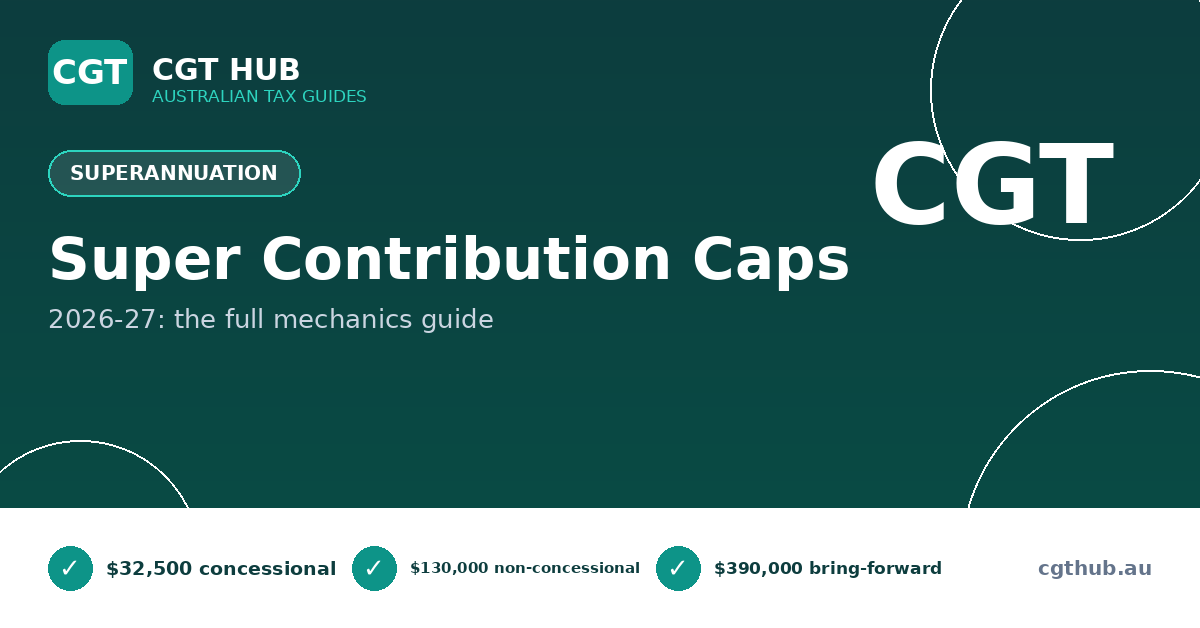
Quick answer: In 2026-27 the concessional (before-tax) contributions cap is $32,500 and the non-concessional (after-tax) cap is $130,000. Everyone knows those two numbers — and nearly every cap guide stops there. The money is in the mechanics: what actually counts toward each cap (your employer’s insurance premiums do), when a contribution officially counts (when the fund receives it, not your payslip date), and how the traps chain together — an unreleased excess can snowball into a triggered bring-forward and up to 94% tax on the same dollars.
If you’re weighing salary sacrifice against personal contributions, read this alongside our superannuation tax and salary sacrifice guide — it has the full 2026-27 worked examples of the 15%-versus-marginal-rate saving. This article is the operations manual for the caps themselves.
How the two caps work — the Daniel example
Every contribution you make lands in one of two buckets, and the buckets have nothing to do with each other:
- Concessional (before-tax) — $32,500. Employer SG, salary-sacrificed amounts, and personal contributions you claim a deduction for. Taxed at 15% inside the fund instead of your marginal rate.
- Non-concessional (after-tax) — $130,000. Money you’ve already paid tax on — personal contributions you don’t claim as a deduction, spouse contributions on your behalf. No tax on the way in, but no deduction either.
Meet Daniel. He earns $110,000 in 2026-27. His employer pays 12% SG: $13,200. He salary sacrifices another $10,000. That’s $23,200 in concessional contributions — leaving $9,300 of headroom under the $32,500 cap, which he could use with a deductible personal contribution before 30 June. His $5,000 after-tax top-up sits in the other bucket: non-concessional, $125,000 of room left there. The salary sacrifice saves him real money: it’s taxed at 15% in the fund instead of his 32% marginal rate (30% bracket + 2% Medicare levy), so $10,000 sacrificed is a $1,700 tax saving. Model your own numbers with our super calculator and check the saving against your bracket in our income tax rates guide.
2026-27 super caps at a glance
| Item | 2026-27 figure |
|---|---|
| Concessional contributions cap | $32,500 |
| Non-concessional contributions cap | $130,000 (nil if your total super balance was $2.1m+ at 30 June 2026) |
| Bring-forward maximum (3 years) | $390,000 if TSB < $1.84m at 30 June 2026 |
| Carry-forward (catch-up) eligibility | Total super balance < $500,000 at 30 June 2026; unused caps from prior 5 years |
| Super guarantee rate | 12% of qualifying earnings, paid per payday |
| Maximum contribution base | $270,830 per year (employer SG stops accruing above this) |
| General transfer balance cap | $2.1 million |
| Government co-contribution | Up to $500; income between $49,293 and $64,293 |
| Division 293 threshold | $250,000 (income + concessional contributions) — extra 15% contributions tax |
Sources: ATO — Concessional contributions cap; ATO — Non-concessional contributions cap; ATO — Key super rates and thresholds.
The concessional cap: what actually counts
The surprise most people get from their accountant: your employer’s SG is inside the $32,500, not on top of it. The concessional cap covers all of these, across every fund you hold:
- Compulsory employer SG (12% in 2026-27).
- Salary-sacrificed amounts.
- Personal contributions you claim a tax deduction for.
- Employer-paid admin fees and insurance premiums — yes, these count toward your concessional cap, and they quietly eat headroom people don’t know they’ve lost.
And the date that matters is the date your fund receives the money — not your payslip date, not the day your employer’s payroll ran. Your employer can legally pay the June SG contribution as late as 28 July, which lands it in the next financial year’s cap. Some employers pay early instead, which can stack five quarters into one year. If you’re topping up in June, transfer by mid-June at the latest.
Catch-up (carry-forward) contributions: the 5-year table nobody prints
If your total super balance was under $500,000 at 30 June 2026, you can use unused concessional cap amounts from the previous five years — oldest first, applied automatically once you exceed the current cap. Here’s the actual cap history you need for the maths:
| Financial year | Concessional cap | Still usable in 2026-27? |
|---|---|---|
| 2020-21 | $25,000 | No — expired 30 June 2026 |
| 2021-22 | $27,500 | Yes — expires 30 June 2027 (use it or lose it) |
| 2022-23 | $27,500 | Yes |
| 2023-24 | $27,500 | Yes |
| 2024-25 | $30,000 | Yes |
| 2025-26 | $30,000 | Yes |
| 2026-27 | $32,500 | Current year |
Meet Priya. Her balance was $380,000 at 30 June 2026 — under $500,000, so she’s eligible. Her unused amounts: 2021-22 $7,500 (cap $27,500, used $20,000); 2022-23 $12,500 (used $15,000); 2023-24 $7,500 (used $20,000); 2024-25 $8,000 (cap $30,000, used $22,000); 2025-26 $5,500 (used $24,500). Total unused: $41,000. Her personal concessional cap for 2026-27 is $32,500 + $41,000 = $73,500. The $7,500 from 2021-22 is used first — and if she doesn’t use it by 30 June 2027, it vanishes. Check your own balance in myGov (ATO online → Super → Carry forward concessional contributions) before making a big EOFY contribution — the figure is there, most people have never looked.
The non-concessional cap and the bring-forward rule
The bring-forward arrangement lets you bring up to two future years’ caps into the current year — but the amount depends on your total super balance at the prior 30 June:
| TSB at 30 June 2026 | Non-concessional cap 2026-27 |
|---|---|
| Less than $1.84 million | $390,000 over 3 years |
| $1.84m to less than $1.97m | $260,000 over 2 years |
| $1.97m to less than $2.1m | $130,000 (no bring-forward) |
| $2.1m or more | Nil |
You must be under 75 at some point in the trigger year. And here’s what the consumer guides gloss over: the arrangement triggers automatically the moment your non-concessional contributions exceed $130,000 in a year. There is no form. Meet Mei: her balance was $1.2 million at 30 June 2026, she inherits $350,000 and tips it all into super in August 2026. That single contribution triggers a 3-year arrangement — her cap is $390,000, so she has $40,000 of room left across 2027-28 and 2028-29 before any further after-tax contribution is an excess. A small employer after-tax contribution or a stray personal payment to a second fund is one of the most common ways people trigger this at the wrong time.
Two more traps. First, the lock-in: if you triggered a bring-forward in 2024-25 or 2025-26, your cap stays at $360,000 — the new $390,000 does not apply to you, because the cap is locked at the first year’s amount with no indexation inside the period. Second, the kill-switch: if your balance is at or above the $2.1 million general transfer balance cap at the prior 30 June, the ATO reduces your remaining bring-forward cap to nil.
What happens if you exceed the caps — in dollars
Excess concessional. Say you overshoot by $4,000 and your marginal rate is 37%. The excess is added to your assessable income: $4,000 × 37% = $1,480 in tax, minus the 15% non-refundable offset ($600) = $880 of extra tax. You can elect to release up to 85% of the excess ($3,400) back to yourself — you have 60 days from the ATO’s determination (or up to 120 days through ATO online). One correction worth making, because several adviser sites still get it wrong: the Excess Concessional Contributions charge no longer applies — it was abolished from 1 July 2021. The ATO says so explicitly. There is no separate charge; it’s just marginal-rate tax minus the offset.
The cascade nobody warns you about. If you do not release an excess concessional contribution, the ATO counts it toward your non-concessional cap. That’s the domino: a $5,000 unreleased excess can push a year that’s already near the limit over $130,000 — accidentally triggering a bring-forward arrangement — and where the balance exceeds the general transfer balance cap, the combined tax on the same dollars can reach 94%. This is the most expensive “I’ll just leave it in super” decision in the tax code.
Excess non-concessional. The ATO issues a determination and you get 60 days to choose: Option 1 — release the excess plus 85% of the associated earnings (the earnings are added to your assessable income with a 15% offset); or Option 2 — leave the excess in super and pay 47% tax on it. A $10,000 excess left in under Option 2 is a $4,700 tax bill. Make no election and the ATO applies Option 1 — unless you’re in a defined-benefit-only fund, which defaults to Option 2.
Common mistakes (the 30 June season collection)
- The payslip-date fallacy. A contribution made on 30 June that the fund receives on 2 July counts for next year. Contribute by mid-June if you’re targeting this year’s cap.
- Forgetting the SG is inside the cap. On a $110,000 salary, $13,200 of your $32,500 is already spoken for before you contribute a cent.
- The insurance-premium invisibility. Employer-paid insurance and admin fees count. People with generous default cover lose headroom silently.
- The $300k salary gotcha (Payday Super era). From 1 July 2026 SG is paid per payday on broader qualifying earnings, and the maximum contribution base is $270,830 a year. On any salary above that, SG alone is 12% × $270,830 = $32,499.60 — the entire concessional cap filled by your employer. There is no room left to salary sacrifice. High earners who used to sacrifice on top of SG are the ones getting determinations this year.
- Two employers, one cap. SG from every job counts toward the same $32,500. If compulsory SG across jobs will breach it, you can apply to the ATO to opt out of SG from one employer — an actual mechanism most dual-job earners don’t know exists.
- Triggering the bring-forward by accident with a stray after-tax contribution, locking in a 3-year period at a bad time.
- Letting carry-forward amounts expire — 2021-22’s unused cap dies on 30 June 2027.
- Assuming a bring-forward contribution is deductible. It isn’t — non-concessional means after-tax. (If you lodge a notice to claim a deduction, that contribution becomes concessional and counts toward the $32,500 instead.)
Tips: getting the most from the 2026-27 caps
- Check myGov first. Your carry-forward balance, SG history, and total super balance are all in ATO online. Look before you contribute, not after the determination arrives.
- Split the concessional decision: salary sacrifice is automatic and spread across the year; a personal deductible contribution is flexible and can be sized precisely in June once you know exactly how much headroom is left. Our tax deductions checklist covers the deduction-notice mechanics.
- Coordinate the June timing with your employer: ask whether the June SG payment will land before or after 30 June before you top up.
- Low-income spouse? The government co-contribution pays 50 cents per dollar of after-tax contribution (up to $500) for incomes between $49,293 and $64,293 — free money that sits outside the concessional cap.
- Near the $250,000 line? If your income plus concessional contributions exceed $250,000, Division 293 adds another 15% contributions tax (total 30%) — factor it into salary-sacrifice decisions.
Division 293 vs Division 296 — don’t mix them up
| Division 293 | Division 296 | |
|---|---|---|
| Since | 2017-18 | 1 July 2026 (first assessments after 30 June 2027) |
| Trigger | Income + concessional contributions > $250,000 | Total super balance > $3 million (further 10% above $10m) |
| Extra tax | 15% on the lesser of the excess or the contributions (total 30%) | 15% on earnings above $3m (effective 30%); 40% above $10m |
FAQ: real questions, real answers
Does my employer’s SG count toward the $32,500, or is it on top?
It counts. The $32,500 covers SG, salary sacrifice, deductible personal contributions, and employer-paid insurance premiums combined. On a $110,000 salary, $13,200 is already used.
What’s the difference between salary sacrificing and making a non-concessional contribution — and can I claim a deduction on a $200,000 bring-forward amount?
Salary sacrifice is concessional: deductible and taxed at 15% in the fund. A non-concessional contribution is after-tax money with no deduction. You cannot claim a $200,000 bring-forward amount as a deduction — but if you lodge a valid deduction notice for a personal contribution, it becomes concessional and counts toward the $32,500 cap instead.
I contributed in June — why does it count for next financial year?
Because the contribution counts when the fund receives it, not when you sent it. A 30 June bank transfer that lands on 2 July belongs to the next year. Contribute by mid-June to be safe.
I put in $140,000 after tax — did I trigger the bring-forward rule?
Yes, automatically — there is no application. If your balance was under $1.84 million at the prior 30 June, you now have a 3-year arrangement with a $390,000 cap: $250,000 of room left across the next two years before any further after-tax contribution is an excess.
Do my unused concessional caps expire?
Yes. You can carry forward unused amounts for five years, but only if your balance was under $500,000 at the prior 30 June — and 2020-21 amounts expired on 30 June 2026, with 2021-22 amounts expiring 30 June 2027. Your exact balance is in myGov under ATO online → Super.
Is it worth contributing beyond the concessional cap, or should I invest outside super?
Non-concessional contributions still get the 15% earnings tax rate inside super (versus your marginal rate outside), but the money is locked until preservation age. Outside super you pay full tax on the way in and CGT on gains, but you keep access. For most people under 50, it’s an access-versus-tax-rate trade-off — model both sides with our income tax calculator and super calculator.
The caps for 2026-27 are $32,500 and $130,000 — but as you’ve seen, the number on the ATO’s table is the least important part. What saves or costs you real money is the mechanics: the fund-receipt date, the surprise items inside the concessional bucket, the automatic bring-forward trigger, and the unreleased-excess cascade. Get those four right and the caps work for you; miss them and a 30 June bank transfer can turn into a determination letter.