The short answer
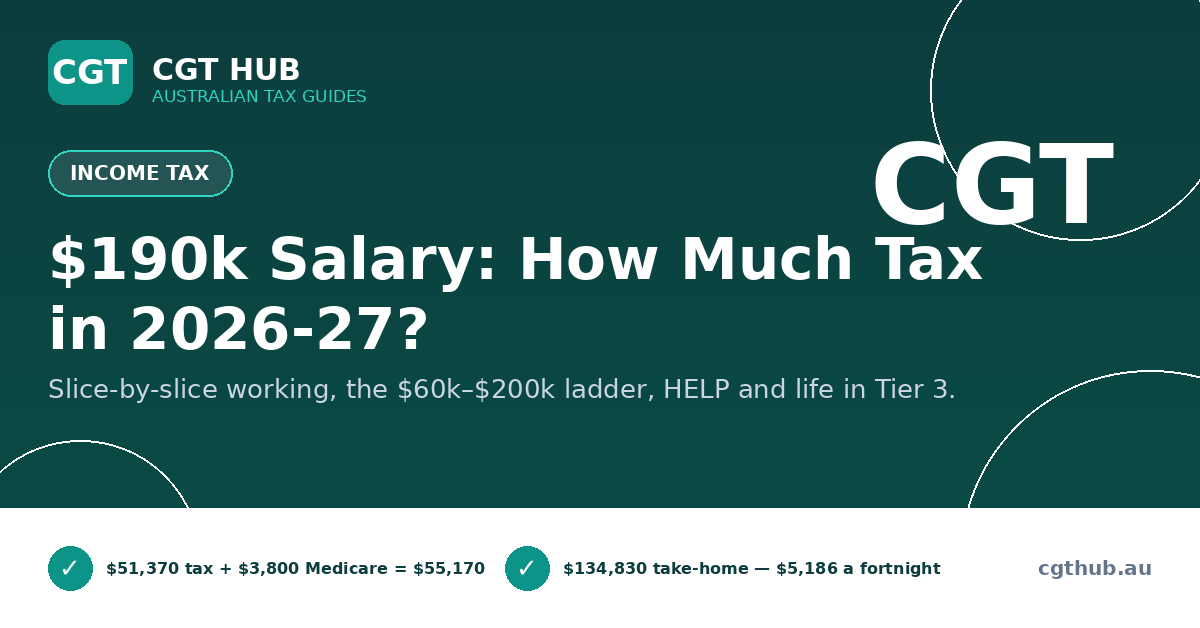
On a $190,000 salary in 2026-27, you pay $51,370 in income tax plus a $3,800 Medicare levy — $55,170 in total — and take home $134,830 a year. That’s $11,235.83 a month, $5,185.77 a fortnight or $2,592.88 a week. Your effective tax rate is 29.0%, and your marginal rate is 37% (39% once the levy is counted). On a 38-hour week, $190,000 is $96.15 an hour before tax and $68.23 an hour after it.
What makes $190,000 interesting is not the headline — it is where the number sits. This is the eleventh rung fully inside the 37% bracket, and it is also the last one: $190,000 is the exact top of the bracket, so a full $55,000 of your salary is taxed at 37% and the 45% rate touches not a single dollar of it — the next dollar you earn is the first one taxed at 45%. The $5,000 step that lands you here keeps just $3,050 — the eleventh $3,050 step in a row, after $140,000 through $185,000 did exactly the same. Your Low Income Tax Offset is long gone — it phases out completely by $66,667 — and your HELP repayment is now $19,000, because you have crossed into the flat 10% top band, where the repayment is 10% of your whole income rather than 17 cents on the dollars above a line. And the surcharge, which was $2,775 at $185,000, is now $2,850 a year if you hold no hospital cover — because you are $25,999 past the Tier 3 line at $164,001, and the rate applies to your whole income. Every figure below is worked from the ATO’s own 2026-27 tables, and independent calculators agree with the headline to the dollar.
| Your situation | Extra taken out | Take-home pay |
|---|---|---|
| Headline — no HELP debt, hospital cover held | — | $134,830 |
| With a HELP debt | $19,000 | $115,830 |
| No hospital cover (1.5% surcharge) | $2,850 | $131,980 |
| With HELP debt and no hospital cover | $21,850 | $112,980 |
| Claiming the $1,000 standard deduction | -$390 | $135,220 |
| Standard deduction + HELP debt | -$490 | $116,320 |
| Salary sacrifice $9,700 into super (full headroom) | -$2,328 net | $134,830 + $8,245 in super |
How the tax on $190,000 is worked out
Australia taxes income in slices, not all at one rate. Only the dollars inside each bracket are taxed at that bracket’s rate — nothing reaches back and re-taxes the dollars you earned below the threshold. On $190,000 the slices stack like this:
| Slice of your salary | Rate | Tax on that slice |
|---|---|---|
| $0 – $18,200 (tax-free threshold) | 0% | $0 |
| $18,201 – $45,000 | 15% | $4,020 |
| $45,001 – $135,000 | 30% | $27,000 |
| $135,001 – $190,000 | 37% | $20,350 |
| Total income tax | $51,370 |
The last row is the one that matters. Only $55,000 of your salary is taxed at 37% — the other $135,000 is taxed exactly as it was at the rungs below. That is why your effective rate is 29.0% even though your marginal rate is 37%: the marginal rate describes the next dollar, not the whole salary. Add the 2% Medicare levy — $3,800 on the full $190,000 — and the total is $55,170, leaving $134,830. The 15% second bracket is new this year: it was 16% in 2025-26, and the one-point cut is worth $268 a year to everyone earning $45,000 or more. It drops again to 14% from 1 July 2027. The cut is already baked into the $51,370 above — last year’s tax on the same salary was $51,638. Check your own circumstances with our income tax calculator — note it still uses 2025-26 rates, so use this article’s figures for 2026-27.
Official 2026-27 tax rates for residents
These are the ATO’s resident rates for 2026-27, for someone claiming the full tax-free threshold. They do not include the 2% Medicare levy.
| Taxable income | Tax on this income |
|---|---|
| $0 – $18,200 | Nil |
| $18,201 – $45,000 | 15c for each $1 over $18,200 |
| $45,001 – $135,000 | $4,020 plus 30c for each $1 over $45,000 |
| $135,001 – $190,000 | $31,020 plus 37c for each $1 over $135,000 |
| $190,001 and over | $51,370 plus 45c for each $1 over $190,000 |
Source: ATO — Tax rates, Australian residents. For the full picture across every salary level, see our income tax rates 2026-27 guide.
Two things in that table deserve a second look. First, $190,000 sits at the very top of the 37% bracket — the bracket ends here, so you have zero headroom before the 45% rate appears. The 45% rate applies to no dollar of a $190,000 salary, but the next dollar you earn is the first one taxed at 45c. Second, the jump from 30% to 37% is the biggest single step in the resident table: at $135,000 your next dollar costs 30c, at $135,001 it costs 37c — 32c to 39c with the levy. This is the eleventh rung where a full $5,000 step sits entirely on the expensive side of that jump, and the last: from here, every further step starts paying 45% on part of it.
With a HELP debt: minus $19,000 — 10% of your whole income, not 17 cents on a slice
If you still owe a HELP debt (HECS-HELP, FEE-HELP or a VET Student Loan), your compulsory repayment on $190,000 of repayment income is $19,000, leaving $115,830. The repayment is collected through the tax system — your employer withholds it during the year and it is settled at tax time — so it never appears as a separate bill, but it is real money out of your pay.
Since 1 July 2025, HELP repayments are marginal, like income tax brackets: the rate applies only to the income above each threshold. For 2026-27 the bands are:
| Repayment income | Compulsory repayment |
|---|---|
| $0 – $69,528 | Nil |
| $69,529 – $129,717 | 15c for each $1 over $69,528 |
| $129,718 – $186,050 | $9,028 plus 17c for each $1 over $129,717 |
| $186,051 and over | 10% of total repayment income |
Source: ATO — Study and training support loans rates and repayment thresholds. For the full explainer, see our HECS-HELP repayment guide.
Read that last row carefully, because it is the one change that defines this rung. Above $186,051 the repayment stops being marginal and becomes a flat 10% of your total repayment income. On $190,000 the maths is simply 10% × $190,000 = $19,000. Do not extend the 17-cent formula past its band: $9,028 plus 17% of the $60,283 above $129,717 gives $19,276.11, which is $276.11 too high — at least one guide online makes exactly that mistake on its $190,000 example. The bands join almost exactly: at $186,050 the 17-cent formula gives $18,604.61, and at $186,051 the flat 10% gives $18,605.10 — no cliff, just a change of method.
Two things follow. First, the ladder’s HELP steps break at this rung: $9,926.11 at $135,000 rising in eleven identical $850 steps to $18,426.11 at $185,000 — and then $19,000 here, a rise of only $573.89. The step from $185,000 keeps $2,476.11 once HELP is counted, not $2,200, because the repayment barely moved. Second, your marginal dollar changes character at this rung. Your last dollar inside the 37% bracket costs 37c of income tax plus 2c of Medicare plus 10c of HELP — 49 cents. But your next dollar, the first one past $190,000, costs 45c of tax plus 2c of levy plus 10c of HELP — 57 cents of every extra dollar goes to the ATO before you see it.
Repayment income is not quite the same as taxable income: it adds back reportable fringe benefits, reportable super contributions and net investment losses. That matters below — sacrificing into super does not shrink your HELP repayment, because the sacrificed amount is added straight back.
No hospital cover: the surcharge is $2,850 — life in Tier 3
The Medicare levy surcharge is charged on top of the 2% levy when your income for surcharge purposes passes $105,000 for singles and you hold no appropriate private hospital cover. On $190,000 it is 1.5% of your whole income — $2,850 — leaving $131,980. With a HELP debt as well, the combined take-home is $112,980.
The 2026-27 singles tiers are:
| Tier | Single income | Surcharge rate |
|---|---|---|
| Base tier | $105,000 or less | 0% |
| Tier 1 | $105,001 – $123,000 | 1% |
| Tier 2 | $123,001 – $164,000 | 1.25% |
| Tier 3 | $164,001 or more | 1.5% |
Source: ATO — Medicare levy surcharge income, thresholds and rates. Our Medicare levy surcharge guide covers the family thresholds and the hospital-cover test in full.
This rung sits $25,999 past the Tier 3 line, so the crossing itself is well behind you — but the cost keeps growing. At $185,000 the surcharge was $2,775; at $190,000 it is $2,850, up $75. The last Tier 2 rung paid $2,050 at $164,000, so the crossing at $164,001 cost $410.02 on a single dollar of income, because the rate applies to your whole income, not just the dollars above the line. Several guides still quote last year’s Tier 3 line of $158,001, and at least one calculator table lists the rate as 2%. For 2026-27 the ATO rate is 1.5% and the line is $164,001. The honest framing for this rung: every $5,000 step from here costs $75 more in surcharge without cover, so the step keeps $2,975 instead of $3,050 — and that $75-a-step drag repeats every year you stay above $164,001 without cover.
Whether hospital cover is worth it at $190,000 is a dollars-and-cents question, not a reflex. The surcharge is $2,850 and buys you nothing — and Tier 3 attracts no private health insurance rebate at all (0% for under-65s from 1 July 2026), so no discount softens the premium side either. Compare the full premium of the cheapest policy that meets the ATO’s “appropriate level of cover” test against $2,850; if the premium is lower, cover wins twice over. The surcharge is charged per day without cover, so a policy taken out mid-year only shelters the days it was held.
The $185,000 to $190,000 step: $3,050 kept, again — and $2,975 without cover
Here is the ladder around this rung, before HELP and the surcharge:
| Salary | Total tax + levy | Take-home | Step keeps |
|---|---|---|---|
| $130,000 | $32,120 | $97,880 | — |
| $135,000 | $33,720 | $101,280 | $3,400 |
| $140,000 | $35,670 | $104,330 | $3,050 |
| $145,000 | $37,620 | $107,380 | $3,050 |
| $150,000 | $39,570 | $110,430 | $3,050 |
| $155,000 | $41,520 | $113,480 | $3,050 |
| $160,000 | $43,470 | $116,530 | $3,050 |
| $165,000 | $45,420 | $119,580 | $3,050 |
| $170,000 | $47,370 | $122,630 | $3,050 |
| $175,000 | $49,320 | $125,680 | $3,050 |
| $180,000 | $51,270 | $128,730 | $3,050 |
| $185,000 | $53,220 | $131,780 | $3,050 |
| $190,000 | $55,170 | $134,830 | $3,050 |
Read the last column and the pattern is obvious: the $130,000-to-$135,000 step kept $3,400, because the top $5,000 of that step was still taxed at 30%. Every step after that keeps exactly $3,050, because every dollar is taxed at 37% plus the 2% levy — 39% gone, 61% kept. That holds all the way to $190,000 — and stops there. So if you are negotiating a raise from $185,000, the honest framing is that a $5,000 rise is worth $3,050 in your bank account, $2,476.11 if you carry a HELP debt, $2,975 if you hold no hospital cover, and $2,401.11 if you carry both. The raise is still worth taking, but the number that lands is smaller than the number on the offer letter. For the full ladder, see our guides to tax on a $185k salary and tax on a $180k salary.
The $3,050 figure hides the surcharge drag inside the step. With cover held the whole $5,000 step keeps the full $3,050. Without cover, $75 of it goes to the extra surcharge — $2,850 against $2,775 — so the step keeps $2,975. Add a HELP debt on top and the step keeps $2,401.11. That is the whole story of this rung — and from the next rung on, the tax maths changes too, because the 45% rate starts claiming part of each step.
Your pay, week by week
On $190,000 the year breaks down like this, before HELP and the surcharge:
| Pay period | Gross pay | Tax + Medicare levy | Take-home |
|---|---|---|---|
| Weekly | $3,653.85 | $1,060.96 | $2,592.88 |
| Fortnightly | $7,307.69 | $2,121.92 | $5,185.77 |
| Monthly | $15,833.33 | $4,597.50 | $11,235.83 |
| Annually | $190,000.00 | $55,170.00 | $134,830.00 |
One detail worth noting: your payslip will not show $5,185.77 a fortnight. Under the ATO’s fortnightly withholding table your employer withholds about $1,975.77 a fortnight in income tax — $51,370 across the year, matching the assessed tax to the dollar — so your payslip lands around $5,331.92 a fortnight. The 2% Medicare levy, $146.15 a fortnight, is not in the standard withholding: it is settled when you lodge. Budget off the $5,185.77, not the $5,331.92, or the $3,800 levy arrives as an unwelcome bill at tax time. With a HELP debt, the withholding rises by about $730.77 a fortnight ($19,000 / 26), and your fortnightly take-home drops to $4,455.00.
That gap is also why calculators disagree by a few dozen dollars: some annualise the PAYG withholding figure instead of the assessed tax. One page quotes $134,776 a year for $190,000 — $54 below the assessed figure. The assessed answer is $134,830, and the calculators that work from the ATO rate tables agree with it to the dollar.
The $1,000 standard deduction is worth $390 here — $505 once HELP and the surcharge count
From 2026-27 you can claim a $1,000 standard deduction for work-related expenses without keeping receipts, instead of itemising. On $190,000 it is worth more than on any lower rung, because the $1,000 comes off the top of your income — the part taxed at 37%:
| Your situation | What the $1,000 saves you | Take-home with the deduction |
|---|---|---|
| No HELP debt, hospital cover held | $390 ($370 tax + $20 Medicare) | $135,220 |
| With a HELP debt | $490 ($390 + $100 HELP) | $116,320 |
| With HELP debt and no hospital cover | $505 ($490 + $15.00 surcharge) | $113,485 |
The HELP leg is the one people miss — and at this rung it has shrunk. The deduction cuts your repayment income by $1,000 too, but because both $190,000 and $189,000 sit in the flat-10% HELP band, your repayment falls by only 10% of $1,000 — $100, not the $170 it was worth at every lower rung, where the 17-cent marginal rate applied. And the surcharge leg is $15.00, because the deduction also cuts your income for surcharge purposes. Three warnings. First, it is a floor, not a bonus: it shrinks dollar for dollar against the work-related deductions you actually claim, so if your real deductions already reach $1,000 it is nil — it does not stack. Second, it replaces itemised work-related claims up to $1,000 — if your real deductions are higher, itemise instead; donations, union fees and other non-work deductions can still be claimed on top. Third, it belongs to the 2026-27 return you lodge from July 2027; claiming it on the 2025-26 return is a named ATO audit trigger this year — see our ATO audit triggers guide. Our standard $1,000 deduction guide covers the rules in full.
Salary sacrifice: the headroom is $9,700 — and $10,000 gains nothing extra
Salary sacrifice into super is the most powerful lever at $190,000 — but only up to the cap. Your employer already contributes 12% super guarantee — $22,800 a year on top of your pay, taking your total package to $212,800. The concessional contributions cap for 2026-27 is $32,500, so your headroom is $9,700. Sacrificing the full $9,700 cuts your taxable income to $180,300: it escapes 37% tax and the 2% levy ($3,783 saved) and is taxed at 15% inside the fund instead ($1,455). Net gain: $2,328.
The cash picture, with a HELP debt: your take-home cash falls from $115,830 to $109,913 — down $5,917 — while $8,245 lands in your super after the fund’s 15% tax. You are $2,328 ahead overall, but $5,917 worse off in the bank account. Do not sacrifice money you need for rent or a mortgage this year; the gain is real, but it is locked in super until preservation age.
Here is the trap that only exists at this rung: the round $10,000 sacrifice overshoots the headroom by $300. The first $9,700 works exactly as above, but the extra $300 is an excess concessional contribution — it is added back to your assessable income and taxed at your marginal rate, with only a 15% offset for the tax the fund already paid. That costs an extra $72 (37% tax of $111, plus 2% levy of $6, less the $45 offset), which wipes out the tax gain on that $300 entirely — and the overshoot also lifts your HELP repayment income to $190,300, adding $30 to your HELP bill. Sacrificing $10,000 nets $2,298 — $30 less than sacrificing $9,700 — while your cash falls further, by $6,202, and $8,500 lands in super. The round number costs you $30; sacrifice $9,700, or use carry-forward cap from earlier years if your total super balance was under $500,000 at the previous 30 June.
Two more traps. First, salary sacrifice does not cut your HELP repayment: reportable super contributions are added back to repayment income, so your HELP bill stays $19,000. If you assumed it fell to the $180,000 figure of $17,576.11, you would overstate the benefit by $1,423.89. Second, it does not cut the surcharge either, for the same reason — the $2,850 stands; assuming otherwise overstates the benefit by a further $150. Together, the two wrong assumptions would overstate the gain by $1,573.89. Division 293 is not a concern here: even if you used the full cap, your income plus concessional contributions would be $222,500, well under the $250,000 threshold. Our salary sacrifice guide and super calculator walk through the numbers for your own balance.
Not an Australian resident? $129,150 — and no tax-free threshold
Foreign residents pay tax at different rates: no $18,200 tax-free threshold, no Medicare levy, no Low Income Tax Offset. On $190,000 a non-resident pays 30% on the first $135,000 ($40,500) plus 37% on the remaining $55,000 ($20,350) — $60,850 in total, leaving $129,150 — $5,680 less than a resident. Most of the gap is the missing tax-free threshold: the first $18,200 costs a non-resident $5,460 while a resident pays nothing on it, plus 15% extra on the $18,201–$45,000 slice ($4,020), partly offset by the $3,800 levy residents pay and non-residents do not.
Working holiday makers are taxed on the same scale as non-residents for their Australian income: 15% to $45,000, 30% to $135,000, 37% to $190,000. On $190,000 a working holiday maker pays $6,750 + $27,000 + $20,350 = $54,100, leaving $135,900 — $1,070 more than the resident’s $134,830. That is a genuine crossover: the lines tied at exactly $136,500, and from there the working holiday maker pulls ahead, because the resident’s $3,800 Medicare levy now outweighs the working holiday maker’s higher income tax. The gap was $170 at $145,000 and $970 at $185,000; at $190,000 it is $1,070, widening by $100 for every further $5,000 step. Note the working holiday maker rate applies to the visa, not to tax residency — an employer must apply it regardless of how long you have lived in Australia.
Super on $190,000: $22,800 from your employer
Super guarantee is 12% of ordinary time earnings in 2026-27, so your employer pays $22,800 into your fund on top of your $190,000 salary. It is not part of your take-home pay and it is not taxed in your hands — it is taxed at 15% inside the fund. Your total package is $212,800, and the $22,800 counts toward your $32,500 concessional cap, leaving the $9,700 of headroom above. If your salary rises during the year, check the guarantee keeps pace: it is calculated on what you are actually paid, so a mid-year raise lifts it too.
Last year, this year, next year
Three years, same salary, three different answers:
| Income year | Income tax | Medicare levy | Total | Take-home |
|---|---|---|---|---|
| 2025-26 | $51,638 | $3,800 | $55,438 | $134,562 |
| 2026-27 | $51,370 | $3,800 | $55,170 | $134,830 |
| 2027-28 | $51,102 | $3,800 | $54,902 | $135,098 |
The 2026-27 improvement over last year is exactly $268 — the one-point cut in the second bracket from 16% to 15%. The 2027-28 improvement is another $268, when the rate falls to 14%. On top of that, the $250 Working Australians Tax Offset starts in 2027-28. It is enacted law — Schedule 3 of the Treasury Laws Amendment (Tax Reform No. 1) Act 2026 — and it is worth the lesser of $250 and the tax on your net labour income. At $190,000 your labour-income tax is far above $250, so the full $250 applies, taking the 2027-28 take-home to $135,348 — up to $518 better than this year. HELP thresholds will also index again on 1 July 2027, but the ATO has not published the 2027-28 figures yet, so no dollar amount is claimed here.
Common mistakes on a $190,000 salary
Using last year’s 16% rate. Some calculators and guides still show 16% for the $18,201–$45,000 bracket. That adds $268 of phantom tax to your estimate. The 2026-27 rate is 15%, and it falls to 14% next year.
Thinking 37% applies to the whole salary. Only $55,000 of your pay is taxed at 37% — and no dollar at all is taxed at 45%, even though $190,000 is the top of the bracket. Your effective rate is 29.0%. Anyone quoting “37% tax on $190k” as $70,300 has misunderstood how brackets work.
Trusting a calculator that still shows 2025-26 base amounts. One popular mortgage-site calculator labels its table FY2026-27 and the second bracket 15%, but still shows the old base amounts — $4,288 instead of $4,020, $31,288 instead of $31,020, $51,638 instead of $51,370. The rate label was updated; the arithmetic was not. If a calculator’s base figure reads $4,288, its answer is $268 too high.
Extending the 17% HELP formula past its band. The 17-cent rate stops at $186,050. Above that the repayment is a flat 10% of your total income — $19,000 on $190,000, not $19,276.11. Extending the formula overstates the repayment by $276.11 and understates your take-home by the same amount.
Reading the surcharge off last year’s tiers. In 2025-26, Tier 3 started at $158,001. In 2026-27 it starts at $164,001 — and $190,000 is $25,999 over the line. You are in Tier 3 at 1.5%, not Tier 2 at 1.25%: an $800-a-year difference against the last Tier 2 rung, and the rate applies to your whole income, not just the dollars above $164,001.
Treating HELP as a flat percentage of total income. That was the old system — and, confusingly, what the top band does now. Below $186,051 the repayment is marginal: 17 cents only on the dollars above $129,717. Your repayment is $19,000 because you are above the line where the system switches to 10% of total income — not 17% of $190,000, which would be $32,300.
Claiming the $1,000 standard deduction a year early. It applies to the 2026-27 return, lodged from July 2027. Claiming it on the 2025-26 return is a named ATO audit trigger this year.
Sacrificing a round $10,000 without checking the cap. Your headroom is $9,700, not $10,000. The extra $300 is taxed at your marginal rate — and it also lifts your HELP repayment income, adding $30 to your HELP bill — so the $10,000 sacrifice nets $2,298, $30 less than the $9,700 one.
Assuming salary sacrifice cuts HELP or the surcharge. It cuts neither — reportable super contributions are added back to both calculations. The sacrifice is still worth $2,328 net on the full headroom, but the benefit is the tax saving alone.
Forgetting the super. $190,000 is your salary, not your package. Add the $22,800 guarantee and your employer is paying $212,800 for you. When you compare offers, compare packages.
Budgeting off your payslip alone. Your payslip shows about $5,331.92 a fortnight, but your true take-home after the levy is $5,185.77. The $146.15-a-fortnight difference is the Medicare levy, which is not in the standard withholding and is settled at tax time.
Frequently asked questions
How much tax do I pay on $190,000 in Australia?
$55,170 in 2026-27 — $51,370 of income tax plus the $3,800 Medicare levy — leaving $134,830. With a HELP debt the total taken out is $74,170 and the take-home is $115,830; without hospital cover, add the $2,850 surcharge.
What is the take-home pay on $190k a fortnight?
$5,185.77 a fortnight, $2,592.88 a week, or $11,235.83 a month, before HELP and the surcharge. With a HELP debt the fortnightly take-home is $4,455.00.
How much HELP do I repay on a $190,000 salary?
$19,000 in 2026-27 — a flat 10% of your total repayment income, because $190,000 is above the $186,051 line where the marginal 17-cent band ends. It is collected through the tax system, so your employer withholds about $730.77 extra a fortnight.
Do I pay the Medicare levy surcharge on $190,000?
Yes, if you do not hold appropriate private hospital cover: 1.5% of your income, or $2,850, because $190,000 sits in Tier 3 ($164,001 or more). Holding complying hospital cover for the full year removes it entirely — and at $190,000 the rate is the top one, with no rebate to soften the premium.
Is $190,000 a good salary in Australia?
It is roughly 110% above median full-time earnings (about $90,532) and about 75% above average weekly ordinary time earnings (about $108,352 a year). After tax it leaves $134,830 — $11,235.83 a month — before HELP and the surcharge. Whether that feels comfortable depends on where you live and what you owe, but by the national numbers it is a strong salary.
How much super do I get on $190,000?
Your employer pays 12%, or $22,800 a year, on top of your salary. It counts toward your $32,500 concessional cap, leaving $9,700 of headroom for salary sacrifice or personal deductible contributions.
What will I take home on $190k in 2027-28?
$135,098 on the legislated 14% second-bracket rate, or $135,348 once the $250 Working Australians Tax Offset is included — up to $518 more than in 2026-27. HELP thresholds will also index, but the ATO has not published those figures yet.
The bottom line
On $190,000 in 2026-27, the ATO takes $55,170 and you keep $134,830 — $5,185.77 a fortnight, with your payslip running about $146 a fortnight ahead of your true take-home until the levy is settled. The number that defines this rung is $19,000: the HELP repayment that switches to a flat 10% of your whole income the moment you cross $186,051. The number that defines the ladder is still $3,050: the amount each $5,000 step keeps from $135,000 to here, because every dollar in that stretch is taxed at 37% plus the levy. Add a HELP debt and this step keeps $2,476.11; add no hospital cover and it keeps $2,401.11. The two levers that move the outcome are the $1,000 standard deduction, worth $390 to $505 depending on your HELP and cover position, and salary sacrifice, which saves $2,328 net on the $9,700 of cap headroom — and $30 less if you push it to a round $10,000. Use both, check your tier before you budget for the surcharge — you are $25,999 over the Tier 3 line — and remember the 2027-28 changes, a 14% second bracket and the $250 offset, will hand you up to $518 next year without you lifting a finger. And remember where you stand: $190,000 is the last dollar of the 37% bracket. The next dollar is taxed at 45%.
This article is general information, not personal tax advice. Your result depends on your deductions, offsets, HELP balance, private health cover and residency — check the ATO pages linked above or speak to a registered tax agent before acting on your own figures.