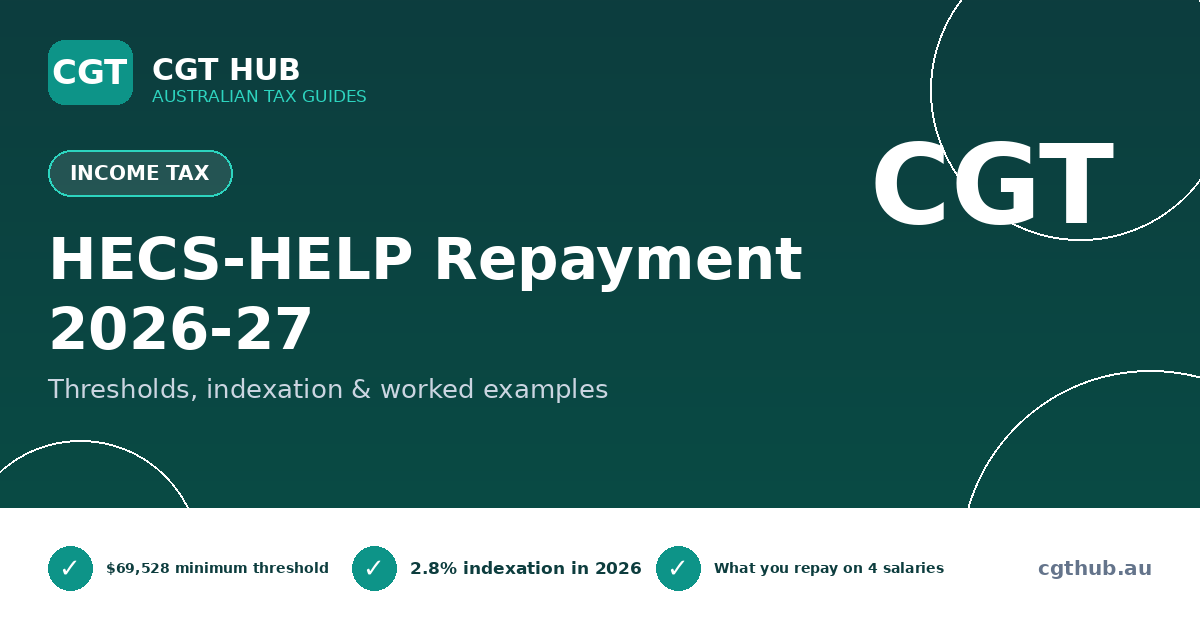
If you have a HECS-HELP debt, 2026-27 is the second year of the most borrower-friendly version of the system Australia has ever run. The minimum repayment threshold is $69,528, repayments are calculated only on income above each band (no more cliff), and indexation was just 2.8% — the lowest since 2021. This guide lays out the exact 2026-27 repayment table, four worked examples with real fortnightly figures, and the traps that still catch people out.
The short answer
In 2026-27, you make no compulsory HECS-HELP repayment if your repayment income is $69,528 or less. Above that, you repay 15 cents per dollar on income from $69,529 to $129,717, then $9,028 plus 17 cents per dollar on income from $129,718 to $186,050, and 10% of your total income once you earn more than $186,051. Your debt is indexed each 1 June — 2.8% in 2026 — and your employer should already be withholding for it if you ticked the HELP box on your TFN declaration.
One timing note that confuses people every October: the tax return you’re lodging now (2025-26) uses last year’s table ($67,000 threshold), while your pay packets this financial year are being withheld under the 2026-27 table. Both tables are below.
How compulsory repayments actually work
HECS-HELP isn’t repaid like a normal loan. There is no direct debit, no statement due date, and no penalty rate. Instead, once your repayment income crosses the minimum threshold, the ATO raises a compulsory repayment on your tax assessment, and your employer withholds extra from each pay to cover it.
The crucial phrase is repayment income, because it is not the same as your taxable income. The ATO builds it from five components:
- Your taxable income
- Total net investment loss (yes — negative gearing gets added back)
- Reportable fringe benefits
- Reportable super contributions (salary sacrifice included)
- Exempt foreign employment income
This is the detail that derails the cleverest planning. Salary-sacrifice an extra $10,000 into super and your taxable income drops — but your HELP repayment doesn’t move a cent, because the sacrificed amount is added straight back in. A negatively geared property doesn’t shield you either; the rental loss is added back too. If an arrangement was sold to you partly as a way to “reduce your HECS”, that part of the pitch was fiction.
The 2026-27 repayment thresholds and rates
These are the official ATO figures for the 2026-27 income year. From the 2025-26 year on, the old 19-tier system — where crossing a threshold by one dollar triggered a repayment on your entire income — is gone. The marginal system only taxes income above each band, exactly like income tax brackets.
| Repayment income | Compulsory repayment |
|---|---|
| $0 – $69,528 | Nil |
| $69,529 – $129,717 | 15c for each $1 over $69,528 |
| $129,718 – $186,050 | $9,028 plus 17c for each $1 over $129,717 |
| $186,051 and over | 10% of your total repayment income |
For reference, the 2025-26 figures (the ones on the return you’re lodging now): $0–$67,000 nil; $67,001–$125,000 = 15c per $1 over $67,000; $125,001–$179,285 = $8,700 plus 17c per $1 over $125,000; $179,286 and over = 10% of total repayment income.
Worked examples: what you actually repay
Here is what the marginal system means in dollars for four common incomes in 2026-27:
- $72,000 income: ($72,000 − $69,528) × 15% = $370.80 per year — about $14.26 a fortnight. Under the old flat-rate design, this same income would have attracted roughly $1,800.
- $95,000 income: ($95,000 − $69,528) × 15% = $3,820.80 per year — about $146.95 a fortnight.
- $150,000 income: $9,028 + ($150,000 − $129,717) × 17% = $12,476.11 per year — about $479.85 a fortnight.
- $200,000 income: 10% × $200,000 = $20,000 per year — about $769.23 a fortnight.
Notice how smoothly the top tier hands over. At exactly $186,050 the marginal bands produce $18,604.61; at $186,051 the flat 10% produces $18,605.10. That 49-cent join is deliberate design — the brutal threshold cliffs of the old system are genuinely gone. The flip side: the 10% top rate applies to your total income, not just the amount over $186,051, so it’s worth knowing exactly where you sit at year-end.
Indexation: the “not interest” that still grows your debt
HECS-HELP charges no interest in the conventional sense. Instead, your balance is indexed every 1 June to keep its real value — and indexation applies whether or not you’re earning above the repayment threshold. A below-threshold earner’s balance still grows.
Two rules govern how much:
- Only debt that has existed for at least 11 months is indexed. Debt from second-semester courses (usually determined in June) skips that year’s indexation.
- Since 1 June 2023, indexation is capped at the lower of CPI or the Wage Price Index. Before this reform, the June 2023 indexation hit 7.1% — the scandal that forced the change. Your debt can now never grow faster than average wages.
| Year applied | Indexation rate |
|---|---|
| 2021 | 0.6% |
| 2022 | 3.9% |
| 2023 | 3.2% (was 7.1%, backdated) |
| 2024 | 4.0% (was 4.7%, backdated) |
| 2025 | 3.2% |
| 2026 | 2.8% — lowest since 2021 |
On the average balance of roughly $27,000, the 2026 indexation added about $756. The 1 June timing creates a genuine planning lever: a voluntary repayment that is cleared by the ATO before 1 June reduces the balance indexation is calculated on. A $5,000 payment landing before 1 June 2027 will save you whatever the 2027 rate is on that $5,000 — at 2.8% that’s $140, simply for paying a few weeks early. Allow up to four business days for electronic or Australia Post payments to clear.
Did you get the 20% cut? Check
In 2025 the government applied a one-off 20% reduction to every study and training loan balance that existed on 1 June 2025 — calculated before that year’s indexation was applied. A $30,000 debt became $24,000 overnight, automatically, with no application needed. The ATO has finished processing the reductions.
If you haven’t checked your myGov/ATO loan account since, check now. Some borrowers found the reduction landed on an account they hadn’t looked at in years — and if your account went into credit after the cut, the ATO refunds the credit provided you have no other tax or Commonwealth debts.
Voluntary repayments: the rules and the timing play
You can make voluntary repayments to the ATO at any time via BPAY, debit or credit card. The rules that matter:
- No discount. The 5% voluntary repayment bonus was removed on 1 January 2017. A voluntary $1,000 reduces your debt by exactly $1,000.
- Not tax-deductible. Unlike some investment debt, voluntary HELP repayments buy you no deduction.
- Not refundable. Once paid, the money is gone — you can’t redraw it. Don’t clear your whole balance in May and then discover your compulsory repayment was going to wipe most of it anyway.
- They don’t replace your compulsory repayment. A voluntary payment in March doesn’t reduce the compulsory amount raised on your assessment.
The one genuinely smart move: if you’re going to make a voluntary payment anyway, make it before 1 June so it also dodges that year’s indexation. And if you’re planning to clear the balance entirely, do it before you lodge your tax return — otherwise a compulsory repayment may still be raised on your assessment, leaving your account in credit and you waiting on a refund.
Employer withholding: the July bill trap
Most compulsory repayments are collected through employer withholding. When you start a job, the TFN declaration form asks whether you have a study and training support loan. Tick yes, and your employer withholds extra each pay using the ATO’s withholding tables.
The trap is in the gaps: start a second job mid-year and forget to tick the box on the new form, and that income is under-withheld all year — the shortfall lands on your tax assessment in July. Run the numbers before 30 June: estimate your repayment income, multiply out your band, and compare it against what was actually withheld. A five-minute check beats a surprise four-figure bill. If you’re self-employed or your income is lumpy, the same arithmetic tells you what to set aside each quarter. Our income tax calculator can help you model the year’s total liability.
Moving overseas doesn’t move the debt
Since 2017, Australians living abroad must lodge a worldwide income declaration with the ATO each year. The same thresholds and marginal rates apply to your worldwide income — at 2026-27’s $69,528 minimum — and failing to lodge can attract penalties. Expats who left years ago and never looked back are the classic casualties: the debt kept indexing every 1 June, the unpaid compulsory amounts kept accruing, and the homecoming balance is routinely $10,000-plus larger than remembered. Out of sight is not out of mind.
Should you pay it off early?
The honest framework is a comparison of rates. Your HELP debt grows at the indexation rate — 2.8% in 2026, and structurally capped at wage growth. Compare that against where else the money could go:
- Versus a mortgage (~6%+): paying the mortgage wins on pure arithmetic.
- Versus a high-interest savings account (4–5%): the savings account wins — you’re earning more than the debt costs you.
- Versus super: salary-sacrificed super still doesn’t reduce your HELP repayment (it’s added back), but the compounding inside super at your age usually beats 2.8% indexation. See our super calculator and the salary sacrifice guide.
Two situations where paying HELP early is genuinely rational: when the compulsory repayment is materially reducing your home loan borrowing capacity (lenders factor the repayment into serviceability, even though the debt itself doesn’t appear on your credit report), and when the psychological weight of the debt is costing you more than the arithmetic. Just never pay it with money you might need back — voluntary payments can’t be redrawn.
Three rules almost nobody knows
- Death cancels the debt. If a borrower dies, the remaining HELP balance is remitted. Any compulsory repayment already assessed for the period before death is still payable from the estate — but the debt itself dies with you. It cannot be inherited.
- FEE-HELP can carry a 25% loan fee. For some undergraduate full-fee units, every $1,000 of tuition becomes $1,250 of debt. The fee doesn’t apply to postgraduate study, enabling courses, or Open Universities units — and it doesn’t count toward your HELP loan limit. Check your provider’s fee schedule before census date, not after.
- Special circumstances can wipe a semester. If illness or events beyond your control forced you to withdraw after census date, you can apply to your provider within 12 months for a recredit — the debt and any loan fee for those units are removed.
Common mistakes
- Assuming salary sacrifice lowers the HELP bill. Reportable super contributions are added back to repayment income. It doesn’t.
- Forgetting the second job. Each employer withholds independently; tick the HELP box everywhere or reconcile at year-end.
- Confusing the tables. The return you lodge in October 2026 uses 2025-26 thresholds ($67,000); this year’s payslips use 2026-27 ($69,528).
- Ignoring indexation below the threshold. No compulsory repayment doesn’t mean no growth — 1 June still arrives.
- Overpaying voluntarily, then lodging. Clear the balance before you lodge, or a compulsory repayment may still be raised.
- Treating HELP as “not real debt” for a mortgage. Lenders absolutely count the repayment against your borrowing power.
FAQ
Is HECS-HELP debt really interest-free?
Technically yes, practically not quite. There is no interest rate and no compounding in the banking sense — but indexation increases your balance each 1 June by the lower of CPI or wage growth (2.8% in 2026). Over a decade, that growth is real money. “Cheapest debt you’ll ever have” is fairer than “free”.
Does HECS-HELP debt affect my credit score?
No. HELP debt doesn’t appear on your credit report and doesn’t directly change your score. But lenders subtract your compulsory repayment from the income they assess when deciding how much to lend you — which is why clearing a small HELP balance can sometimes unlock a noticeably larger mortgage.
What if my income is below the threshold this year?
You make no compulsory repayment, and any withholding your employer took for HELP comes back to you as part of your tax refund. Your balance still gets indexed on 1 June. Repayments resume automatically when your income rises above the threshold again.
I’m moving overseas — do I still have to repay?
Yes. Lodge the ATO’s worldwide income declaration each year; if your worldwide income exceeds the threshold ($69,528 in 2026-27), a compulsory repayment is raised. The marginal rates apply identically. Penalties apply for not lodging.
Can I get a voluntary repayment refunded if I change my mind?
No. Voluntary repayments are not refundable and can’t be redrawn. Only overpay when you’re certain — and if your aim is to clear the debt completely, pay before you lodge your return.
How does HELP interact with the Medicare levy?
They’re calculated independently on your tax assessment, but both use income measures broader than plain taxable income. If you’re modelling your total year-end position, read our Medicare levy guide alongside the 2026-27 income tax brackets — HELP sits on top of both.
Conclusion
The 2026-27 HECS-HELP system is the fairest version Australia has run: a $69,528 threshold, marginal rates with no cliffs, indexation capped at wage growth and running at just 2.8%, and a 20% cut already banked for existing borrowers. The system asks only that you understand two numbers — your repayment income, not your taxable income, and the 1 June indexation date. Get the employer withholding right, use the pre-June timing lever if you’re paying voluntarily, and don’t let an overseas move or a second job turn a gentle system into a surprise bill.
Figures verified against the ATO’s published study and training loan repayment thresholds and Study Assist guidance, October 2026. Thresholds and indexation rates change yearly — always confirm the current year’s figures before making decisions.