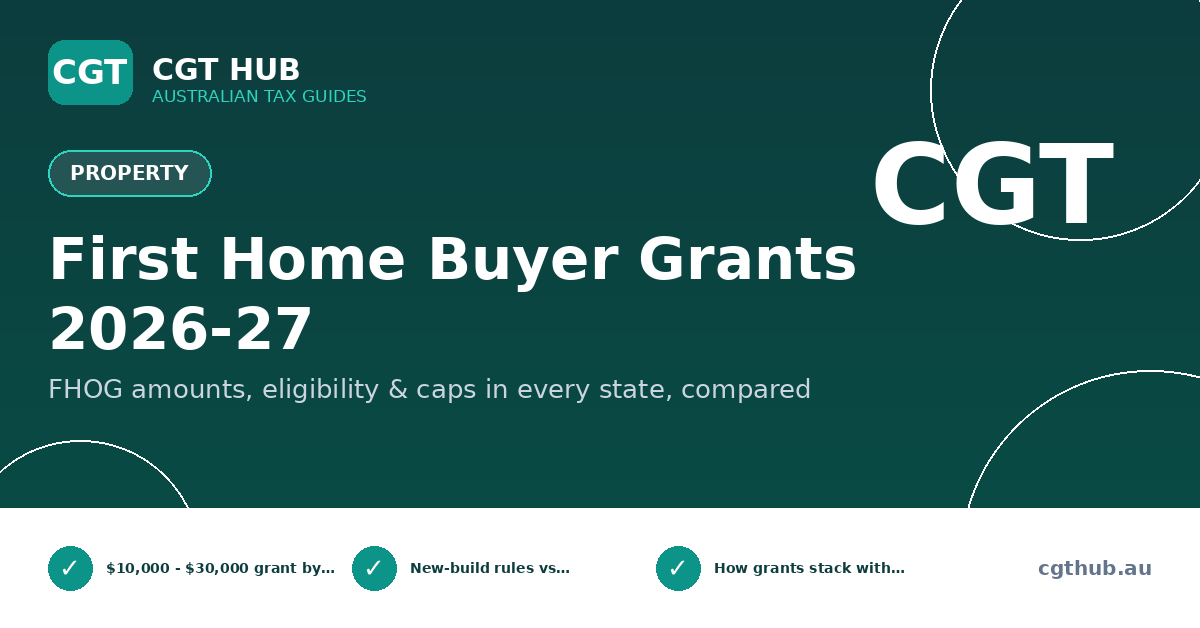
If you are buying your first home in Australia in 2026-27, there is free money on the table — anywhere from $10,000 to $50,000 depending on your state. But the First Home Owner Grant (FHOG) is one of the most misunderstood handouts in Australian housing policy. Most buyers get at least one big fact wrong: that it applies to any first home (it doesn’t — new builds only), that it stacks automatically with stamp duty relief (it does, but the rules are separate), or that your income matters (it doesn’t).
This guide compares the first home buyer grant in every state and territory for 2026-27 with verified figures, maps the contract-date traps that decide your amount, and works out the combined dollar value of grants plus duty concessions plus the federal schemes. All figures were checked against the state revenue offices in October 2026.
The one rule that kills most hopes: it is new builds only
The FHOG is paid on new homes only: a home that has not previously been occupied or sold as a place of residence, an off-the-plan purchase, a house-and-land package, or a substantially renovated home. Vacant land with a build contract can qualify; established homes never do.
This is where most buyers trip up. A $750,000 established home in Brisbane gets $0 grant. The same $750,000 spent on a new build under the cap gets $30,000. Revenue offices are strict about this — “substantially renovated” means most of the building was removed or replaced, not a fresh coat of paint and new benchtops.
Separately, most states offer stamp duty concessions for first home buyers, and these usually do cover established homes. The two are often confused, so this guide covers both.
First home buyer grants by state, 2026-27
| State / Territory | Grant | Price cap | Residence rule |
|---|---|---|---|
| NSW | $10,000 | ≤ $600k new home; ≤ $750k land + build combined | 12 months continuous (contracts from 1 Jul 2023) |
| VIC | $10,000 | ≤ $750k total (land + build) | 12 months continuous |
| QLD | $30,000 | Under $750k (land + build + variations) | 6 months within 12 months of settlement |
| WA | $10,000 | $800k south of the 26th parallel; $1M north (from 7 May 2026) | 6 months within 12 months |
| SA | Up to $15,000 | No cap (contracts on/after 6 Jun 2024) | 6 months within 12 months |
| TAS | $20,000 | No cap (transactions 1 Jul 2026 – 30 Jun 2027) | 6 months within 12 months |
| NT | $50,000 HomeGrown Territory Grant | No cap (contracts to 30 Sep 2027) | 12 months continuous |
| ACT | None (scrapped 2019) | n/a | n/a — see duty abolition below |
Sources: Revenue NSW, SRO Victoria, Queensland Revenue Office, WA Government FHOG fact sheet, RevenueSA, SRO Tasmania, nt.gov.au, act.gov.au — all checked October 2026.
The 1 July 2026 change wave: several states just moved the goalposts
If your information comes from an article written before mid-2026, it may be wrong. The biggest changes:
- Tasmania cut its grant from $30,000 to $20,000 for transactions commencing 1 July 2026 – 30 June 2027. Its 100% stamp duty exemption for established homes under $750,000 also ended on 30 June 2026 and was not replaced — Tasmanian first home buyers purchasing established homes now pay full duty.
- The ACT abolished stamp duty for all first home buyers from 1 July 2026 — no income test, no property value cap. The catch: no buyer or partner may have owned property anywhere in the last five years, and you must occupy the home continuously for 12 months from settlement. The ACT pays no FHOG, so this duty abolition is the assistance.
- Western Australia raised its FHOG cap from $750,000 to $800,000 south of the 26th parallel (from 7 May 2026). The $1 million northern cap is unchanged — WA remains the only state with a regional bonus baked into the grant.
- Queensland’s $30,000 grant continues. Some broker articles claimed it would revert to $15,000 from 1 July 2026; the live Queensland Revenue Office page confirms $30,000 for contracts signed on or after 20 November 2023, with no end date. Do not trust pre-July articles on this.
- The NT’s $50,000 HomeGrown Territory Grant was extended — contracts can now be signed up to 30 September 2027. Note its 12-month residence requirement is double most states’. The NT’s old $10,000 established-home window (contracts 1 Oct 2024 – 30 Sep 2025) has closed.
Are you eligible? The five tests
1. Citizenship and age
At least one applicant must be an Australian citizen or permanent resident, and every applicant must be a natural person (not a company or trust) aged 18 or older. New Zealand special-category visa holders count as permanent residents in Queensland, South Australia and Victoria.
2. Never owned (with the partner trap)
Neither you nor your spouse or de facto partner may have owned residential property in Australia before 1 July 2000, or owned-and-lived-in one since — and nobody may have received a FHOG in any state before. The revenue offices assess the couple, not the individual. A popular forum thread on this exact scenario warns “it’s a trap”: if your partner bought a unit eight years ago and lived in it, both of you are disqualified, even if the title is in your name only. Leaving an ineligible name off the title to claim the grant is fraud.
There is a nuance worth knowing: investment-only ownership can still qualify. If you (or your partner) owned a property you never lived in — a pure investment — several revenue offices, including Queensland’s and WA’s, say this does not always disqualify you. Check your state’s fact sheet before assuming you are out.
3. Move in and stay
You must occupy the home as your principal place of residence: six continuous months within the first year in Queensland, South Australia, Western Australia and Victoria; twelve continuous months in New South Wales (for contracts from 1 July 2023), the Northern Territory and the ACT.
4. Overseas property and inheritances
Only Australian property counts. Owning a flat in London or Lahore does not disqualify you — a common worry among migrant buyers. Inheritances are trickier: it depends on the state and whether you lived in the inherited property, so check the rules before applying.
5. No income test — on the grant itself
There is no income or means test on the FHOG. Many buyers confuse it with the federal schemes: the old Home Guarantee income caps are gone, but Help to Buy shared equity is still income-tested. Different programs, different rules.
Worked examples: what “total help” looks like in dollars
Competitor articles stop at the grant table. But buyers care about the combined figure: grant + stamp duty saving + lenders mortgage insurance (LMI) saving via the federal schemes. Here is what that looks like for three realistic 2026-27 purchases.
Queensland: $745,000 new build
- FHOG: $30,000 (under the $750,000 cap — but only just; see the buffer warning below)
- Transfer duty: $0 under the First Home (New Home) Concession for contracts from 1 May 2025 — a saving of about $26,550 at standard rates
- LMI: $0 via the First Home Guarantee with a 5% deposit
Combined assistance: roughly $56,550, plus the LMI saving on a 95% loan.
Western Australia: $600,000 new build south of the 26th parallel
- FHOG: $10,000
- Stamp duty: $0 — WA charges no duty up to $600,000 for first home buyers
Combined assistance: roughly $30,000. For first home buyers in Perth, WA’s duty concession does as much heavy lifting as the grant.
ACT: $850,000 established home
- FHOG: $0 — no grant exists
- Stamp duty: $0 from 1 July 2026, uncapped — a saving of around $29,000 at standard rates
This is the best “no grant” deal in the country: an established-home buyer in Canberra gets a five-figure saving that simply does not exist for the equivalent buyer in Sydney or Melbourne.
Run your own numbers with our stamp duty calculator and mortgage calculator to see how the concessions change your deposit target.
New vs established: the decision math
In NSW and Victoria this choice has real money on both sides. Take a $780,000 purchase in NSW:
- Established home: $0 grant, but a stamp duty concession applies to the duty bill — worth checking in our NSW & VIC stamp duty guide.
- New build at the same price: $10,000 grant plus the duty concession — but the land-plus-build total must stay under $750,000 to keep the grant, so a $780,000 contract loses it entirely.
This is the break-even calculation most buyers never do: at $740,000, the new build wins clearly ($10,000 grant + duty concession). At $780,000, the grant vanishes and the new-build premium may no longer be worth it. The exact crossover depends on the state’s duty thresholds — model both sides before you commit.
Timing traps: your contract date decides your grant
- Tasmania: a contract signed on 29 June 2026 vs 2 July 2026 is a $10,000 difference — the $30,000→$20,000 cutover is a hard date.
- Western Australia: the $750,000→$800,000 cap change took effect on 7 May 2026 — buyers who signed in April at $780,000 missed the grant entirely.
- Northern Territory: the $50,000 HomeGrown grant requires a contract by 30 September 2027; the established-home $10,000 window is already closed.
- South Australia: the no-cap, up-to-$15,000 regime only applies to contracts on or after 6 June 2024 — earlier contracts ran under the old rules.
- Queensland: the $30,000 rate requires a contract on or after 20 November 2023 (or foundations laid from that date for owner-builders); earlier contracts get $15,000.
What stacks with what
Stated plainly, because competitors gesture at this without numbers:
- FHOG + stamp duty concession + Home Guarantee = yes. The most powerful combination — Queensland’s revenue office says so explicitly.
- Grants + Help to Buy shared equity = yes. State concessions can sit alongside the federal equity stake.
- Help to Buy + Home Guarantee = no. They are alternatives, not add-ons. Pick one.
- HomeGrown + FreshStart (NT) = no. The $50,000 grant and the $30,000 non-first-buyer grant cannot be claimed together.
- FHOG + FHSS withdrawal = yes. You can use the First Home Super Saver Scheme to build the deposit and still claim the state grant.
Common mistakes that cost first home buyers
- Budgeting the grant into an established-home purchase. The #1 forum confusion. The grant never applies to established homes — budget duty relief there instead.
- Blowing the cap with build variations. In Queensland, Victoria and NSW the grant looks at land + build including variations. A $20,000 variation that pushes a $740,000 package to $760,000 loses the entire grant. Keep a buffer of at least $30,000 under the cap.
- Counting the grant as deposit cash. The grant is paid at settlement for purchases or at the first loan drawdown for builds, so it is not cash in hand when you sign. Queensland’s revenue office explicitly warns against relying on it as deposit money. Some lenders will count it, others won’t.
- Signing before getting the FHSS determination. If you are also using the First Home Super Saver Scheme, the ATO determination must come before you sign the contract — signing first disqualifies the withdrawal.
- Forgetting the residence clock. Renting the place out in year one can trigger a grant repayment — with penalties.
- Assuming the partner rules don’t apply to you. De facto relationships of two-plus years count in WA; revenue offices look at the couple.
Tips: squeeze the most from the system
- Apply through your lender. Most banks are approved FHOG agents and can lodge the application with your loan — faster than going direct to the revenue office.
- Target 5–10% under the cap. Caps are cliffs, not sliding scales: $1 over loses the whole grant.
- Get pre-approval that accounts for the grant. Ask the lender explicitly whether they will count the grant toward your deposit — policies differ.
- Time your contract around cutovers. If you are close to a date change (Tasmania, NT), a week’s delay can be worth five figures.
- Check the federal schemes first. The Queensland Revenue Office confirms the FHOG does not affect Home Guarantee eligibility — since 1 October 2025, places are unlimited and income caps are gone.
Frequently asked questions
Can I use the first home buyer grant as my deposit?
Not reliably. The grant is paid at settlement for purchases or at the first loan drawdown for builds, so it is not cash in hand when you sign. Some lenders will count it toward your deposit, others won’t — confirm with your lender before relying on it.
My partner owned a home before we met. Do we both lose the grant?
Almost always, yes. Revenue offices assess the couple: if your spouse or de facto partner has owned residential property (and lived in it) or has received a FHOG before, neither of you qualifies. The one exception is investment-only ownership you never lived in, which several states still allow.
I inherited a property. Am I still a first home buyer?
It depends on the state and whether you lived in it. Inheriting a property you never occupied is treated more leniently in some jurisdictions — but check your state’s fact sheet rather than assuming, because WA’s inheritance rules in particular catch people out.
Does owning property overseas disqualify me?
No. Only Australian residential property counts toward the “never owned” test. This comes up constantly among migrant buyers, and the answer is reassuring.
Does my income affect the grant?
No — there is no income or means test on the FHOG itself. The confusion comes from the federal schemes: Help to Buy shared equity is income-tested (2026-27 limits: $103,000 single / $165,000 joint), and the old Home Guarantee income caps were removed in October 2025.
What if my build goes over the price cap after I sign?
You lose the whole grant. Queensland, Victoria and NSW all include contract variations in the cap calculation, and caps are cliffs — there is no partial grant. Keep a healthy buffer under the cap and get variations priced in writing before approving them.
The bottom line
Australia’s first home buyer assistance in 2026-27 is genuinely generous — up to $50,000 in the NT, $30,000 in Queensland, and duty abolished outright in the ACT — but it is a maze of new-build-only rules, contract-date cutovers and state quirks. The buyers who win are the ones who check three things before signing: which side of the cap their total package sits on, which side of any date cutover their contract falls on, and whether their partner’s history disqualifies them both. Get those three right and the assistance is worth tens of thousands; get one wrong and it can be worth nothing.