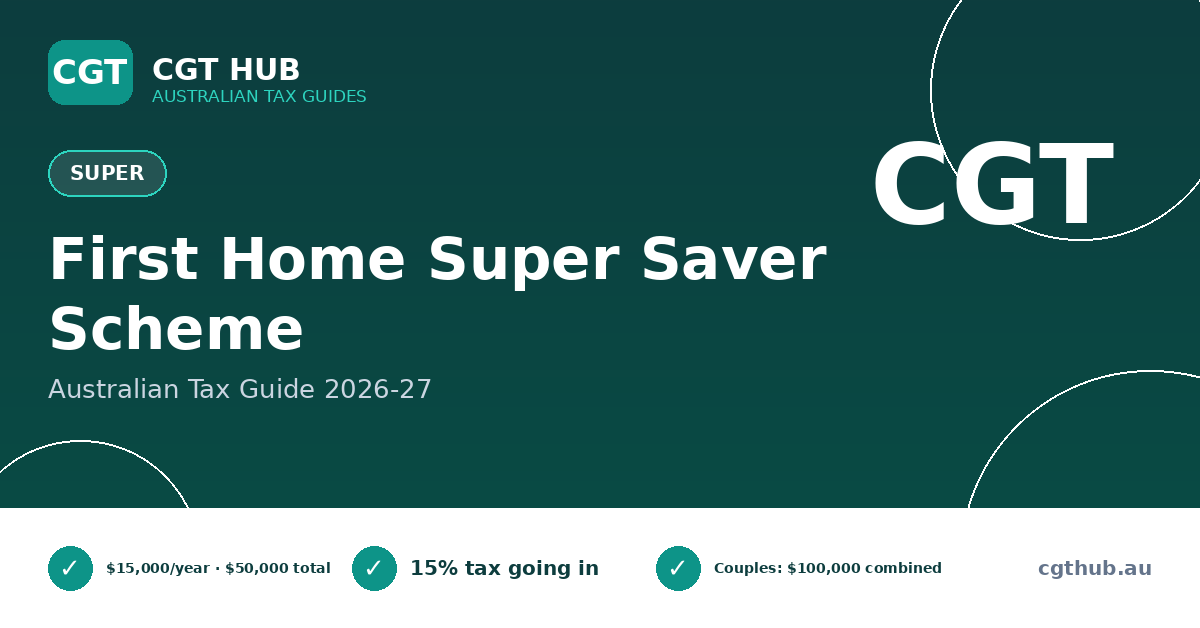
Quick answer: The First Home Super Saver Scheme (FHSSS) lets you save a first-home deposit inside your super fund — up to $15,000 of voluntary contributions per financial year and $50,000 in total — then withdraw them (plus earnings) when you buy. Because concessional contributions are taxed at just 15% on the way in and the released amount gets a 30% tax offset on the way out, most savers end up roughly $8,000–$10,000 better off than stashing the same money in a savings account. But the scheme has strict timing rules, a lifetime one-release limit, and several traps the glossy guides skip.
This guide covers how the scheme actually works in 2026-27, a full worked example on a $90,000 salary, the 85% rule that shrinks your release amount, the September 2024 timing changes almost nobody has updated their advice for, and the seven things competitors don’t tell you — alongside our salary sacrifice guide and the super calculator.
How the FHSSS works in five steps
- Make voluntary contributions. Salary-sacrifice through your employer, or make personal contributions to your super fund. Only voluntary contributions count — compulsory Super Guarantee payments, spouse contributions and government co-contributions are all excluded. Contributions count in the financial year your fund receives them, not when they leave your pay.
- Request an FHSS determination from the ATO. When you’re ready to buy, log into myGov → ATO online services → Super → First Home Saver. The determination tells you exactly how much you’re eligible to release. You can request as many determinations as you like.
- Request a release. This is the irreversible step. The ATO instructs your fund to release the eligible amount; the money comes to the ATO first, tax is withheld, then the balance lands in your bank account. Allow 15–25 business days.
- Buy within 12 months. Sign a contract to purchase or construct a qualifying home within 12 months of your release request (a 12-month extension is available from the ATO). Notify the ATO within 28 days of signing the contract.
- Move in. You must genuinely intend to live in the home, and occupy it for at least 6 months within the first 12 months it’s practicable to occupy.
(Source: ATO — First home super saver scheme.)
The numbers that matter in 2026-27
| Rule | Amount |
|---|---|
| Voluntary contributions counted per financial year | $15,000 |
| Total across all years | $50,000 |
| Concessional contributions counted in release amount | 85% (the other 15% was already taxed in your fund) |
| Non-concessional contributions counted in release amount | 100% |
| Associated earnings | Deemed at the ATO’s shortfall interest charge rate (not your fund’s actual returns) |
| Tax on release of concessional portion | Your marginal rate incl. Medicare levy, minus a 30% tax offset |
| Concessional contributions cap (2026-27) | $32,500 (includes SG — check the ATO, caps are indexed) |
| If you don’t buy | Recontribute to super, or pay a flat 20% FHSS tax on the assessable released amount |
Worked example: Sarah earns $90,000
Sarah’s marginal rate is 30% plus the 2% Medicare levy — 32% total. She salary-sacrifices $15,000 a year for three years ($45,000 in total) into the FHSSS.
The way in:
- The $15,000 salary sacrifice is taxed at 15% inside her super fund: $2,250 a year.
- Had she taken it as salary, she’d have paid 32%: $4,800 a year.
- Tax saved on the way in: $2,550 a year, or $7,650 over three years.
- Her SG contributions (12% of $90,000 = $10,800) plus the $15,000 sacrifice total $25,800 — comfortably under the $32,500 concessional cap, so no excess-contributions issues.
The way out:
- Her release amount is 85% of her $45,000 concessional contributions = $38,250, plus deemed associated earnings (say roughly $3,000 at the ATO’s deeming rate) = about $41,250 of assessable released amount.
- Tax withheld on release: her 32% marginal rate minus the 30% FHSS offset = an effective 2%, so about $825.
- She receives roughly $40,425 toward her deposit.
The comparison: to pull $40,425 from after-tax savings on a 32% marginal rate, Sarah would have needed about $59,450 of pre-tax salary. She sacrificed $45,000, which cost her only $30,600 of take-home pay. Net result: the scheme has put her roughly $9,800 ahead of saving from salary — and she earned a deemed return inside super along the way. Run your own numbers in our super calculator and income tax calculator.
Concessional or non-concessional: which contributions to use?
The 85% rule makes the choice matter. If you salary-sacrifice $15,000 in a year, your release amount includes $12,750 of it. If you contribute $15,000 after tax, your release amount includes the full $15,000.
But don’t stop there — the tax story flips it back. The concessional $15,000 cost you only $12,750 in contributions tax terms (15% paid in the fund), while the non-concessional $15,000 already had your full marginal rate taken out of it at salary time. For most people on 32% or above, concessional contributions win comfortably, which is why salary sacrifice is the engine of this scheme.
The notice-of-intent trap: if you make personal contributions and want them treated as concessional (claimed as a tax deduction), you must lodge a “notice of intent to claim a tax deduction” with your fund and have it acknowledged — before you lodge your tax return for that year. Miss that notice and the contribution counts as non-concessional by default. The ATO is strict on this; it’s one of the most common ways people accidentally halve their tax benefit. See our super contribution caps guide for the full mechanics.
The timing traps (read this before you sign anything)
More FHSSS plans die on timing than on anything else:
- The 30 June boundary. Contributions count in the year your fund receives them. A salary-sacrifice contribution from your June payroll that lands in July counts for the next year — which can blow both your $15,000 FHSSS year-limit and your concessional cap. Arrange late-June sacrifices well before the deadline.
- Determination timing changed in September 2024. Older guides (and some accountants) still say you must get your determination before signing any contract. Since 15 September 2024, you only need the determination by settlement — you can request one after exchanging contracts as long as you don’t yet legally own the property. The window to request a release after signing also expanded from 14 days to 90 days. (Source: Spry Roughley — FHSS changes from September 2024.) If an adviser quotes you the old rule, they’re out of date.
- The 15–25 business day wait. The ATO recommends allowing 15–25 business days from release request to money in your account. Don’t schedule your release for the week before settlement.
- The 28-day notification. After signing a contract, you have 28 days to notify the ATO via myGov. Miss it and FHSS tax can apply.
- The 12-month clock. Sign a purchase or construction contract within 12 months of your release request (extensions to 24 months are available). After that, it’s recontribute or pay the 20% tax.
Seven things the glossy guides don’t tell you
1. The release can push you into a higher tax bracket
The assessable released amount is added to your taxable income in the year of release. A $41,000 release on top of a $90,000 salary puts you at $131,000 — still under the 37% bracket threshold ($135,000), but if you’re near a bracket edge, part of your release gets taxed at the higher rate before the 30% offset applies. The ATO withholds an estimate at release time; your tax return reconciles the rest. Time your release for a lower-income year if you can.
2. “Associated earnings” aren’t your actual earnings
The ATO doesn’t use your fund’s real investment returns. It deems earnings at the shortfall interest charge rate (roughly 4–5% a year). In a good year your super earned more and you effectively under-claim; in a bad year your contributions “earned” money your fund never made — and the shortfall comes out of the rest of your super balance. Either way, the release amount is never less than what the formula gives you.
3. One release per lifetime — so don’t fire early
You can get as many determinations as you like, but you can only ever make one release request. Release $20,000 for a purchase that falls through and you can’t “top up” with another release later (you’d recontribute the $20,000 or pay the 20% tax). Only request the release when you’re genuinely about to buy.
4. Your fund might say no
Not every super fund participates. Check before you contribute that your nominated fund will release FHSS amounts — defined benefit funds and constitutionally protected funds are excluded entirely. Discovering your fund won’t release, after years of contributing, is a nightmare scenario that’s easy to avoid with one phone call.
5. The 20% fallback tax isn’t as scary as it sounds — but it wipes the benefit
If you release and never buy, you can keep the money and pay FHSS tax of 20% of the assessable released amount (not the total released). That roughly reverses the tax concessions you received. Recontributing the net amount back into super as a non-concessional contribution is usually the better option — it preserves your retirement balance and avoids the tax entirely.
6. Owning property overseas doesn’t disqualify you
The “never owned property” test only covers Australian real property interests — fee simple, company title, or a lease of Australian land. If you owned a home in another country, you’re still eligible (a limited financial-hardship exception also exists for those who lost Australian property). Almost no consumer guide mentions this.
7. It stacks with other first-home help
Your FHSS release is just deposit money — it combines freely with stamp duty concessions (see our NSW & VIC first home buyer guide) and the Australian Government’s 5% Deposit Scheme, which removed its place limits from 1 October 2025. Stacking a $40,000 FHSS release with a 5% deposit scheme and a stamp duty exemption is how many buyers get over the line. Estimate your repayments with our mortgage calculator.
Common mistakes
- Contributing more than $15,000 in one year expecting it all to count — only $15,000 of that year’s contributions is eligible for release.
- Counting SG contributions. Your employer’s compulsory super doesn’t count, no matter how much you wish it did.
- Forgetting the notice of intent for personal deductible contributions (see above).
- Salary-sacrificing in June without checking the money lands before 30 June.
- Blowing the concessional cap. SG + salary sacrifice over $32,500 in 2026-27 means excess contributions taxed at your marginal rate — which can erase the FHSSS benefit. See our caps guide.
- Requesting the release too early — remember, one release per lifetime and a 12-month clock starts ticking.
- Signing a contract and forgetting the 28-day ATO notification.
Tips to get the most from the scheme
- Start early, even with small amounts. The $50,000 total needs at least four financial years at the $15,000 yearly cap — plan backwards from when you want to buy.
- Couples, double it. Each eligible person gets their own $50,000 — that’s a $100,000 combined deposit pool. Siblings or friends buying together can each use it too.
- Prefer salary sacrifice over personal contributions if your employer supports it — no notice-of-intent paperwork, and the tax is handled at source.
- Keep a contribution spreadsheet. Track each voluntary contribution by financial year against the $15,000 limit. The ATO’s determination should match your records — if it doesn’t, query it before requesting release.
- Get a determination early as a sanity check. Determinations are free and unlimited — use one to confirm your eligible amount before you’re under contract pressure.
Frequently asked questions
Can I use the FHSSS for an investment property?
No. The property must be residential premises in Australia that you genuinely intend to occupy — at least 6 months within the first 12 months it’s practicable to live in. Houseboats, motor homes and vacant land (unless you’re building on it) are all excluded.
Can I withdraw contributions in the same financial year I made them?
Yes. Any voluntary contribution made from 1 July 2017 can be included in your determination, up to the date you request it. There’s no minimum holding period.
What happens to my super balance after the release?
Only the FHSS amounts leave. Everything else — your SG contributions, their earnings, and any voluntary contributions beyond the release — stays in super for retirement. If the deemed earnings exceed what your FHSS contributions actually earned, the difference comes from your remaining balance.
Does using the FHSSS affect my other super?
Released amounts don’t count against your contribution caps again — the caps were already applied when the contributions went in. But the released assessable amount does count as taxable income in the release year, which can affect HELP repayments, the Medicare levy surcharge and family payments.
I’ve already exchanged contracts — is it too late?
Not necessarily. Since 15 September 2024, you can still request a determination as long as you haven’t become the legal owner (settlement usually transfers ownership), and you then have 90 days from the contract date to make a valid release request. Get moving immediately — the old “must apply before signing” rule no longer applies, but the windows are still tight.
Is the FHSSS worth it compared to just saving in a bank account?
For anyone on a marginal rate above 15% — which is almost everyone working full-time — the maths favours the scheme, as the worked example shows. The main costs are complexity and the fact that your money is locked in super until you buy. If your purchase is more than a year or two away, it’s one of the most tax-effective savings vehicles available for a deposit.
The bottom line
The First Home Super Saver Scheme is genuinely one of the best deposit-building tools in the Australian tax system: $15,000 a year and $50,000 total of your own money, taxed at 15% going in and roughly your marginal rate minus 30% coming out. Our worked example put a $90,000 earner nearly $9,800 ahead over three years. The scheme punishes haste, though — respect the 30 June boundary, get the determination sorted before settlement, lodge your notices of intent, and only ever pull the release trigger when you’re truly ready to buy. For the contribution mechanics, pair this guide with our salary sacrifice deep-dive and check your numbers in the super calculator.