The Quick Answer
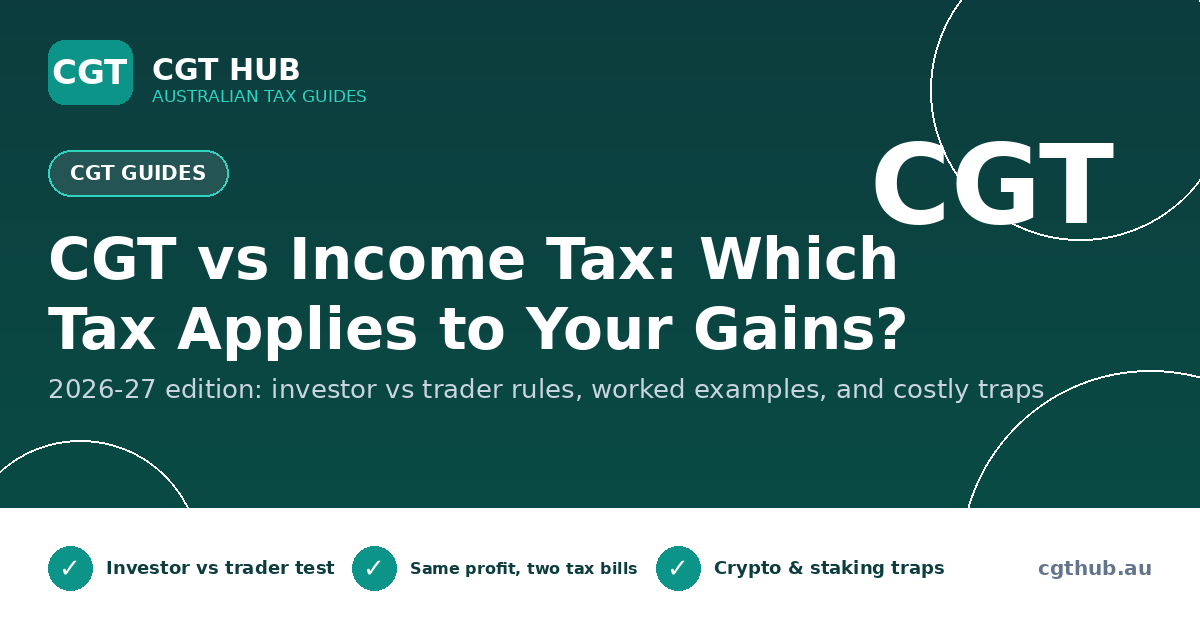
Here is the thing most Australians get wrong first: capital gains tax is not a separate tax. It is part of your income tax. When you sell an investment asset for a profit — shares, an investment property, crypto you bought to hold — the profit (the capital gain) is added to your taxable income and taxed at your marginal rate.
Ordinary income tax applies when your profit comes from carrying on a business or a profit-making undertaking. If you buy and sell shares so frequently and systematically that the ATO sees you as a share trader, your shares are treated as trading stock and your profits are ordinary business income — no CGT rules, and crucially no 50% CGT discount.
Same profit, two very different tax bills. Keep reading and you will know exactly which one applies to you — and how to prove it.
How Capital Gains Tax Actually Works
CGT applies when a “CGT event” happens — usually when you sell or dispose of an asset you acquired on or after 20 September 1985. The calculation is simple:
Capital gain = Capital proceeds (what you sold it for) − Cost base (what it cost you, including purchase price, stamp duty, brokerage, and improvements)
All your capital gains for the year are added up, capital losses are subtracted (losses can only offset gains, never your wages), and the net capital gain is added to your taxable income for that financial year. It is taxed at your 2026-27 marginal tax rate — there is no flat CGT rate, despite what half the internet claims.
The one genuine concession: if you held the asset for more than 12 months as an investor, the 50% CGT discount halves the gain before it hits your return. A $40,000 gain becomes $20,000 of taxable income.
You can run the numbers yourself on the CGT calculator and the income tax calculator.
How Ordinary Income Tax Applies to Asset Profits
If you are carrying on a business of buying and selling assets, the ATO does not call your profit a capital gain at all. Your purchases are “trading stock” — the same as fruit and veg to a grocer — and your profits are ordinary assessable income, taxed at your full marginal rate with no discount, no matter how long you held.
But there is a silver lining for traders: your costs are deductible in the year you incur them. You do not wait until you sell. And your losses are deductible against your other income — unlike capital losses, which can only offset capital gains. For someone trading at a loss, that difference is enormous.
Investor vs Trader: The Side-by-Side Comparison
The ATO’s own guidance (“Share investing versus share trading”) draws this line clearly:
| Investor | Trader | |
|---|---|---|
| Profit on sale | Capital gain — CGT rules apply | Ordinary income — business profits |
| 50% discount (12+ months) | Yes | No |
| Purchase price | Counts only when you sell (cost base) | Deductible in the year incurred |
| Losses | Offset capital gains only; carried forward | Deductible against all income |
| Dividends/rewards | Assessable income | Assessable income |
| When costs are claimed | At sale | In the year incurred |
Most Australians who buy and sell shares are investors in the ATO’s eyes. Being a trader takes more than enthusiasm — it takes a pattern.
The “Carrying On a Business” Test: What the ATO Actually Looks At
There is no magic number of trades that flips you from investor to trader. The ATO weighs several factors together:
- Intention: did you buy to profit from short-term price movements, or for long-term growth and dividends?
- Repetition and regularity: are you buying and selling frequently and systematically, or occasionally?
- Scale: is the capital involved substantial relative to your means?
- Organisation: do you operate in a business-like way — research, records, a plan, dedicated equipment?
- Holding periods: short turnarounds suggest trading; multi-year holds suggest investing.
One more sting in the tail: even a one-off profit-making transaction can be ordinary income rather than a capital gain if you entered into it with a profit-making purpose — the classic example is buying a property to renovate and flip. You do not need to be “in business” at all.
If you change from investor to trader (or back), the tax treatment of your profits changes with you — talk to an accountant before making the switch, because getting it wrong costs real money.
Worked Example: The Same $40,000 Profit, Two Tax Bills
Meet Priya. She earns a $95,000 salary and makes $40,000 profit on shares in 2026-27.
Scenario A — Priya the investor. She held the shares for 15 months. The 50% CGT discount cuts her gain to $20,000, added to her $95,000 salary = $115,000 taxable income. That extra $20,000 sits in the 30% bracket, so the extra tax is roughly $6,000.
Scenario B — Priya the trader. She flipped the shares in weeks as part of a regular trading routine. No discount: the full $40,000 is ordinary income, $135,000 total taxable income, extra tax roughly $12,000.
Identical profit, double the tax — that is why the investor/trader line matters. (Medicare levy not included; see the income tax calculator for your exact position.)
But flip the scenario: if Priya had lost $40,000, the investor can only carry that loss forward against future capital gains, while the trader deducts the full $40,000 against her salary this year — a $12,000 tax saving immediately. Being a trader is not all downside.
Crypto: The Investor/Trader Split Nobody Warns You About
Crypto follows the same rules, with extra traps. If you buy Bitcoin to hold, your profit on disposal is a capital gain — and the 50% discount applies after 12 months. But if you trade frequently with a business-like setup, the ATO can treat your crypto profits as ordinary income with no discount. Our crypto tax guide covers the CGT side in detail.
Either way, some crypto activity is always ordinary income, never CGT:
- Staking rewards and mining output — assessable as ordinary income at market value when received (your later sale of those coins is then a separate CGT event).
- Airdrops earned by doing something (a task, a referral) — income on receipt; free unsolicited airdrops generally get a nil cost base, so the whole sale price becomes gain later.
The “Neither” Category: Assets That Escape Both
Some disposals are neither CGT nor income tax:
- Your main residence — generally exempt from CGT (see our main residence exemption guide).
- Pre-20 September 1985 assets — acquired before CGT began; exempt.
- Personal-use assets costing $10,000 or less — a car, furniture, or crypto bought to spend. Gains are disregarded entirely.
- Collectables costing $500 or less — artwork, jewellery, antiques under the threshold.
Common Mistakes
- Claiming the 50% discount as a trader. If your profits are ordinary income, the discount does not exist. This is the ATO’s favourite audit trigger in this space.
- Using capital losses against wages. Capital losses only offset capital gains — you cannot subtract a share loss from your salary. (Traders can, because their losses are ordinary deductions.)
- Assuming “holding for a year” makes you an investor. Frequency, intention and organisation matter more than any single holding period.
- Thinking CGT is a flat rate. It is your marginal rate applied to the gain. A $200,000 gain on top of a big salary is mostly taxed at 45%.
- Sloppy cost-base records. Every brokerage fee, stamp duty charge and improvement adds to your cost base and shrinks the gain. No records, no claim.
Tips to Keep More of Your Gain
- Time your disposals. Selling in a low-income year (sabbatical, between jobs) can drop your gain into a lower bracket.
- Harvest losses. Before 30 June, consider realising losses to offset gains in the same year — you cannot carry a gain forward, but you can manage losses.
- Keep a trading diary. If you are an investor, document your long-term intention at purchase time. If the ATO ever asks, contemporaneous notes beat memory.
- Track the 12-month clock. Waiting a few extra weeks to cross the 12-month mark halves the taxable gain — check our 50% discount guide for the exact rules.
- Get advice at the boundary. If you are unsure whether you are a trader, the cost of an accountant’s opinion is trivial next to a wrong classification.
FAQ
Is capital gains tax separate from income tax?
No. In Australia, CGT is part of income tax. Your net capital gain is added to your taxable income and taxed at your marginal rate. There is no standalone CGT rate.
How many trades make me a share trader?
There is no fixed number. The ATO considers intention, frequency, scale, organisation and holding periods together. Occasional selling does not make you a trader; a systematic, business-like routine does.
Can I be an investor and a trader at the same time?
Yes — for different assets or activities. You might hold blue-chip shares as an investor while running a separate, systematic crypto trading operation taxed as ordinary income. Keep the records completely separate.
Does selling within 12 months make me a trader?
Not by itself — it just means no 50% discount on that gain. Short holding periods are one factor the ATO considers, but a single quick sale by an otherwise long-term investor is still a capital gain.
Are staking rewards CGT or income tax?
Ordinary income. Staking and mining rewards are assessable income at market value when received. When you later sell those coins, the sale is a separate CGT event with that value as your cost base.
What happens if I switch from investing to trading?
The tax treatment changes with you. Shares you held as an investor become trading stock, and future profits are ordinary income. Get professional advice before switching — the transition itself can have tax consequences.
The Bottom Line
Most of the time, selling an asset for a profit means capital gains tax — part of your income tax, taxed at your marginal rate, with the 50% discount available after 12 months. But if your activity looks like a business — frequent, systematic, profit-motivated — the ATO will tax your profits as ordinary income instead, with no discount but immediate deductions for your costs. Know which one you are, document it, and time your disposals around it. That is worth more than any tax “hack” you will find online.