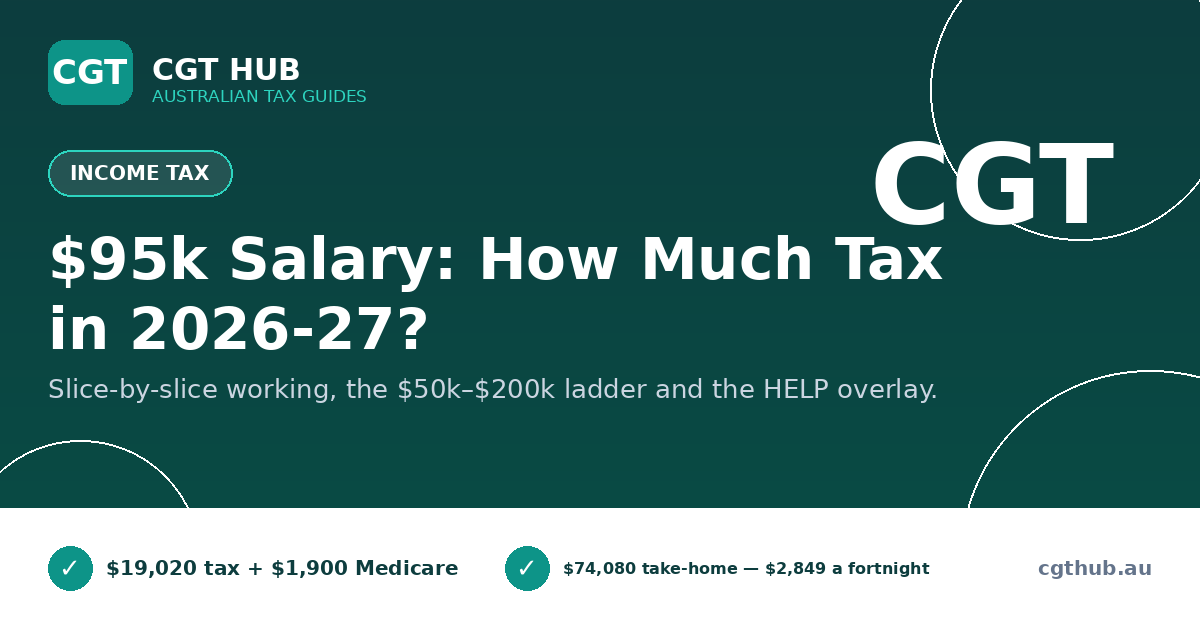
On a $95,000 salary in the 2026–27 financial year, an Australian resident pays $19,020 in income tax plus $1,900 in Medicare levy — $20,920 in total — leaving $74,080 take-home for the year. That works out to $6,173.33 a month, $2,849.23 a fortnight and $1,424.62 a week, at an effective tax rate of 22.0%.
Those figures assume a single resident claiming the tax-free threshold, with no deductions, no HELP debt and no private health insurance surcharge. Change any of those and the number moves — and there is also a second correct answer to this question: $74,400, thanks to the brand-new $1,000 standard deduction that starts this year. The rest of this guide shows the full working, the salary ladder from $50k to $200k, the mistakes everyone makes, and two legal ways to keep more of it. Every figure below is calculated at the verified 2026–27 ATO rates.
The short answer
$95,000 gross. $19,020 income tax. $1,900 Medicare levy. $74,080 in your pocket. Your marginal rate is 30% (32% once the levy is counted), which means every extra dollar you earn from here costs 32 cents — but only the dollars above $45,000 are taxed at that rate. The first $18,200 is tax-free, the next $26,800 is taxed at just 15%, and that is why your effective rate is 22.0% even though your top rate is 30%.
If you have a HELP debt, subtract another $3,820.80 and your take-home falls to $70,259.20. If you claim the new $1,000 standard deduction instead, your take-home rises to $74,400. And if you are not an Australian resident for tax purposes, the answer is different again: $66,500.
One more thing makes $95,000 special: you are only $10,000 below the Medicare levy surcharge threshold of $105,000. No other rung in our salary ladder sits this close to the surcharge. A $10,000 pay rise without appropriate hospital cover does not just cost you 32% on the extra dollars — it can add a surcharge on your whole salary. That is the trap this guide works through in dollars.
How the tax on $95,000 is worked out
Australia taxes income in slices, not at one flat rate. Only the slice of your income that sits inside each bracket pays that bracket’s rate. On $95,000 the slices look like this:
| Slice of income | Rate | Tax |
|---|---|---|
| $0 – $18,200 | 0% | $0 |
| $18,201 – $45,000 ($26,800) | 15% | $4,020 |
| $45,001 – $95,000 ($50,000) | 30% | $15,000 |
| Total income tax | $19,020 | |
| Medicare levy (2% of $95,000) | 2% | $1,900 |
| Total tax + levy | $20,920 | |
| Take-home pay | $74,080 |
The most common misunderstanding about Australian tax is right here: the 30% rate applies to $50,000 of your salary, not to all $95,000 of it. The first $18,200 is tax-free and the next $26,800 is taxed at half that rate. That is why your effective rate is 22.0% while your marginal rate is 30% — and why the claim that “the government takes a third of my pay” is wrong by about $10,000 on this salary.
Two warnings about the numbers you will see elsewhere. First, some calculators still show 16% as the second-bracket rate for 2026-27. That rate was correct last year; from 1 July 2026 it is 15% — worth $268 in your pocket. If a calculator shows $73,812 take-home on $95,000, it is using last year’s rates and its headline is $268 too low. Second, some calculators apply the new $1,000 standard deduction by default and show $74,400. That number is also correct — it just answers a different question, the one you get after you lodge, not the one your payslip answers. This guide uses the $74,080 payslip figure as the headline and works through the $74,400 version separately.
Your $95,000 pay, cut into pay cycles
The same $74,080, cut into the pay cycles you actually live on. These figures are before any HELP repayment; with a HELP debt, subtract $3,820.80 a year ($146.95 a fortnight).
| Pay period | Gross | Tax + Medicare | Take-home |
|---|---|---|---|
| Yearly | $95,000 | $20,920 | $74,080 |
| Monthly | $7,916.67 | $1,743.33 | $6,173.33 |
| Fortnightly | $3,653.85 | $804.62 | $2,849.23 |
| Weekly | $1,826.92 | $402.31 | $1,424.62 |
| Daily (260 working days) | $365.38 | $80.46 | $284.92 |
| Hourly (38-hour week) | $48.08 | $10.59 | $37.49 |
On a 38-hour week, $95,000 is $48.08 an hour before tax and $37.49 an hour after tax and Medicare. If you are comparing a $95,000 salary with hourly or contract work, that $37.49 is the number to compare against — not the $48.08, and not the $74,080. Contract rates also have to cover your super, leave and the gaps between jobs, so a contractor needs materially more than $48 an hour to match this package.
$95,000 against other salaries
Here is where $95,000 sits on the ladder, using the same 2026-27 resident rates throughout. Every figure is the no-deductions, no-HELP position, so the rows are directly comparable.
| Salary | Income tax | Medicare levy | Total tax | Take-home |
|---|---|---|---|---|
| $50,000 | $5,270 | $1,000 | $6,270 | $43,730 |
| $60,000 | $8,420 | $1,200 | $9,620 | $50,380 |
| $70,000 | $11,520 | $1,400 | $12,920 | $57,080 |
| $75,000 | $13,020 | $1,500 | $14,520 | $60,480 |
| $80,000 | $14,520 | $1,600 | $16,120 | $63,880 |
| $85,000 | $16,020 | $1,700 | $17,720 | $67,280 |
| $90,000 | $17,520 | $1,800 | $19,320 | $70,680 |
| $95,000 | $19,020 | $1,900 | $20,920 | $74,080 |
| $100,000 | $20,520 | $2,000 | $22,520 | $77,480 |
| $110,000 | $23,520 | $2,200 | $25,720 | $84,280 |
| $120,000 | $26,520 | $2,400 | $28,920 | $91,080 |
| $130,000 | $29,520 | $2,600 | $32,120 | $97,880 |
| $150,000 | $36,570 | $3,000 | $39,570 | $110,430 |
| $200,000 | $55,870 | $4,000 | $59,870 | $140,130 |
The pattern to notice is the effective rate climbing steadily: 12.5% at $50,000, 22.0% at $95,000, 29.9% at $200,000. Your marginal rate is 30% from $45,001 all the way to $135,000, so between $95,000 and $130,000 every extra dollar is taxed at the same 32% including Medicare — the effective rate rises only because more of your income sits in the 30% slice. Read the individual rungs in our tax on $90k and tax on $100k guides.
Is $100k much better than $95k? The $5,000 raise, honestly
A $5,000 raise from $95,000 to $100,000 is worth $3,400 in your pocket. The other $1,600 goes to tax: $1,500 of income tax at 30% plus $100 of Medicare levy at 2%. Your fortnightly take-home rises from $2,849.23 to $2,980.00 — an extra $130.77 a fortnight.
That is the honest version of the pay-rise maths. The version people fear — that a raise pushes your whole salary into a higher bracket and leaves you worse off — cannot happen under a marginal system. Only the $5,000 above $95,000 is taxed at 30%; everything below it is taxed exactly as before. A raise never reduces your take-home pay through income tax. But at $95,000 there is one genuine sting that does not exist at the lower rungs: the Medicare levy surcharge.
At $100,000 you are still $5,000 below the $105,000 surcharge threshold as a single person, so the raise itself is clean. But a second $5,000 raise — to $105,000 or beyond — crosses it. Without appropriate private hospital cover, the surcharge is 1% of your whole income from $105,001, not just of the dollars above the threshold. On $106,000 that is $1,060 a year on top of the ordinary tax. If you are negotiating a raise from $95,000, the hospital-cover question is worth settling before your salary crosses $105,000, because the surcharge is charged on the entire income, and the cheapest hospital policy is usually less than the surcharge itself.
With a HELP debt: minus $3,821
If you have a HECS-HELP or other study loan, your take-home is lower — and the way the repayment is calculated changed recently, so older guides get this wrong. Since 1 July 2025, compulsory HELP repayments use a marginal system: you only pay a percentage of the income above the threshold, not a percentage of everything you earn.
For 2026-27 the ATO’s thresholds are: nothing on repayment income up to $69,528, then 15 cents for each dollar over $69,528 up to $129,717. On a $95,000 salary your repayment is:
($95,000 − $69,528) × 15% = $25,472 × 15% = $3,820.80
That takes your take-home from $74,080 down to $70,259.20 a year, or $2,702.28 a fortnight. Your employer withholds the repayment from your pay during the year, so you feel it fortnight by fortnight rather than as a lump sum at tax time — but the amount is the same either way.
Two things people get wrong here. First, the old threshold of $54,435 that still appears in plenty of articles was the 2024-25 figure; the 2026-27 threshold is $69,528. Second, some calculators still use the 2025-26 threshold of $67,000 and show a $4,200 repayment on $95,000 — $379.20 too high. Under the old pre-July-2025 system, crossing a threshold meant a rate applied to your whole income, so one extra dollar could cost hundreds. That cliff is gone: now only the slice above $69,528 is charged, so earning more never makes you worse off. Your loan balance itself is indexed separately — 2.8% was applied on 1 June 2026 — which is different from the repayment and does not come out of your pay. Our full HECS-HELP repayment guide works through the thresholds, the marginal maths and the indexation in detail.
Medicare levy surcharge: $0 — with only $10,000 of headroom
The Medicare levy surcharge is a separate charge of 1% to 1.5% for higher earners who do not hold appropriate private hospital cover. On $95,000 as a single person, you pay $0 surcharge — the 2026-27 single threshold is $105,000, so you have $10,000 of headroom before it bites.
That threshold is worth stating plainly because several websites still quote $93,000. That was the 2024-25 figure. The ATO’s 2026-27 thresholds are $105,000 for singles and $210,000 for families, with tier 1 at 1% from $105,001 to $123,000, tier 2 at 1.25% to $164,000, and tier 3 at 1.5% above that. If a guide tells you the surcharge starts at $93,000, it is a year out of date.
Here is why the $10,000 matters more at $95,000 than at any lower rung: the surcharge is calculated on your whole income once you cross the threshold, not just the dollars above it. Cross $105,000 without hospital cover and the first year costs 1% of everything — $1,060 on $106,000. A $10,000 raise from $95,000 to $105,000 is worth $6,800 in ordinary take-home; push $1,000 past the threshold without cover and $1,060 of surcharge eats most of that gain. Hospital cover that meets the ATO’s requirements is usually cheaper than the surcharge, which is exactly the trade-off the surcharge is designed to force.
There is one trap, though: the family test uses combined income. If you are part of a couple, your partner’s income counts too. A household on $95,000 plus $120,000 has combined income of $215,000 — above the $210,000 family threshold — so both partners can be liable for the surcharge even though neither salary alone crosses a threshold. The surcharge is then calculated on each person’s own income. If your household income is anywhere near $210,000, check the family position rather than your own salary in isolation. Our Medicare levy surcharge guide covers the tiers, the family test and the hospital-cover rules.
Two legal ways to keep more of your $95,000
1. The $1,000 standard deduction — take-home $74,400
From the 2026-27 income year, you can claim a $1,000 standard deduction instead of itemising your work-related deductions. Take the $1,000 off your taxable income and it becomes $94,000: income tax falls to $18,720, the Medicare levy falls to $1,880, and your take-home rises to $74,400 — $320 better than the $74,080 headline figure, or exactly $2,861.54 a fortnight.
The catch is that it is a choice, not an extra. You claim the $1,000 instead of your actual work deductions, so if your real deductions are more than $1,000 — union fees, tools, home-office costs, car expenses — itemising still wins. And your employer does not apply it to your withholding, so the $320 arrives as a refund when you lodge, not in your fortnightly pay. But for anyone whose work deductions are small or hard to document, it is $320 for no paperwork. Our $1,000 standard deduction guide works through the crossover maths.
One warning about comparing calculators: some online calculators apply the $1,000 standard deduction by default and show $74,400 as the headline take-home, while most show $74,080. Both numbers are correct — they just answer different questions. The $74,080 figure is your pay before you lodge; the $74,400 figure is what you end up with after claiming the deduction on your return.
2. Salary sacrifice into super — $850 better off per $5,000
Every $1,000 you salary-sacrifice into super saves 32 cents in the dollar of income tax and Medicare, and costs 15 cents in the dollar of super contributions tax inside the fund. The net gain is 17 cents in the dollar — $170 per $1,000 sacrificed, or $850 on a $5,000 sacrifice.
On a $5,000 sacrifice: your cash salary falls to $90,000, your cash take-home falls to $70,680 (down $3,400), but $5,000 lands in your super fund and $4,250 of it survives the 15% contributions tax. Your overall position improves by $850, and the money is invested for retirement rather than spent. The trade-off is real: the $4,250 is locked away until you meet a condition of release, usually preservation age. Sacrificing also interacts with the super caps — the concessional cap is $32,500 for 2026-27, and your employer’s 12% SG ($11,400 on $95,000) already uses just over a third of it, leaving $21,100 of headroom. Keep total concessional contributions under the cap or the excess is taxed at your marginal rate and the advantage disappears.
One more interaction worth knowing at $95,000: salary sacrifice does not shrink your HELP repayment the way it shrinks your income tax. HELP is calculated on repayment income, which adds reportable super contributions back in. Sacrifice $5,000 and your income tax falls, but your $3,820.80 HELP repayment stays exactly where it was.
Your payslip withholds slightly less than you owe
If you are paid weekly, your employer withholds roughly $402 a week in tax and Medicare — about $20,900 over the year. Your assessed bill is $20,920. The difference at lodgement is a few dollars either way: a tiny bill or a tiny refund, depending on rounding in the weekly tables and whether your pay varies through the year. It is not a mistake: the withholding schedules round each pay, so they land within a few dollars of the assessment rather than on it exactly.
The gap grows if you claim the $1,000 standard deduction. Withholding does not know about it, so your assessed bill falls to $20,600 while roughly $20,900 was still withheld — a refund of about $310. The same thing happens with any deduction your employer cannot see: it is not that your employer got it wrong, it is that only your tax return knows the full picture. If your refund is much bigger than a few hundred dollars, something else is going on — usually a second job, a HELP debt that was not declared, or the tax-free threshold claimed twice. Those are the situations that turn a refund into a bill, and they are worth fixing with your employer now rather than discovering at tax time.
If you are not a resident: $66,500, not $74,080
Non-residents do not get the $18,200 tax-free threshold and do not pay the Medicare levy. For 2026-27 the non-resident rate is 30% on income up to $135,000, so the tax on $95,000 is simply 30% × $95,000 = $28,500, leaving $66,500 take-home — $7,580 less than a resident on the same salary.
That gap is the whole value of the tax-free threshold and the 15% bracket: a resident pays $19,020 of income tax on $95,000 where a non-resident pays $28,500. Residency is decided by the ATO’s tests — where you live, your family and economic ties, how long you have been here — not by your visa label alone, and getting it wrong is one of the most expensive mistakes in the tax system. If your residency status is unclear, our tax residency guide covers the tests, and the answer is worth confirming before you lodge.
2025-26 vs 2026-27 vs 2027-28
Three years, same $95,000 salary, no deductions, no HELP debt:
| Income year | Income tax | Medicare levy | Total | Take-home |
|---|---|---|---|---|
| 2025-26 | $19,288 | $1,900 | $21,188 | $73,812 |
| 2026-27 | $19,020 | $1,900 | $20,920 | $74,080 |
| 2027-28 | $18,752 | $1,900 | $20,652 | $74,348 |
The 2026-27 improvement is $268 a year — about $5 a week — from the second-bracket rate falling 16% to 15%. The same again is legislated for 2027-28, when the rate falls to 14% and take-home rises another $268 to $74,348. A proposed $250 Working Australians Tax Offset is also scheduled to begin in 2027-28, which would add to that improvement if it proceeds as announced. Neither change is large on its own, but together they are worth $536 a year against the 2025-26 position, and they compound with the $1,000 standard deduction if you claim it. Note that these year-on-year comparisons assume the same $95,000 salary; a pay rise will move your tax by far more than any rate change.
Is $95,000 a good salary?
It depends what you compare it with. Against the ABS benchmarks, $95,000 sits just above the full-time median of about $90,532 a year (ABS Employee Earnings, August 2025) and about $13,350 below the full-time average of about $108,352 (ABS Average Weekly Earnings, May 2026). Averages are pulled up by high earners and the median is the better guide to what a typical full-timer earns, so on that measure $95,000 is a touch above the typical full-time pay packet — and well above the all-employee median of about $74,100, which includes part-time workers.
In hourly terms it is $48.08 on a 38-hour week, against a national minimum wage of $26.44 an hour from 1 July 2026. In practical terms it is enough to be a comfortable single income in most of regional Australia and a tight one in Sydney or Melbourne, where housing costs dominate. Whether it feels good depends mostly on your rent or mortgage, whether there is a second income in the household, and whether you carry a HELP debt — the $3,820.80 a year it costs is the difference between $74,080 and $70,259, and that is a real amount of money at this salary level.
Common mistakes that cost real money
Thinking the 30% rate applies to everything
The most expensive misunderstanding in Australian tax. Your top rate is 30%, but only $50,000 of your $95,000 is taxed at 30%. Believing the flat-rate version leads people to turn down overtime, extra shifts and pay rises they would actually keep 68 cents in the dollar on. Run the slice maths before you say no to extra work.
Forgetting the HELP repayment is on top of tax
HELP is not part of your income tax and it is not deductible. It is an extra $3,820.80 on top of the $20,920, and it is calculated on your repayment income — which includes things like reportable fringe benefits and net investment losses added back — not just your salary. If you salary-sacrifice, your repayment income can stay high even as your taxable income falls, so the HELP repayment does not shrink the way your income tax does.
Claiming the tax-free threshold on two jobs
You can only claim the $18,200 tax-free threshold with one employer. Claim it twice and the second employer withholds too little all year, which lands as a tax bill. On a second job paying $15,000, the shortfall is roughly $4,800 — the 30% income tax plus 2% Medicare on income that stacks on top of your $95,000 salary, which the second employer withheld nothing on. Tell the second employer you are not claiming the threshold there.
Assuming the $1,000 standard deduction is automatic
It is not. Your employer never applies it, and it only helps if you actually claim it on your return — and only if your real work deductions are under $1,000. If you claim it and also claim itemised deductions, the ATO will disallow one of them.
Judging the MLS on your salary alone
At $95,000 the surcharge test is genuinely close, and the family test makes it closer. A couple on $95,000 and $120,000 is over the $210,000 family threshold even though neither partner is near the $105,000 single threshold. Check the household figure, not just your own payslip, before deciding you do not need hospital cover — and check it again before your next pay rise, because $10,000 is not much headroom.
Ignoring the super sitting on top
Your $95,000 salary is not your whole package. Your employer also pays 12% super guarantee — $11,400 a year — on top of your salary, taking your total package to $106,400. When you compare salaries, compare the package: a $95,000 salary with 12% super beats a $100,000 contractor rate with no super, no leave and no paid sick days.
FAQ
How much tax do I pay on $95,000 in Australia?
$19,020 in income tax plus $1,900 in Medicare levy — $20,920 in total for 2026-27, as an Australian resident claiming the tax-free threshold with no deductions and no HELP debt. That is an effective rate of 22.0%.
What is $95,000 after tax per fortnight?
$2,849.23 a fortnight, or $6,173.33 a month and $1,424.62 a week. With a HELP debt it is $2,702.28 a fortnight; with the $1,000 standard deduction it is $2,861.54 a fortnight.
How much tax on $95,000 with HECS-HELP?
An extra $3,820.80 a year on top of the $20,920, taking your total deductions to $24,740.80 and your take-home to $70,259.20. The repayment is 15% of the $25,472 of your income above the $69,528 threshold.
Do I pay the Medicare levy surcharge on $95,000?
No, as a single person — the 2026-27 single threshold is $105,000, so you have $10,000 of headroom. But if you are in a couple, the family test uses combined income: a household over $210,000 pays the surcharge without appropriate hospital cover, even if neither partner earns over $105,000 alone. And remember the surcharge is charged on your whole income once you cross the threshold, so a pay rise past $105,000 without hospital cover costs more than the extra tax on the raise.
Is $95,000 a good salary in Australia?
It is just above the full-time median of about $90,532 and about $13,350 below the full-time average of about $108,352, so it is a touch above the typical full-time pay packet. It is $48.08 an hour on a 38-hour week, against a $26.44 minimum wage. Whether it feels comfortable depends mostly on housing costs and whether there is a second household income.
How much is $95,000 an hour?
$48.08 an hour gross on a 38-hour week, or $37.49 an hour after income tax and Medicare. On a 40-hour week it is $45.67 gross an hour.
Will I get a tax refund on $95,000?
Probably a small one. Your employer withholds about $20,900 over the year against an assessed bill of $20,920 — a difference of a few dollars either way. Claim the $1,000 standard deduction and the refund grows to about $310. A much larger refund usually means something else is going on, like a second job or deductions your employer could not see.
Wrapping up
On $95,000 in 2026-27 you pay $19,020 of income tax and $1,900 of Medicare levy, and you keep $74,080 — $2,849.23 a fortnight. A HELP debt costs another $3,820.80, the new $1,000 standard deduction hands back $320, and the surcharge does not touch you as a single person — but with only $10,000 of headroom to spare, your next pay rise is the one to watch. The two numbers worth remembering are 22.0% and 32%: 22.0% is what you actually pay overall, and 32% is what your next dollar costs. Everything else — the raise, the sacrifice, the second job — follows from those two.
Figures use the ATO’s 2026-27 resident rates and thresholds, the 2026-27 HELP repayment thresholds, the 2026-27 Medicare levy surcharge thresholds and the 2026-27 concessional contributions cap: ATO — study and training loan repayment thresholds and rates, ATO — Medicare levy surcharge income, thresholds and rates 2026-27 and ATO — concessional contributions cap. This article is general information, not personal tax advice.