If you own an investment property in Australia, there’s a tax bill that arrives every year that most first-time landlords never see coming. It’s not council rates. It’s not stamp duty. It’s land tax — and in some states, you can owe it on a single investment unit you assumed was far too modest to attract any tax.
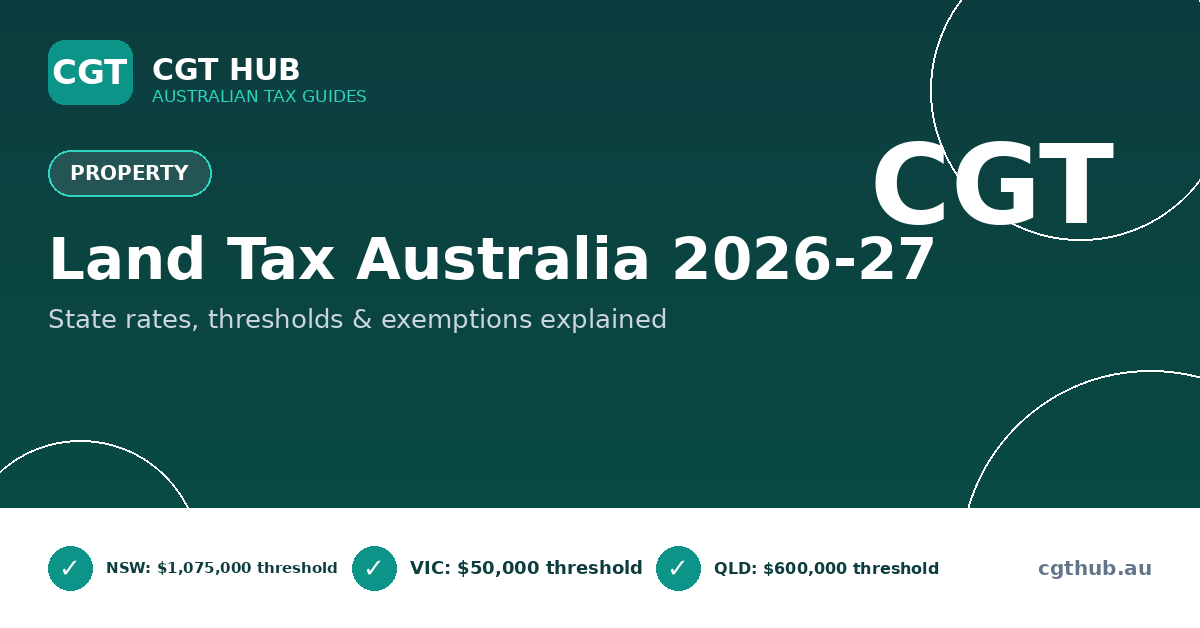
Here’s the short answer: land tax is a state government tax on the land value of property you own, assessed once a year. In 2026-27, you pay it only if your total taxable land value exceeds your state’s threshold — $1,075,000 in NSW, $50,000 in Victoria, $600,000 in Queensland, $936,000 in South Australia and $300,000 in Western Australia. Your own home is generally exempt, but investment properties, vacant blocks and holiday houses are not.
This guide covers how land tax works in 2026-27, every major state’s rate tables, two fully worked calculations, the exemptions people wrongly assume they have, and the mistakes that cost investors the most money. Pair it with our stamp duty guide for NSW and VIC.
How land tax actually works
Land tax is levied by each state and territory government on land you own — not by your local council, and not by the ATO. Three things trip up almost everyone who encounters it for the first time:
1. It’s taxed on the land value, not the property value. The figure used is the unimproved or “site” value — what the bare block is worth, excluding buildings. You’ll find it on your council rates notice. On a $900,000 apartment, the land component might be only $350,000 (apartments share the land); on a $900,000 house on a big block it might be $700,000. Same purchase price, very different land tax bills.
2. All your land in that state is added together. Every state aggregates the taxable land value of every property you own in that state, then applies the threshold and rates once to the total. Own three NSW investment units with land values of $400,000 each? That’s a combined $1,200,000 — above the $1,075,000 threshold — so you’re paying land tax even though no single property is worth much.
3. It’s a snapshot on one date each year. Land tax is assessed on what you owned at midnight on a single date: 31 December in NSW and Victoria, 30 June in Queensland, South Australia and Western Australia. Sell a property on 2 January in NSW and you’re still the person who owned it on 31 December — so you cop the full year’s assessment, not the buyer.
Land tax vs council rates: not the same thing
This is the single most common confusion in every Australian property forum, so let’s settle it. Council rates are charged by your local council to fund local services — rubbish, roads, parks — and every property owner pays them. Land tax is charged by the state government, most owner-occupiers pay nothing because their home is exempt, and the money funds state services like schools and hospitals. You can pay both on the same property. Neither offsets the other.
State-by-state thresholds and rates for 2026-27
Every state sets its own threshold, rates and assessment date:
| State | Tax-free threshold (individuals) | Top marginal rate | Assessment date |
|---|---|---|---|
| NSW | $1,075,000 | 2% above $6,571,000 | 31 Dec |
| VIC | $50,000 | 2.65% above $3,000,000 | 31 Dec |
| QLD | $600,000 | 2.25% above $10,000,000 | 30 Jun |
| SA | $936,000 | 2.40% above $3,504,000 | 31 Dec |
| WA | $300,000 | 2.67% above $11,000,000 | 30 Jun |
NT charges no land tax. The ACT taxes investment properties with no general tax-free threshold; Tasmania’s threshold is low — check the relevant revenue office for current figures.
New South Wales
NSW’s general threshold for the 2026 land tax year is $1,075,000, with a premium threshold of $6,571,000 — both frozen at their 2024 levels, with a review flagged for 1 June 2027. Rates: $100 plus 1.6% of the land value above the general threshold; $88,036 plus 2% above the premium threshold. Two quirks matter. First, NSW uses a three-year average of your land values, which smooths valuation spikes. Second, land held in most discretionary and family trusts is taxed at a special trust rate from the first dollar — no threshold — unless the trust qualifies as a fixed trust. Foreign persons pay a separate surcharge on residential land with no threshold (recently 5% — confirm the current figure with Revenue NSW).
Victoria
Victoria is where most investors get the shock. The general threshold is just $50,000 — cut from $300,000 in the 2024 land tax year — and the rates introduced in 2024 are legislated through 2033. The full general scale for 2026 (published by the State Revenue Office Victoria):
| Total taxable site value | Land tax payable |
|---|---|
| Under $50,000 | Nil |
| $50,000 to under $100,000 | $500 |
| $100,000 to under $300,000 | $975 |
| $300,000 to under $600,000 | $1,350 + 0.3% of amount above $300,000 |
| $600,000 to under $1,000,000 | $2,250 + 0.6% of amount above $600,000 |
| $1,000,000 to under $1,800,000 | $4,650 + 0.9% of amount above $1,000,000 |
| $1,800,000 to under $3,000,000 | $11,850 + 1.65% of amount above $1,800,000 |
| $3,000,000 and over | $31,650 + 2.65% of amount above $3,000,000 |
Land held through most trusts is assessed from a lower $25,000 threshold at higher surcharge rates. Absentee owners — including many Australians living overseas — pay an extra 4% of the total taxable value on top. And since 2025, Victoria’s vacant residential land tax (VRLT) applies statewide: 1% of the capital improved value in the first vacant year, 2% in the second, 3% from the third.
Queensland
Queensland assesses land tax at midnight on 30 June — and only Queensland land is counted; interstate holdings are not aggregated. The individual threshold is $600,000 and hasn’t moved since 2007, which is why so many Brisbane investors have drifted into liability as values rose. Rates for individuals (per the Queensland Revenue Office):
| Total taxable value | Rate of tax |
|---|---|
| $0–$599,999 | Nil |
| $600,000–$999,999 | $500 + 1¢ for each $1 above $600,000 |
| $1,000,000–$2,999,999 | $4,500 + 1.65¢ for each $1 above $1,000,000 |
| $3,000,000–$4,999,999 | $37,500 + 1.25¢ for each $1 above $3,000,000 |
| $5,000,000–$9,999,999 | $62,500 + 1.75¢ for each $1 above $5,000,000 |
| $10,000,000 or more | $150,000 + 2.25¢ for each $1 above $10,000,000 |
Companies and trustees face a lower $350,000 threshold with higher marginal rates (up to 2.75%). An absentee surcharge applies on top for foreign and interstate absentee owners — reported around 2.5–3% for 2025-26; check the Queensland Revenue Office for the current figure.
South Australia
SA indexes its thresholds annually to movements in site values. For 2026-27 the general threshold jumped to $936,000 (up from $833,000), with further thresholds at $1,504,000, $2,188,000 and $3,504,000. Rates: 0.5% of the value above $936,000 up to $1,504,000; $2,840 + 1% above $1,504,000 up to $2,188,000; $9,680 + 2% above $2,188,000 up to $3,504,000; $36,000 + 2.4% above $3,504,000. Land held on trust is assessed from just $25,000. One SA quirk in your favour: there is no foreign surcharge on land tax — SA’s 7% foreign ownership surcharge applies to stamp duty on acquisition instead.
Western Australia
WA’s threshold is $300,000, assessed at midnight on 30 June, with the taxable value capped at the lesser of the current unimproved value or 150% of the previous year’s. The scale: $300 flat for $300,001–$420,000; $300 + 0.25% of the amount above $420,000 up to $1,000,000; $1,750 + 0.9% above $1,000,000 up to $1,800,000; $8,950 + 1.8% above $1,800,000 up to $5,000,000; $66,550 + 2% above $5,000,000 up to $11,000,000; $186,550 + 2.67% above $11,000,000. WA currently imposes no foreign-owner surcharge on land tax.
How to calculate your land tax: step by step
- Find the taxable land value of each property — the site/unimproved value from your council rates notice, not the purchase price.
- Subtract any exempt land — your principal place of residence and any other exempt holdings come out entirely.
- Add everything in the same state together — each state assesses only its own land.
- Compare the total to your state’s threshold — below it, you owe nothing.
- Apply the rate table — the tax is on the excess over the threshold, not the whole value.
Worked example 1: NSW investor
Sarah owns two Sydney investment properties. After Revenue NSW’s three-year averaging, her combined taxable land value for the 2026 land tax year is $1,300,000:
- Amount above threshold: $1,300,000 − $1,075,000 = $225,000
- Tax: $100 + (1.6% × $225,000) = $100 + $3,600 = $3,700 for the year
Sarah’s properties are worth well over $2 million combined, but her land tax is $3,700 — because the tax bites only on the land component above the threshold. That’s why the frozen NSW threshold matters: every year land values rise, more investors cross a line that no longer moves with them. And this figure is generally deductible against her rental income, as we cover in our rental income tax guide.
Worked example 2: Victorian investor
David owns one investment unit in Melbourne with a total taxable site value of $450,000 — in the $300,000–$600,000 bracket:
- Amount above $300,000: $450,000 − $300,000 = $150,000
- Tax: $1,350 + (0.3% × $150,000) = $1,350 + $450 = $1,800 for the year
A single unit, one property — and a $1,800 annual bill. Now the absentee version: with an $800,000 site value, the general tax would be $2,250 + (0.6% × $200,000) = $3,450 — plus the 4% absentee surcharge of $32,000. Total: $35,450. That surcharge is the most expensive line in Australian land tax, and expats holding Victorian property are the people it hits.
Exemptions and concessions
Your principal place of residence (PPR) is exempt in every state — but the exemption isn’t always automatic. In several states you must claim it, and it can be lost: move out and rent the home for more than the allowed period and it may become taxable.
Primary production land (genuine farms) is exempt or concessional in most states. Charitable and religious land is generally exempt. Retirement villages and aged care have specific concessions, and NSW offers eligible build-to-rent properties a 50% land tax reduction.
Trusts and companies get harsher treatment. In NSW, most discretionary trusts are taxed from the first dollar at the special trust rate. In Victoria, trust land is assessed from $25,000 at surcharge rates. In Queensland, companies and trustees start at $350,000 with higher marginal rates. If your properties sit in a trust, get advice before restructuring — fixing land tax can trigger stamp duty and capital gains tax that dwarf the saving.
Five mistakes that cost investors real money
1. “My home is exempt, so I’m fine.” Your home is exempt — your investment property and holiday house aren’t. The PPR exemption covers the one property you actually live in; everything else counts toward the aggregated total.
2. Selling at the wrong time of year. Because land tax is a snapshot at midnight on 31 December (NSW/VIC) or 30 June (QLD/SA/WA), selling on 2 January in NSW means you wear the entire year’s assessment. If a sale is planned near year-end, the settlement date genuinely changes who pays — and parties routinely adjust the price for it.
3. Forgetting land tax is deductible. Land tax on an income-producing property is generally deductible against your rental income — the same as interest, insurance and agent fees. Investors who leave it off their tax return are donating money to the ATO. Our negative gearing guide shows how these holding costs interact with your overall position.
4. Ignoring the trust threshold trap. Buying through a discretionary trust for asset protection, then discovering NSW taxes the land from the first dollar, is an expensive lesson. Model the land tax position of the ownership structure before you buy.
5. Assuming the valuation is right. Land tax is only as accurate as the Valuer-General’s figure behind it — and those valuations are mass-produced. Every state gives you a window to object (in NSW it’s generally 60 days from the assessment). If your land value looks inflated against comparable sales, an objection can cut your bill for years, because the corrected value flows into future assessments too.
Tips to keep your land tax under control
- Check your valuations and claim every exemption — PPR, primary production, charitable use. Some must be applied for; they aren’t automatic.
- Spread purchases across states strategically — thresholds apply per state, so $1.5 million of land split between NSW and Queensland may attract no tax, while the same value in one state does. Factor it in, but don’t let tax drive the investment decision.
- Time disposals around the assessment date where a sale is already planned.
- Keep land tax records with your rental records so the deduction is never missed at tax time.
Frequently asked questions
Do I pay land tax on my own home?
No — your principal place of residence is exempt in every state. Investment properties, vacant land and holiday houses are taxable, and their values are aggregated. Move out and rent your former home and the exemption can fall away.
Is land tax the same as council rates?
No — see the section above. Council rates go to your local council for local services and everyone pays them; land tax goes to the state government and most owner-occupiers are exempt. Separate bills, separate governments.
I sold my investment property in February — why did I get a land tax bill?
Land tax is assessed on ownership at midnight on the assessment date (31 December in NSW/VIC, 30 June in QLD/SA/WA). If you owned it then, the full year’s bill is yours — even if you sold the next month. Adjustments between buyer and seller at settlement are common; check your contract.
Is land tax tax-deductible?
Yes, where the property produces assessable income — generally deductible against that rental income. Land tax on your own home is not.
How is land tax different from stamp duty and CGT?
Stamp duty is a one-off tax when you buy; capital gains tax applies when you sell at a profit; land tax is the annual tax for holding. One property can attract all three across its life.
Do trusts pay more land tax?
Usually, yes. Most states tax trust-held land from a much lower threshold — or from the first dollar — and at higher rates than individual ownership. Fixed trusts and SMSFs have their own rules, so check your state’s revenue office for your specific structure.
The bottom line
Land tax is the holding cost investors most often underestimate — not because the rates are hidden, but because of the mechanics: aggregation across properties, site values instead of purchase prices, a once-a-year snapshot date, and thresholds that haven’t moved in years. Pull your land valuations once a year, run the numbers, claim your exemptions, and make sure the deduction lands on your tax return. Ten minutes of attention here reliably saves real money.