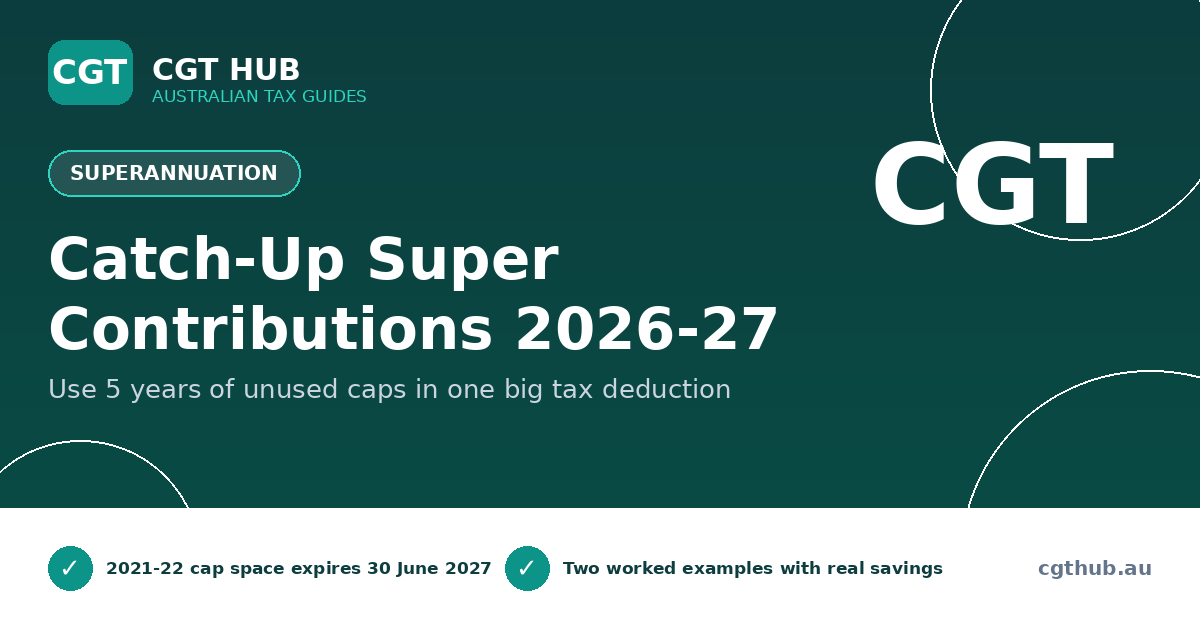
If you haven’t maxed out your super contributions in recent years, the tax system owes you a second chance — literally. Carry-forward (catch-up) concessional contributions let you mop up unused super caps from the last five financial years and claim them as one big tax deduction in 2026-27. For someone sitting on $70,000 of unused cap space, that’s a deduction worth up to $32,900 off this year’s tax bill.
But there’s a catch hiding in the fine print: unused cap from 2021-22 expires on 30 June 2027. If you don’t use it this financial year, it vanishes. Here’s how the rules work, how to check your balance, and the traps that catch people out.
How carry-forward contributions work
Since 1 July 2018, your concessional contributions cap hasn’t been a hard annual ceiling. Under section 291-20 of the tax law, any cap you didn’t use in the previous five financial years gets added to your current-year cap automatically. The ATO tracks it from what your funds report — there’s no form to lodge and no election to make.
For 2026-27, the five years that count are:
- 2021-22: cap was $27,500
- 2022-23: cap was $27,500
- 2023-24: cap was $27,500
- 2024-25: cap was $30,000
- 2025-26: cap was $30,000
- 2026-27 (this year): cap is $32,500
Your boosted cap for 2026-27 is $32,500 plus whatever you didn’t use across those five years. In the absolute best case — zero concessional contributions for five straight years — that’s $27,500 × 3 + $30,000 × 2 + $32,500 = $175,000 of concessional contributions in a single year. Most people will have a smaller number because employer super guarantee used up part of the cap along the way.
One rule matters more than any other: your total super balance across every account you hold must have been under $500,000 at 30 June 2026. Not $500,000 or less — strictly under. A balance of exactly $500,000 fails the test. The threshold isn’t indexed either, so it stays $500,000 every year.
The expiry calendar: 2021-22 amounts die this year
Unused cap doesn’t wait around forever. Each year’s unused amount expires five years after it arose, and the oldest amounts are always used first. That means right now, in 2026-27, the clock is ticking on one specific cohort:
| Unused cap from | Cap that year | Last financial year you can use it |
|---|---|---|
| 2021-22 | $27,500 | 2026-27 — expires 30 June 2027 |
| 2022-23 | $27,500 | 2027-28 |
| 2023-24 | $27,500 | 2028-29 |
| 2024-25 | $30,000 | 2029-30 |
| 2025-26 | $30,000 | 2030-31 |
Unused amounts from 2020-21 already expired on 30 June 2026 — they’re gone, no extensions, no appeals. If your myGov carry-forward figure includes 2021-22 amounts, this is the year to use them or lose them. Nobody else’s guide seems to put this deadline front and centre, which is exactly why so much unused cap quietly evaporates every 30 June.
Step-by-step: using your carry-forward cap in 2026-27
Step 1 — Check your actual balance on myGov
Don’t guess. Log in to myGov, open the ATO service, go to Super → Information → Carry-forward concessional contributions. It shows your unused amounts and confirms whether you pass the $500,000 test. A few timing quirks to know:
- Figures for the current financial year may not appear for the first few months.
- If you have an SMSF, last year’s figure won’t be right until your SMSF annual return is processed.
- Defined-benefit fund members: prior-year contribution info may not reach the ATO until 31 October.
Step 2 — Work out your real room
Your boosted cap is $32,500 plus your unused amounts. But your employer contributions count too — the 12% super guarantee (now paid with each pay cycle under payday super) and any salary sacrifice both eat into the same cap. So:
Room left = ($32,500 + unused amounts) − (employer SG + salary sacrifice already paid or expected this year)
This is where most people trip up. On a $150,000 salary, 12% SG alone is $18,000 — more than half the base cap gone before you’ve done anything.
Step 3 — Make the contribution
You can use either salary sacrifice or a personal deductible contribution. For most people making a catch-up, a personal contribution is simpler — one lump sum from your bank account to your fund. Critical timing point: your fund must RECEIVE the money by 30 June. Clicking “pay” on 30 June with a bank transfer that clears on 1 July means the contribution counts for next year, not this one. Most funds suggest allowing at least a week.
Step 4 — Lodge your notice of intent
If you made a personal contribution and want the tax deduction, you must lodge a Notice of Intent to Claim a Tax Deduction with your fund — and the fund must acknowledge it — before you lodge your tax return. This cannot be done retrospectively. If you have more than one fund and contributed to both, you need a separate notice for each fund. And if you roll over or withdraw the contribution before the notice is acknowledged, the deduction is lost entirely.
Worked example 1: Sophie’s $70,000 catch-up
Sophie earns $180,000 in 2026-27. Her total super balance was $340,000 at 30 June 2026, so she passes the $500,000 test. Her myGov shows $70,000 of unused cap from 2021-22 to 2025-26.
Her employer pays $12,000 in super guarantee this year. Her boosted cap is $32,500 + $70,000 = $102,500, so she has $90,500 of room. She makes a $70,000 personal deductible contribution and lodges her notice of intent.
- Tax saved on her income: $70,000 × 39% (37% bracket + 2% Medicare levy) = $27,300
- Tax paid inside super: $70,000 × 15% = $10,500
- Net tax saving: $16,800 — plus $70,000 more compounding in super
Division 293 check: her income for Division 293 purposes comes in around $192,000 (taxable income after the deduction plus total concessional contributions) — comfortably under the $250,000 threshold, so no extra 15% applies. That’s a clean $16,800 win.
Worked example 2: Daniel’s redundancy year (with the Division 293 sting)
Daniel is made redundant in 2026-27 and his taxable income lands at $280,000. His balance was $410,000 at 30 June 2026 and he has $60,000 of unused cap. Between jobs, he has no employer contributions this year.
He makes a $60,000 personal deductible contribution. His taxable income drops to $220,000.
- Income tax saved: $60,000 × 47% (45% bracket + 2% Medicare) = $28,200
- Contributions tax in super: 15% × $60,000 = $9,000
- Division 293: his income for Division 293 purposes is $220,000 + $60,000 = $280,000 — $30,000 over the $250,000 threshold. Extra 15% on the $30,000 excess = $4,500
- Net saving: $28,200 − $9,000 − $4,500 = $14,700
Still a $14,700 win on top of $60,000 extra in super — but notice how Division 293 quietly took $4,500 off the headline saving. High earners doing big catch-ups should always model this before contributing, not after.
7 common mistakes that cost real money
1. The 30 June illusion. The contribution counts when your fund receives it, not when you send it. BPAY and bank transfers can take days. Aim for mid-June at the latest.
2. The notice-of-intent trap. Personal contribution, no notice lodged (or lodged after your tax return, or never acknowledged by the fund) = no deduction, and the money still counts against your cap. With multiple funds, it’s one notice per fund.
3. Guessing instead of checking myGov. Your employer’s SG and any salary sacrifice already used part of your space. The ATO’s figure is the source of truth — your mental arithmetic isn’t.
4. Misreading the $500,000 test. It’s all accounts combined, measured at the previous 30 June, strictly under $500,000, never indexed. But failing one year isn’t fatal — it’s re-tested every 30 June, so a market dip can reopen the window before your oldest unused years expire.
5. Ignoring Division 293. As Daniel’s example shows, a big catch-up in a high-income year can push your Division 293 income over $250,000 and trigger an extra 15%. Still usually worth it — just know the real number.
6. Trying to use a partner’s unused cap. Carry-forward is strictly per-member. You cannot transfer, gift or share unused cap with a spouse, no matter how much sense it would make.
7. Blowing past the boosted cap. If you overshoot, the excess is added to your assessable income and taxed at your marginal rate (with a 15% offset for the contributions tax already paid). You can elect to release up to 85% of the excess, but anything left in the fund also counts toward your non-concessional cap. Measure twice, contribute once.
When carry-forward pays off most
The strategy shines in lumpy-income years — the exact years when a big deduction is worth the most:
- A property or share sale: a large capital gain in 2026-27 pairs beautifully with a catch-up contribution to pull taxable income back down.
- Redundancy or termination payouts: the payout pushes you into a higher bracket for one year only — the perfect year to deploy unused cap.
- Bonus or business profit spike: contractors and business owners with volatile income can bank unused cap in lean years and spend it in bumper ones.
- Before the 2021-22 amounts expire: if any of your unused cap dates from 2021-22, 30 June 2027 is a hard deadline regardless of your income year.
One more coordination point: if you’re already salary sacrificing, factor it into your room calculation first. And if you’re 67 to 74, you generally need to meet the work test (40 hours in a 30-day period) to contribute at all — though a one-off work-test exemption exists if your balance was under $300,000 at the previous 30 June.
FAQ
How do I check my carry-forward balance?
Log in to myGov → ATO → Super → Information → Carry-forward concessional contributions. It shows your unused amounts by year and whether you meet the $500,000 test. If you have an SMSF, wait until your annual return is processed for an accurate figure.
Do I need to be employed to use carry-forward contributions?
No. Anyone eligible can make a personal deductible contribution — employees, the self-employed, and even people not working. If you’re 67 to 74, the work test (or its one-off exemption) applies.
Can I use my partner’s unused super cap?
No. Unused concessional cap is personal to each member and cannot be transferred or shared, even with a spouse.
What happens if I contribute more than my boosted cap?
The excess is included in your assessable income and taxed at your marginal rate, with a 15% tax offset for contributions tax already paid. You can elect to have up to 85% of the excess released from super; any excess left in the fund also counts toward your non-concessional contributions cap.
Is the $500,000 test a one-off?
No — it’s tested fresh every 30 June. If your balance is over $500,000 this year, you can’t use carry-forward this year, but you can use it in a later year (before the oldest amounts expire) if your balance drops back under.
Do salary sacrifice and employer SG use up my unused amounts?
Yes. Every concessional contribution — SG, salary sacrifice, personal deductible — counts against the same cap. Unused amounts from the oldest year are applied first, which is why the 2021-22 cohort is the one to watch this year.
The bottom line
Carry-forward contributions are one of the few genuine “do-overs” in the tax system: five years of unused super cap, claimable as a single deduction. In 2026-27 the maths is unusually generous — a $32,500 base cap, up to $142,500 of historical room, and a 15% contributions tax rate against marginal rates as high as 47%. The two things to get right are the 30 June 2027 expiry of 2021-22 amounts and the notice of intent before you lodge your return. Get those right, check your real figure on myGov, and a catch-up contribution can be the single biggest legal tax saving you make this year. Run your own numbers with our super tax calculator and income tax calculator before you commit.
Further reading: Super Contribution Caps 2026-27 · Superannuation Tax & Salary Sacrifice · Division 293 Tax Explained · First Home Super Saver Scheme · Division 296: the $3M Super Tax · ATO: Concessional contributions cap