The short answer
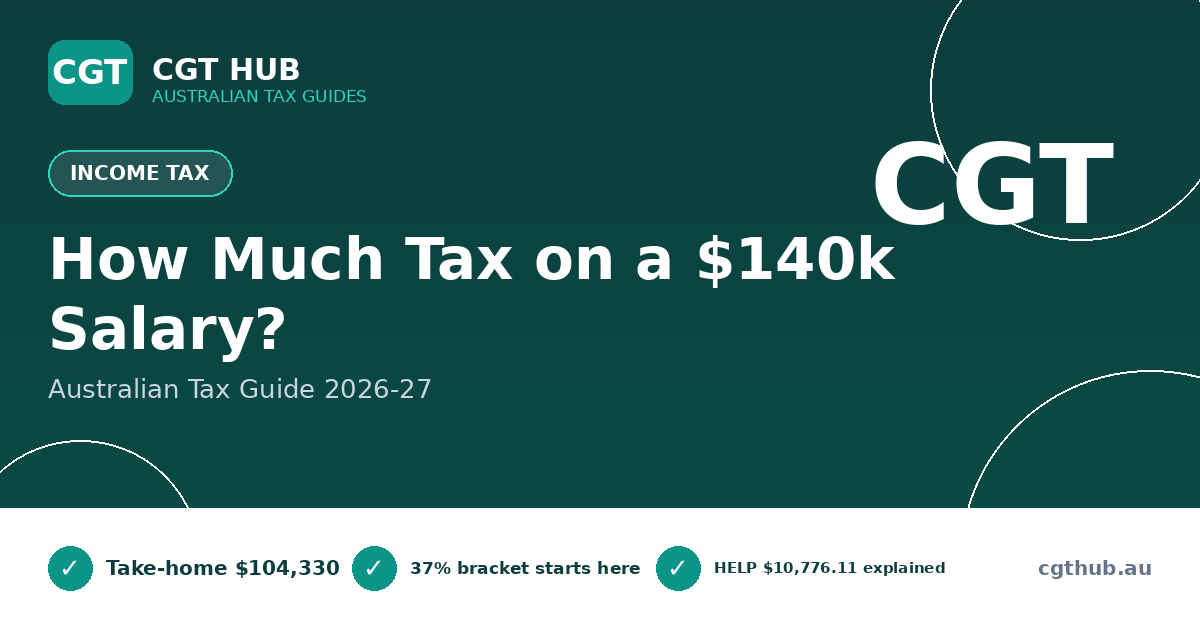
On a $140,000 salary in 2026-27, you pay $32,870 in income tax plus a $2,800 Medicare levy — $35,670 in total — and take home $104,330 a year. That’s $8,694.17 a month, $4,012.69 a fortnight or $2,006.35 a week. Your effective tax rate is 25.5%, and your marginal rate is 37% (39% once the levy is counted). On a 38-hour week, $140,000 is $70.85 an hour before tax and $52.80 an hour after it.
What makes $140,000 interesting is not the headline — it is where the number sits. This is the first rung inside the 37% bracket: $5,000 of your salary is taxed at 37%, and the $5,000 step that lands you here is the first step in the whole ladder that keeps less than $3,400 with hospital cover — it keeps $3,050. At $135,000 you were still on the last dollar taxed at 30%; one dollar past $135,000, your marginal rate jumps 7 points. Your Low Income Tax Offset is long gone — it phases out completely by $66,667 — and your HELP repayment is now $10,776.11, because you sit $10,283 into the 17-cent repayment band. And the surcharge, which was $1,687.50 at $135,000, is now $1,750 a year if you hold no hospital cover. Every figure below is worked from the ATO’s own 2026-27 tables, and four independent calculators agree with the headline to the dollar.
| Your situation | Extra taken out | Take-home pay |
|---|---|---|
| Headline — no HELP debt, hospital cover held | — | $104,330 |
| With a HELP debt | $10,776.11 | $93,553.89 |
| No hospital cover (1.25% surcharge) | $1,750 | $102,580 |
| With HELP debt and no hospital cover | $12,526.11 | $91,803.89 |
| Claiming the $1,000 standard deduction | −$390 | $104,720 |
| Standard deduction + HELP debt | −$560 | $94,113.89 |
| Salary sacrifice $10,000 into super | −$2,050 net | $104,330 + $8,500 in super |
How the tax on $140,000 is worked out
Australia taxes income in slices, not all at one rate. Only the dollars inside each bracket are taxed at that bracket’s rate — nothing reaches back and re-taxes the dollars you earned below the threshold. On $140,000 the slices stack like this:
| Slice of your salary | Rate | Tax on that slice |
|---|---|---|
| $0 – $18,200 (tax-free threshold) | 0% | $0 |
| $18,201 – $45,000 | 15% | $4,020 |
| $45,001 – $135,000 | 30% | $27,000 |
| $135,001 – $140,000 | 37% | $1,850 |
| Total income tax | $32,870 |
The last row is the one that matters. Only $5,000 of your salary is taxed at 37% — the other $135,000 is taxed exactly as it was at the rung below. That is why your effective rate is 25.5% even though your marginal rate is 37%: the marginal rate describes the next dollar, not the whole salary. Add the 2% Medicare levy — $2,800 on the full $140,000 — and the total is $35,670, leaving $104,330.
The 15% second bracket is new this year: it was 16% in 2025-26, and the one-point cut is worth $268 a year to everyone earning $45,000 or more. It drops again to 14% from 1 July 2027. The cut is already baked into the $32,870 above — last year’s tax on the same salary was $33,138.
If you want to check the arithmetic against your own circumstances — a different HELP balance, a partner’s income, salary packaging — run the numbers through our income tax calculator. Note it still uses 2025-26 rates, so treat its headline as last year’s answer and use the figures in this article for 2026-27.
Official 2026-27 tax rates for residents
These are the ATO’s resident rates for 2026-27, for someone claiming the full tax-free threshold. They do not include the 2% Medicare levy.
| Taxable income | Tax on this income |
|---|---|
| $0 – $18,200 | Nil |
| $18,201 – $45,000 | 15c for each $1 over $18,200 |
| $45,001 – $135,000 | $4,020 plus 30c for each $1 over $45,000 |
| $135,001 – $190,000 | $31,020 plus 37c for each $1 over $135,000 |
| $190,001 and over | $51,370 plus 45c for each $1 over $190,000 |
Source: ATO — Tax rates, Australian residents. For the full picture across every salary level, see our income tax rates 2026-27 guide.
Two things in that table deserve a second look. First, $140,000 sits just $5,000 inside the 37% bracket — the bracket runs all the way to $190,000, so you have $50,000 of headroom before the 45% rate appears. Second, the jump from 30% to 37% is the biggest single step in the resident table. There is no gradual ramp: at $135,000 your next dollar costs 30c in tax, at $135,001 it costs 37c. Add the levy and the step is 32c to 39c.
With a HELP debt: minus $10,776.11 — 17 cents on the $10,283 above the line
If you carry a HELP (formerly HECS) debt, the repayment is deducted from your pay on top of income tax and the levy. The 2026-27 repayment thresholds work on a marginal basis — you only repay on the income above each threshold, not on your whole salary:
| Repayment income | Repayment |
|---|---|
| Up to $69,528 | Nil |
| $69,529 – $129,717 | 15c for each $1 over $69,528 |
| $129,718 – $186,050 | $9,028 plus 17c for each $1 over $129,717 |
| Over $186,050 | 10% of total repayment income |
At $140,000 you sit $10,283 into the 17-cent band, so the repayment is $9,028 + 17% × $10,283 = $10,776.11. Your take-home with a HELP debt is $104,330 − $10,776.11 = $93,553.89 — $3,598.22 a fortnight.
The step from $135,000 is worth noticing: the HELP repayment rose by exactly $850.00 (17% × $5,000). That is the second clean step in a row — at $130,000 the repayment was $9,076.11, at $135,000 it was $9,926.11, and now $10,776.11. Every $5,000 step in this part of the ladder adds a flat $850 to the repayment, because the whole step sits inside the same 17-cent band. The step stays clean until $186,050, where the 10%-of-total-income rule takes over.
Two traps catch people here. First, the repayment is based on repayment income, not taxable income — reportable super contributions and net investment losses count, so salary sacrificing into super does not cut your HELP repayment (more on that below). Second, the repayment is not extra tax: it comes off your HELP balance. You are paying down a debt, not losing the money — but it still comes out of this year’s take-home pay, so budget on $93,553.89, not $104,330. Source: ATO — Study and training support loans rates and repayment thresholds. Full detail, including how the ATO calculates repayment income, is in our HELP repayment 2026-27 guide.
The Low Income Tax Offset: $0 — gone by $66,667
The Low Income Tax Offset (LITO) is worth up to $700, paid in full on taxable incomes up to $37,500, then tapered away in two stages until it reaches zero at $66,667. At $140,000 it is $0 — it has been gone for a long time, and nothing in the 2026-27 changes brings it back.
That matters because several calculators still show a LITO line in their breakdowns. If a calculator shows you a LITO amount on a $140,000 salary, it is using stale rules — the offset is $0 at this income, and the $32,870 tax figure above already reflects that. The offset that does matter at $140,000 is the new $1,000 standard deduction, covered below.
Medicare levy surcharge: $1,750 — still Tier 2, but the boundary is behind you
The Medicare levy itself is a flat 2% — $2,800 on $140,000, already counted in the headline. The surcharge is separate: an extra 1% to 1.5% if you earn over the threshold and do not hold an appropriate level of private hospital cover. For singles in 2026-27 the tiers are:
| Income for surcharge purposes (single) | Surcharge rate |
|---|---|
| $105,000 or less | 0% |
| $105,001 – $123,000 (Tier 1) | 1% |
| $123,001 – $164,000 (Tier 2) | 1.25% |
| $164,001 and over (Tier 3) | 1.5% |
At $140,000 you are in Tier 2, so the surcharge is 1.25% × $140,000 = $1,750 a year with no hospital cover, taking your pay to $102,580. With a HELP debt and no cover, it is $104,330 − $10,776.11 − $1,750 = $91,803.89.
The step from $135,000 added just $62.50 to the surcharge ($1,687.50 → $1,750) — the rate did not change, only the income it applies to. You stay in Tier 2 until $164,000, so the surcharge grows by $62.50 for every $5,000 step from here. At $150,000 it will be $1,875. The surcharge is also the cheapest problem in this article to fix: a basic hospital policy that costs less than $1,750 a year and meets the ATO’s requirements wipes the whole surcharge out, and the policy itself is a separate expense, not a tax. Source: ATO — Medicare levy surcharge thresholds and rates. Our Medicare levy surcharge guide works through the tiers and the hospital-cover test in full.
One warning: surcharge income is not the same as taxable income. Reportable fringe benefits, reportable super contributions and net investment losses are added back, so salary sacrificing can push your surcharge income up even while your taxable income falls. If you sit near a tier boundary, check the surcharge income definition before you sacrifice.
Take-home pay by pay period
The annual figure is $104,330. Here is what that looks like in the pay cycles people actually live on — before HELP and the surcharge, with hospital cover held:
| Pay period | Gross pay | Tax + levy withheld | Take-home pay |
|---|---|---|---|
| Annual | $140,000.00 | $35,670.00 | $104,330.00 |
| Monthly | $11,666.67 | $2,972.50 | $8,694.17 |
| Fortnightly | $5,384.62 | $1,371.92 | $4,012.69 |
| Weekly | $2,692.31 | $685.96 | $2,006.35 |
| Daily (260 working days) | $538.46 | $137.19 | $401.27 |
| Hourly (38-hour week) | $70.85 | $18.05 | $52.80 |
With a HELP debt, the fortnightly figure falls to $3,598.22. With no hospital cover, it falls to $3,945.38. With both, it is $3,531.07. Those are the numbers to budget on — the headline $4,012.69 only applies if neither deduction touches you.
The first step inside the 37% bracket: $135,000 to $140,000 keeps $3,050
This is the section that explains why $140,000 feels different from $135,000 even though the pay rise is only $5,000. Every $5,000 step in the ladder from $105,000 to $135,000 kept exactly $3,400 with hospital cover, because every dollar in those steps was taxed at 30% plus the 2% levy. The step to $140,000 breaks the pattern:
| Step | Extra tax + levy | You keep |
|---|---|---|
| $130,000 → $135,000 | $1,600 | $3,400 |
| $135,000 → $140,000 | $1,950 | $3,050 |
| $140,000 → $145,000 | $1,950 | $3,050 |
| $140,000 → $150,000 | $3,900 | $6,100 |
The extra $350 of tax on the step is the 7-point jump applied to the full $5,000 (7% × $5,000 = $350). From here, every $5,000 step keeps $3,050 until $190,000, where the 45% rate cuts it to $2,650. The $140,000 rung is also where the “your pay rise is mostly tax” feeling starts to have real numbers behind it: with a HELP debt, the $135,000 → $140,000 step keeps only $2,200 ($3,050 − $850 HELP); without hospital cover and with HELP, it keeps $2,137.50. A $5,000 pay rise that lands $2,137.50 in your bank account is still a pay rise — but it is worth knowing before you negotiate, not after.
For the rung you came from, see our tax on a $135k salary guide; for the next rung up, see tax on a $150k salary.
Two legal ways to keep more of your $140,000
1. The $1,000 standard deduction — worth $390, more than at any rung below
From 2026-27, most taxpayers can claim a $1,000 standard deduction instead of itemising work-related expenses — no receipts, no logbook, just the flat $1,000. On a $140,000 salary it cuts your taxable income to $139,000, so the tax falls to $32,500 and the levy to $2,780. Total tax becomes $35,280 and take-home rises to $104,720 — the deduction is worth $390.
That $390 is $70 more than the same deduction was worth at $135,000, and the reason is the bracket you just entered: at $135,000 the top $1,000 of income was taxed at 30%, so the deduction saved $300 of tax; at $140,000 the top $1,000 is taxed at 37%, so it saves $370 of tax plus $20 of levy. The higher your marginal rate, the more a deduction is worth — and $140,000 is the first rung where the standard deduction shelters 37% dollars.
With a HELP debt, the deduction is worth $560: the $390 above plus $170, because the lower repayment income cuts the HELP repayment from $10,776.11 to $10,606.11, taking take-home to $94,113.89. With HELP and no hospital cover it is worth $572.50 — the surcharge also trims $12.50, to $1,737.50, and take-home reaches $92,376.39.
Do not claim it twice: if you claim the $1,000 standard deduction you cannot also claim the individual work-related expenses it replaces. If your real deductible expenses are above $1,000, itemising still wins. Our standard deduction guide works through the trade-off. And do not claim it on a 2025-26 return — it starts in 2026-27, and premature claims are one of the ATO’s audit triggers this year.
2. Salary sacrifice $10,000 into super — worth $2,050 net, $350 more than at $135,000
Sacrificing $10,000 of salary into super cuts your taxable income to $130,000. The tax falls to $29,520 and the levy to $2,600 — a gross saving of $3,550. Less the 15% contributions tax on the $10,000 ($1,500), the net saving is $2,050, and $8,500 lands in your super fund. Your take-home stays $104,330 on paper, but you have $8,500 more in super and you paid $2,050 less tax overall.
The net figure is $350 higher than at $135,000, where the same sacrifice was worth $1,700 net. The reason is again the bracket: $5,000 of the sacrificed amount escapes the 37% rate and $5,000 escapes the 30% rate, so the gross saving is $3,550 instead of $3,200. Salary sacrifice gets more valuable the moment you cross into the 37% bracket — it is the one lever in this article that improves at $140,000 instead of worsening.
There is plenty of room to use it. Your employer already pays 12% super guarantee — $16,800 on $140,000 — and the concessional contributions cap for 2026-27 is $32,500, leaving $15,700 of headroom before you hit the cap. A $10,000 sacrifice fits comfortably inside it. Two warnings, though. First, sacrificing does not cut your HELP repayment or your surcharge: reportable super contributions count in both repayment income and surcharge income, so HELP stays $10,776.11 and the surcharge stays $1,750. Second, sacrificed money is locked in super until preservation age — it is a retirement decision, not a pay-rise decision. Run the numbers on our super calculator and read our salary sacrifice guide before you sign the form.
PAYG vs assessed: why your payslip and your assessment disagree
Your employer withholds tax every pay cycle using the ATO’s PAYG tables — roughly $1,371.92 a fortnight on $140,000, or $35,670 across the year. That matches the assessed total of $35,670 almost exactly, so for a plain salary with no other income the assessment and the payslip should agree to the dollar.
They diverge when something else is in play: a HELP debt (withheld separately and reconciled at lodgement), the surcharge (not withheld by your employer at all — it lands on your assessment), investment income, a second job, or the standard deduction (applied at lodgement, not in your payslips). If your assessment shows a bill, the usual cause at this income is the surcharge: $1,750 that was never withheld during the year. If it shows a refund, the usual cause is the standard deduction — $390 that your employer never gave you during the year.
If you are not a resident: $97,650, not $104,330 — and the working holiday maker is $70 ahead of you
Residency changes everything at $140,000. A foreign resident pays no Medicare levy, but also gets no tax-free threshold — and the 37% band applies above $135,000 just as it does for residents. The tax is 30% × $135,000 + 37% × $5,000 = $42,350, leaving $97,650 — $6,680 less than a resident keeps.
Do not use a flat 30% on the whole amount: that gives $42,000 and $98,000, which is wrong by $350. The 37% slice applies to non-residents too.
The working holiday maker is the surprise. On the same $140,000, a WHM pays 15% × $45,000 + 30% × $90,000 + 37% × $5,000 = $35,600 and keeps $104,400 — $70 more than a resident. At $135,000 the resident was still $30 ahead ($101,280 vs $101,250); the two lines tie at exactly $136,500, where both keep $102,195. $140,000 is the first rung in the ladder where the working holiday maker comes out in front, because the resident’s 2% levy now outweighs the WHM’s missing tax-free threshold. The gap widens from here: by $150,000 the WHM is $230 ahead. Full detail is in our tax residency guide.
2025-26 vs 2026-27 vs 2027-28
| Year | Income tax | Medicare levy | Total | Take-home | With HELP |
|---|---|---|---|---|---|
| 2025-26 (16% bracket) | $33,138 | $2,800 | $35,938 | $104,062 | $92,812 |
| 2026-27 (15% bracket) | $32,870 | $2,800 | $35,670 | $104,330 | $93,553.89 |
| 2027-28 (14% bracket) | $32,602 | $2,800 | $35,402 | $104,598 | — |
2026-27 is $268 better than 2025-26 — the one-point cut in the second bracket, worth 1% × $26,800. With a HELP debt the improvement is $741.89: the $268 bracket saving plus $473.89 from the higher HELP thresholds (the 2025-26 repayment at $140,000 was $11,250; the 2026-27 repayment is $10,776.11). The surcharge was $1,750 in both years — $140,000 was already in Tier 2 in 2025-26.
From 1 July 2027 the second bracket drops to 14%, worth another $268, taking take-home to $104,598. The legislated $250 Working Australians Tax Offset would add up to $250 more on top, so 2027-28 could be up to $518 better than this year. Both are legislated, not promised — but keep an eye on the offset, which is the part most likely to move before it starts.
Common mistakes that cost real money
Thinking the 37% rate applies to your whole salary. It applies to $5,000 of it. Your effective rate is 25.5%, and turning down a pay rise because it “pushes you into a higher bracket” is the most expensive misunderstanding in Australian tax — moving into a higher bracket can never leave you with less take-home pay.
Claiming the $1,000 standard deduction on a 2025-26 return. It starts in 2026-27. Early claims are one of the ATO’s audit triggers this year, and the fix is an amended return plus interest.
Claiming the standard deduction and itemising the same expenses. It is one or the other. If your real work expenses top $1,000, itemise — the standard deduction is the floor, not a bonus on top.
Assuming salary sacrifice cuts your HELP repayment. It does not. Reportable super contributions are added back into repayment income, so the $10,776.11 stays exactly where it is. The same applies to the surcharge.
Forgetting the surcharge until assessment time. Your employer does not withhold it. If you hold no hospital cover, $1,750 arrives as a bill at lodgement — budget for it monthly ($145.83) or buy cover that costs less than the surcharge.
Using a flat 30% for a non-resident or WHM calculation. Both pay 37% on the slice above $135,000. A flat-rate shortcut overstates a non-resident’s take-home by $350 and understates the WHM’s tax by $350.
Budgeting on $104,330 when you have a HELP debt. Your real take-home is $93,553.89 — $10,776.11 a year, or $414.47 a fortnight, never reaches your bank account. Budget on the smaller number.
FAQ
How much tax do I pay on a $140,000 salary in Australia?
$35,670 in 2026-27: $32,870 income tax plus the $2,800 Medicare levy. You take home $104,330 a year, $8,694.17 a month or $4,012.69 a fortnight, before any HELP repayment or surcharge.
What is the take-home pay on $140,000 a year after tax?
$104,330 a year with hospital cover and no HELP debt. With a HELP debt it is $93,553.89; with no hospital cover it is $102,580; with both it is $91,803.89.
What tax bracket is $140,000 in Australia?
The 37% marginal bracket — but only the $5,000 above $135,000 is taxed at 37%. The rest is taxed at 0%, 15% and 30%, which is why the effective rate is 25.5%.
How much HELP do I repay on $140,000?
$10,776.11 in 2026-27: $9,028 plus 17 cents on the $10,283 above the $129,717 threshold. The repayment comes off your HELP balance — it is not extra tax.
Is $140,000 a good salary in Australia?
It is roughly double the full-time median, and it puts you in the top slice of earners. After tax it is $8,694 a month before HELP and the surcharge — comfortable in most of the country, tighter in Sydney and Melbourne once housing is counted. Whether it feels good depends mostly on the HELP debt and the mortgage, not the tax.
How much super do I get on a $140,000 salary?
$16,800 a year at the 12% super guarantee, paid by your employer on top of your salary — it does not come out of your take-home pay. The concessional cap is $32,500, so you have $15,700 of headroom for salary sacrifice before the cap bites.
Wrapping up
On $140,000 in 2026-27 you take home $104,330 — $8,694.17 a month, $4,012.69 a fortnight, $2,006.35 a week. The number that defines the rung is not the headline but the crossing: $5,000 of your salary is now taxed at 37%, the $5,000 step that got you here keeps $3,050 instead of $3,400, and every extra $1,000 from here keeps $610 with cover, $440 with a HELP debt. The standard deduction is worth $390 here — $70 more than a rung lower — and salary sacrifice is worth $2,050 net, $350 more, because both now shelter 37% dollars. The working holiday maker has just overtaken you by $70, and the resident’s advantage that held all the way up the ladder is gone. Check your own numbers against the tables above, budget on the take-home figure that matches your situation — $93,553.89 with HELP, $102,580 without cover, $91,803.89 with both — and if a pay rise to $145,000 is on the table, it keeps $3,050 of the $5,000. That is the deal from here to $190,000.