The short answer
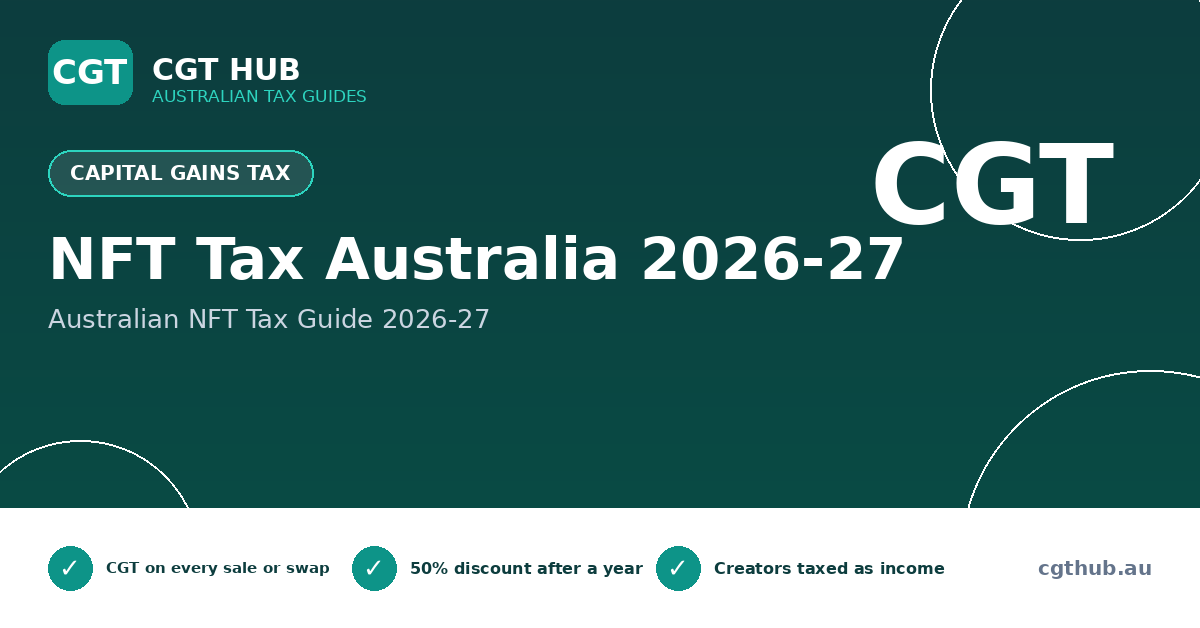
Yes, NFTs are taxable in Australia. For most people who buy an NFT hoping it goes up in value, it is a capital gains tax (CGT) asset — sell it, swap it or give it away and you have a CGT event. Hold it for more than 12 months and the 50% CGT discount can halve the taxable gain. If you create and sell NFTs as a business, the money is ordinary income instead, and royalties keep coming in as income even after you stop.
The trap most people miss is the purchase itself. Buy an NFT with Ethereum or another cryptocurrency and you trigger CGT on the crypto you spent — before the NFT has done anything at all. One purchase, two tax events. This guide works through the ATO’s rules for investors, creators and gamers, with worked examples in Australian dollars at real 2026-27 rates.
What is an NFT, for tax purposes?
A non-fungible token is a unique digital token on a blockchain. Unlike a Bitcoin, which is interchangeable with any other Bitcoin, each NFT is one of a kind. NFTs typically record ownership of digital pictures or artworks, video clips, memes and items used in online games — but the ATO notes an NFT can represent an ownership interest in any tangible or intangible asset, even where the asset itself is stored outside a digital ledger.
The ATO updated its NFT guidance on 12 June 2026 (QC66097), and its position is simple: there are no special tax rules for NFTs. The tax treatment depends on your circumstances, the way you use the NFT and your reasons for holding it. The same NFT can be taxed three different ways in three different hands.
How NFTs are taxed: the three treatments
| How you hold the NFT | Tax treatment | When tax bites |
|---|---|---|
| Investor — bought to hold and sell for a profit | CGT asset | On disposal: sale, swap, gift or donation |
| Creator or business — minting and selling NFTs, or trading them as stock | Ordinary income / trading stock | When you receive payment, including royalties |
| Personal use — bought to use yourself (rare) | Personal use asset | Often no tax at all — see below |
Most readers of this guide are in the first row. The rest of this article is written for investors first, then covers creators, gamers and the edge cases.
When does CGT apply to an NFT?
A CGT event happens when you dispose of the NFT. Disposal is broader than selling. Any of these triggers it:
- Selling the NFT for Australian dollars or another cryptocurrency
- Swapping one NFT for another NFT, or for crypto
- Gifting the NFT — treated as a disposal at market value, even though you received nothing
- Donating it
- Losing it — if the NFT is stolen or permanently lost, you may be able to claim a capital loss (with evidence)
These do not trigger CGT:
- Buying an NFT with Australian dollars — no disposal, no gain
- Holding an NFT while its price moves — unrealised gains are not taxed
- Moving an NFT between wallets you own — no change of ownership, no disposal. But watch the fee: if the network fee is taken out of your crypto holding, that slice is a disposal of the fee amount, with capital gain consequences
The double tax event nobody warns you about
Pay for an NFT with crypto and the ATO sees two separate disposals. First, you dispose of the crypto you spent — if that crypto has gone up since you bought it, the gain is taxable right there. Second, you acquire the NFT, and its cost base is the Australian-dollar value of the crypto at the moment of the trade, plus gas and marketplace fees. The worked example below puts real numbers on this: Maya’s single NFT purchase creates a $2,000 gain on her Ethereum before she has even owned the NFT for a day.
Working out your capital gain or loss
The formula is the same as for shares or property:
Capital gain (or loss) = capital proceeds − cost base
Capital proceeds are what you receive — or the market value of what you receive — in Australian dollars at the time of disposal. The cost base is what it cost you to acquire and dispose of the NFT:
- The purchase price in Australian dollars (the AUD value of any crypto you paid, at the time of the trade)
- Gas fees, marketplace fees and auction fees paid to buy it
- Fees paid to sell it
- Incidental costs such as legal or valuation fees, if any
Every figure must be converted to Australian dollars at the time of each transaction. A record that says “sold for 3 ETH” is not enough — you need the AUD value on the day. Keep the exchange or marketplace record; if the platform is gone, a reputable price source for that date will do.
The 50% CGT discount
Individuals who hold a CGT asset for more than 12 months before disposing of it can discount the capital gain by 50% — only half the gain counts as assessable income. The 12 months are measured from acquisition to disposal, day for day. Sell on day 364 and you get nothing; sell on day 366 and you halve the gain. Companies do not get the discount, and super funds get a one-third discount instead.
One warning for long-term holders: from 1 July 2027 the 50% discount is abolished for individuals and replaced with CPI indexation of the cost base plus a 30% minimum tax on the gain. Gains that accrued before 1 July 2027 keep the old discount treatment — the change is prospective, not retrospective. If you are sitting on an NFT with a large unrealised gain, the timing of your sale now matters more than it used to. We cover the reform in full in our CGT reform 1 July 2027 guide.
2026-27 tax rates used in these examples
Australian resident rates for 2026-27 (excluding the 2% Medicare levy):
| Taxable income | Tax rate | Tax on this bracket |
|---|---|---|
| $0 – $18,200 | 0% | Nil |
| $18,201 – $45,000 | 15% | 15c per $1 over $18,200 |
| $45,001 – $135,000 | 30% | $4,020 + 30c per $1 over $45,000 |
| $135,001 – $190,000 | 37% | $31,020 + 37c per $1 over $135,000 |
| $190,001 and over | 45% | $51,370 + 45c per $1 over $190,000 |
Source: ATO individual income tax rates. The second bracket dropped from 16% to 15% on 1 July 2026 — several crypto tax guides still quote the old 16%, so check the year on anything you read. Capital gains are not taxed at a separate rate; the gain is added to your other taxable income and taxed at your marginal rate. That is why the same NFT sale can cost one person 15% and another 45%.
Try the numbers on your own sale with our CGT calculator — it applies the discount and your marginal rate automatically.
Worked example 1: the flip — and the hidden second gain
Maya earns a salary of $85,000. In August 2026 she buys 2 ETH at $3,000 each — $6,000 in total. In September she uses both ETH to buy an NFT when ETH is worth $4,000. In February 2027 she sells the NFT for 3 ETH when ETH is worth $5,000. Marketplace selling fees are $150.
Step 1 — the crypto she spent. Buying the NFT disposes of her 2 ETH. They cost $6,000 and were worth $8,000 at the trade, so she has a $2,000 capital gain on the ETH — even though she never cashed out to dollars.
Step 2 — the NFT’s cost base. The NFT cost $8,000 (the AUD value of the 2 ETH) plus $120 in gas fees: a cost base of $8,120.
Step 3 — the NFT sale. She receives 3 ETH worth $15,000, less $150 in fees. Capital gain = $15,000 − $150 − $8,120 = $6,730. She held the NFT for five months, so no 50% discount applies.
Step 4 — the tax. Her total capital gains are $2,000 + $6,730 = $8,730, added to her $85,000 salary for taxable income of $93,730. Her marginal rate is 30%, so the extra tax on the gains is roughly $8,730 × 30% = $2,619 (plus the 2% Medicare levy on the additional income). The NFT “profit” most people would quote — $15,000 received for an $8,000 asset — understates her taxable gain, because the ETH gain is taxed too.
Worked example 2: the 12-month discount
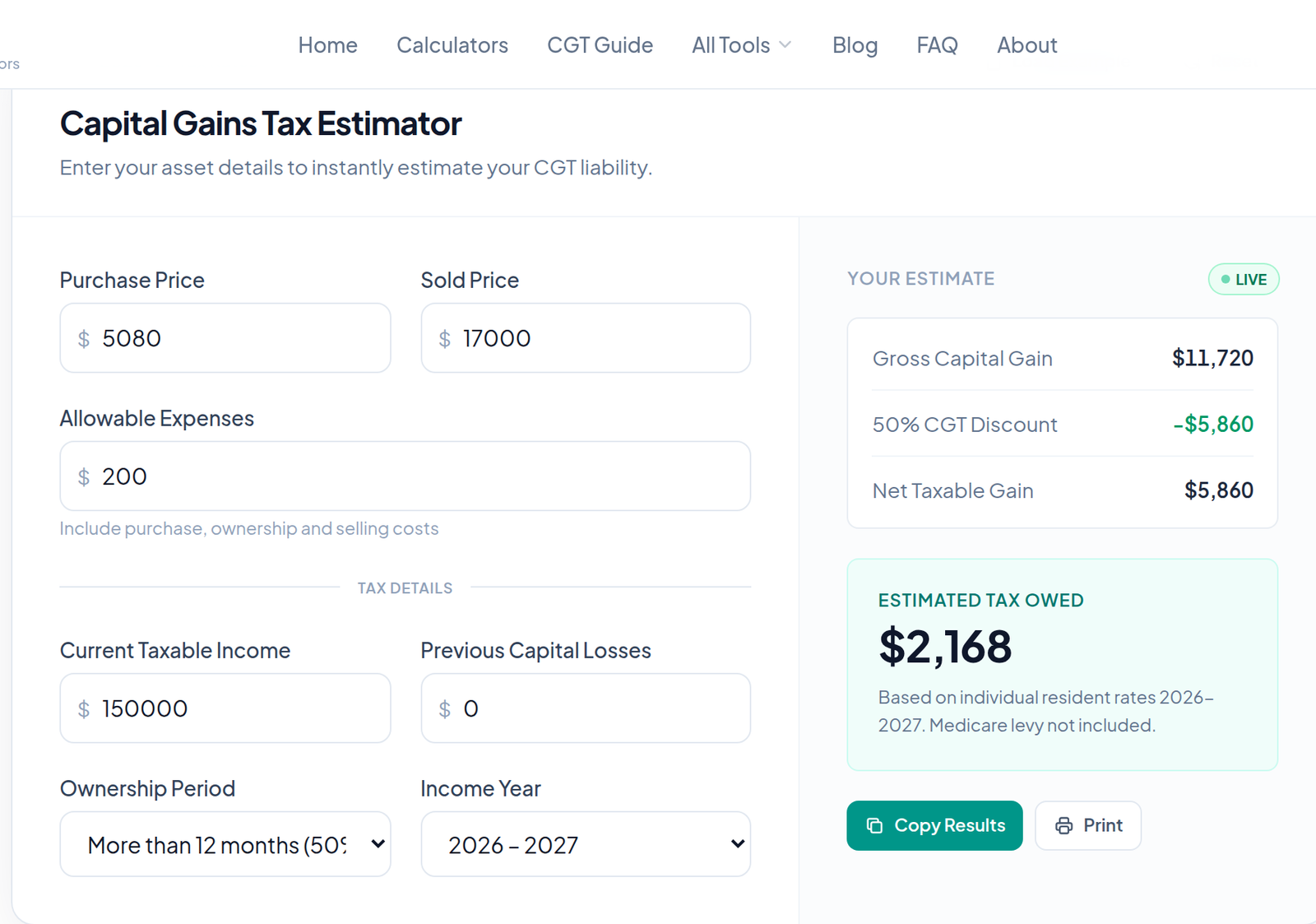
Liam buys an NFT with Australian dollars in October 2025 for $5,000, paying $80 in gas fees. His cost base is $5,080. He sells it in December 2026 — 14 months later — for $17,000, with $200 in selling fees.
Capital gain = $17,000 − $200 − $5,080 = $11,720. Because he held the NFT for more than 12 months, the 50% discount applies: only $5,860 is added to his assessable income. His other taxable income is $150,000, putting him in the 37% bracket, so the tax on the gain is about $5,860 × 37% = $2,168. Had he sold two months earlier, the full $11,720 would have been assessable and the tax would have roughly doubled to $4,336.
Note the timing: the discount as described here applies to disposals before 1 July 2027. After that date, indexation and the 30% minimum tax apply instead — check the reform guide linked above before timing a sale around the 12-month mark.
Worked example 3: the creator
Priya is a digital artist. She mints an NFT of her artwork and sells it for $12,000. Because she created it as part of her business, the $12,000 is ordinary income, not a capital gain — no 50% discount, no cost base, and the full amount is added to her taxable income. Her smart contract also pays her a 10% royalty on resales; when the NFT later resells for $20,000, she receives $2,000. That royalty is ordinary income too — and the ATO’s own example makes the point that it stays ordinary income even if she stops carrying on the business.
If her other income is $60,000, her taxable income becomes $74,000 and the extra $14,000 is taxed at her 30% marginal rate: about $4,200. Her NFT turnover is $14,000, well under the $75,000 GST registration threshold, so no GST. Cross $75,000 of turnover and she must register for GST and charge 10% on her sales — and if she sells through a marketplace, the platform may be responsible for GST on sales it facilitates for offshore sellers to Australian consumers.
Worked example 4: the loss
Tom buys an NFT for $9,000 plus $100 in gas — a cost base of $9,100. The project collapses and he sells for $4,000, paying $100 in fees. His capital loss is $4,000 − $100 − $9,100 = $5,200.
A capital loss cannot be deducted against salary or wages. It can only offset capital gains — in the same year, or carried forward to future years indefinitely. If Tom also sold shares at a $5,200 gain that year, the loss wipes it out. If he has no gains, the loss sits on his record until he does. Keep the records: a carried-forward loss is only useful if you can prove it.
When an NFT is a personal use asset
In rare circumstances, an NFT can be a personal use asset — something you bought mainly to use or enjoy yourself, not to profit from. The ATO gives two examples:
- Jo buys an NFT that gives her the right to a private viewing of a portrait in a gallery each year, and uses it to celebrate a family birthday. For Jo, the NFT is a personal use asset.
- Jude is a gamer whose NFT cards are rewards he uses inside the game. The cards are personal use assets. Because he has no rights to the artwork on the cards, they are not collectables.
The payoff: a capital gain on a personal use asset is disregarded if the asset cost $10,000 or less to acquire. The catch: a capital loss on a personal use asset is always disregarded, so you cannot use it. And if the NFT does carry rights to the underlying artwork, it may be a collectable instead — gains and losses on collectables acquired for $500 or less are disregarded. Most NFTs bought on a marketplace as an investment will not qualify. Do not assume yours does.
NFTs in a business, and GST
If you run a business that creates or trades NFTs, the tokens are trading stock or business assets, not CGT assets held as an investor. The ATO’s example: Kim, a professional artist, sells 10 NFTs of her portrait as business income, and the commissions she receives on later resales are business income too. Osman, who buys one of Kim’s NFTs to use in his art-tour business, holds it as a CGT asset of the business.
On GST, an NFT is not a form of digital currency, so the digital-currency GST exemptions do not apply. Whether GST applies depends on whether the supply is taxable or GST-free — and if you operate an NFT marketplace as an electronic distribution platform, you are responsible for GST on sales you facilitate for offshore sellers to Australian consumers. If your enterprise turnover is under $75,000, GST registration is optional; over it, it is compulsory. Our GST guide for small business covers the registration rules.
Airdrops, staking rewards and free NFTs
Free is not the same as tax-free. If you receive an NFT as an airdrop and it is an established NFT with a clear market price, the market value is ordinary income when you receive it. If it is a new airdrop with no established market, you may not need to declare income — and your cost base is what you paid for it, which may be zero. Either way, the later sale is a separate CGT event measured from that cost base. The same logic applies to staking rewards and other crypto income: income when received, CGT when disposed of. See our crypto staking tax guide for the income side.
How to report NFTs in your tax return
In myTax, capital gains from NFT disposals go in the CGT section (item 18), and income from creating or selling NFTs as a business goes in as business or other income. The ATO expects you to keep records of every transaction for at least five years after you dispose of the asset. For each transaction, keep:
- The date and time of the transaction
- The Australian-dollar value at the time — of the NFT, of any crypto paid or received, and of any fees
- What the transaction was for (purchase, sale, swap, gift, fee)
- Exchange and marketplace records, wallet addresses and transaction hashes
- Your calculation of each capital gain or loss
The ATO data-matches crypto exchange data, and its 2026-27 compliance focus includes crypto and NFTs. If you are unsure whether your NFT art sales are a hobby or a business, the ATO Community answer to that exact question is worth reading — when does selling NFT artwork become taxable income? A return that omits an NFT sale the ATO already knows about is one of the fastest ways to get a please-explain letter — read our ATO data-matching guide and the audit triggers guide if that letter has already arrived.
The 2026-27 return is due 31 October 2027 if you lodge yourself; if you use a registered tax agent, the lodgment program generally gives you until 15 May 2028.
Common mistakes
- “I never cashed out, so there’s no tax.” Swapping one NFT or crypto for another is a disposal. The tax event happens at the swap, not at the bank withdrawal.
- Forgetting the crypto you spent. Paying with ETH is a disposal of the ETH. Price it in AUD at the time of the trade.
- Leaving gas fees out of the cost base. Gas, marketplace and auction fees are part of the cost base — and part of the proceeds calculation on sale.
- Claiming the 50% discount too early. Twelve months means twelve months. Day 364 gets nothing.
- Using stale tax rates. The 2026-27 second bracket is 15%, not 16%. Several crypto guides still show last year’s rate.
- Treating creator income as a capital gain. If you mint and sell as a business, it is ordinary income — no discount, and royalties keep coming.
- No records. “The exchange shut down” is not a defence. Export your history now, and keep it for five years after disposal.
- Ignoring the 1 July 2027 reform. The discount is going away. A sale timed for June 2027 is taxed very differently from one in July.
Frequently asked questions
Do I pay tax on NFTs if I only bought and never sold?
No. Buying with Australian dollars and holding are not CGT events. You pay tax when you dispose of the NFT — by selling, swapping, gifting or donating it. If you bought with crypto, though, the crypto you spent is taxed at the time of purchase.
Is swapping one NFT for another taxable?
Yes. A swap is a disposal of the NFT you give up and an acquisition of the one you receive, both valued in Australian dollars at the time. Two NFTs of equal value can still produce a taxable gain if the one you gave up cost you less.
How is an NFT different from crypto for tax?
It isn’t, in substance. The ATO treats NFTs as crypto assets and applies the same CGT framework. The differences are practical: NFTs are unique, so valuing them is harder; they can be personal use assets or collectables in ways a Bitcoin cannot; and creators earn royalties that have no equivalent in plain crypto.
What if my NFT was stolen or the project rugged?
If the NFT is stolen or permanently lost, you may be able to claim a capital loss — but you need evidence: the transaction history, the wallet records, any police report or platform correspondence. A token that is simply worthless because the project failed is still yours; the loss is only realised when you dispose of it, even for a nominal amount.
Do I need to register for GST to sell NFTs?
Only if you are carrying on an enterprise and your GST turnover reaches $75,000. Hobby creators and one-off investors do not register. If you do register, GST applies to your sales — and marketplace rules may make the platform responsible for GST on some transactions.
Does the 50% CGT discount apply to NFTs?
Yes, for individuals who hold the NFT for more than 12 months and dispose of it before 1 July 2027. After that date the discount is replaced by CPI indexation of the cost base and a 30% minimum tax on the gain, with pre-1 July 2027 accrued gains keeping the old treatment.
The bottom line
NFT tax in Australia is ordinary CGT with a few sharp edges: the crypto you spend is taxed, the swap you forgot is a disposal, and the creator’s income is not a capital gain at all. The rules reward two habits — holding for more than 12 months while the discount still exists, and keeping a record of every transaction in Australian dollars at the time it happened. Do those two things and the NFT section of your return is a calculation, not a crisis.
This article is general information, not personal tax advice. If your NFT activity is large, involves a business, or crosses into GST territory, speak to a registered tax agent.