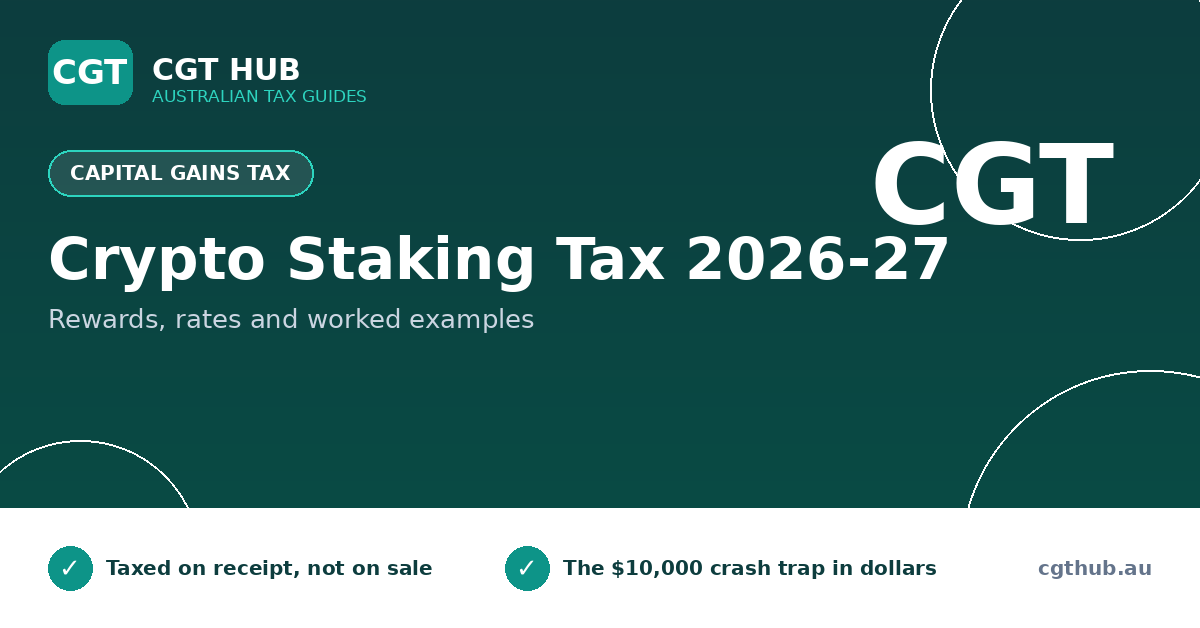
Quick answer: In Australia, crypto staking rewards are taxed as ordinary income the moment you receive them — not when you sell them. The ATO takes the Australian dollar value of the tokens on the day they land in your wallet, adds it to your taxable income at your marginal rate, and that same dollar value becomes the cost base of those tokens. If you later sell them for more, only the rise above that value is a capital gain. If they fall, the loss is a capital loss — and it can never be used to cancel out the income tax you already paid on the reward. That last point is the one that catches people out, and it’s the reason this guide exists.
This guide covers the 2026-27 rules for staking tax in Australia: how the ATO treats your rewards, three worked examples with real figures, when rewards count as “received”, liquid staking, restaking, the investor-versus-business line, what the 1 July 2027 CGT reform changes, and exactly where it all goes on your tax return.
How staking works, in one paragraph
Staking is how proof-of-stake blockchains — Ethereum, Solana, Cardano and the like — keep themselves running. You lock up some of your coins to help validate transactions, and the network pays you extra coins for it. The ATO calls the people who create new blocks “forgers”, but the tax treatment is the same whether you run your own validator, delegate to a staking pool, or tap “Earn” on an exchange: the extra tokens you receive are income. The coins you staked in the first place stay yours and nothing is taxed until you dispose of them — it’s only the rewards that trigger tax on receipt.
The ATO’s core rule
The ATO’s position is short and has not changed in years: crypto is a CGT asset, not money, and staking rewards are ordinary income. The ATO’s own “Staking rewards and airdrops” page says the money value of the additional tokens you receive is included in your ordinary assessable income at the time you receive the tokens, and the cost base of those tokens is their market value at that time. Two consequences follow that most guides rush past:
- The tax bill arrives before any cash does. You owe tax on the reward in the year you receive it, even if you never convert a single token to dollars. Your tax return doesn’t care that your “income” is still sitting in a wallet.
- Every reward is its own tax event. If your exchange credits you 0.02 SOL every day, that’s roughly 365 separate income events a year, each valued in Australian dollars on its own day. Your total staking income for the year is the sum of all of them.
| What happens | Tax treatment | When |
|---|---|---|
| Staking reward received | Ordinary income at AUD market value | The day you receive the tokens |
| Reward tokens later sold, swapped or spent | CGT event; gain = proceeds minus cost base (the receipt value) | The day you dispose of them |
| Reward tokens held more than 12 months, then sold | 50% CGT discount on the gain (for disposals up to 30 June 2027) | At disposal |
| DeFi interest earned | Ordinary income at AUD market value | The day you receive it |
| Airdrop received for goods or services | Ordinary income at market value | The day you receive it |
| Airdrop received as a hobby or entertainment freebie | Not assessable income — but cost base is still market value on receipt | At later disposal |
2026-27 tax rates used in this guide
All worked examples use the 2026-27 resident income tax rates, plus the 2% Medicare levy. The levy applies to your taxable income, so it applies to staking income too — but franking-style credits never reduce it, and the same applies here: there is no credit to offset it.
| Taxable income (2026-27) | Tax on this income |
|---|---|
| $0 – $18,200 | Nil |
| $18,201 – $45,000 | 15c for each $1 over $18,200 |
| $45,001 – $135,000 | $4,020 plus 30c for each $1 over $45,000 |
| $135,001 – $190,000 | $31,020 plus 37c for each $1 over $135,000 |
| $190,001 and over | $51,370 plus 45c for each $1 over $190,000 |
The examples ignore tax offsets to keep the maths visible — your actual bill may be lower if offsets apply. They also assume no Medicare levy surcharge.
Worked example 1: Maya, the small staker
Maya earns a $95,000 salary and stakes 100 SOL through an exchange. Over 2026-27 she receives 6.5 SOL in rewards, credited in small amounts through the year. The Australian dollar value of each credit on the day it arrived adds up to $1,820.
Her salary already puts her in the 30% bracket, so the staking income is taxed at 30% plus the 2% Medicare levy:
- Staking income: $1,820
- Income tax: 30% × $1,820 = $546.00
- Medicare levy: 2% × $1,820 = $36.40
- Total extra tax: $582.40
Two things worth noticing. First, Maya pays $582.40 even though she never sold a single SOL — the rewards are still sitting in her exchange account. Second, her cost base for those 6.5 SOL is $1,820. If she sells them later for $2,500, her capital gain is only $680, not $2,500. If she sells them for $1,200, she has a $620 capital loss, which can offset other capital gains but never her salary or her staking income.
Worked example 2: the “double tax” myth, in dollars
The most common complaint about staking tax is that the ATO taxes you twice — once when the reward arrives and again when you sell it. It feels that way, but the maths says otherwise. The two legs tax two different slices of value, never the same dollars.
Tom earns a $150,000 salary, putting him in the 37% bracket. On 15 August 2025 he receives 0.5 ETH in staking rewards, worth $2,400 that day. He holds the 0.5 ETH and sells it on 20 September 2026 for $3,600.
Leg one — income, August 2025 (FY2025-26):
- Ordinary income: $2,400
- Income tax: 37% × $2,400 = $888.00
- Medicare levy: 2% × $2,400 = $48.00
- Tax on the reward: $936.00
Leg two — capital gain, September 2026 (FY2026-27):
- Sale proceeds: $3,600; cost base: $2,400 (the receipt value)
- Capital gain: $1,200 — and he held the tokens for 13 months, so the 50% discount applies
- Taxable gain: $600
- Income tax: 37% × $600 = $222.00; Medicare levy: 2% × $600 = $12.00
- Tax on the gain: $234.00
Tom’s total economic gain is $3,600 — he paid nothing for the reward tokens and sold them for $3,600. His total tax is $936 + $234 = $1,170, or about 32.5% of the gain. The $2,400 was taxed once as income and never again; the $1,200 rise was taxed once as a discounted capital gain. That is not double taxation. It only feels like it because the first bill arrives a year before the cash does.
Worked example 3: the crash trap
This is the scenario that actually hurts people, and it’s the one most guides mention in a single sentence. Read it slowly, because the asymmetry is the whole point.
Priya earns a $95,000 salary and stakes heavily through 2026-27. Her rewards for the year total $10,000 in Australian dollar value on the days they were received. Her tax on that income:
- Income tax: 30% × $10,000 = $3,000.00
- Medicare levy: 2% × $10,000 = $200.00
- Total tax on the rewards: $3,200.00
Then the market falls. By 30 June 2027 her reward tokens are worth $3,000. She sells them all, crystallising a capital loss of $7,000 ($10,000 cost base minus $3,000 proceeds).
Here is the trap: a capital loss can only offset capital gains. It cannot reduce her salary, and it cannot reduce the $10,000 of staking income she already declared. The $7,000 loss carries forward indefinitely until she makes a capital gain to absorb it — but it does nothing for her 2026-27 return. Her position at the end of the year:
- Cash from selling the tokens: $3,000
- Tax already paid on the rewards: $3,200
- Capital loss carried forward: $7,000 (useful only against future capital gains)
She paid more in tax than the tokens are now worth. Nothing about this is a mistake or an ATO error — it is how the rules work when income is taxed on receipt and losses are quarantined to the CGT system. The practical lesson is unglamorous but real: if you stake a meaningful amount, set aside cash for the tax on each reward as it arrives, because a later price fall does not refund it. Some stakers sell a small slice of each reward as it lands to fund the tax bill; that sale is itself a CGT event, but on a slice whose cost base equals its sale price, so the gain is near zero.
When exactly are rewards “received”?
The ATO taxes rewards “at the time you receive the tokens”. In practice, receipt means different things on different platforms, and the distinction matters for which financial year the income lands in.
Exchange staking. When Binance, Coinbase, Kraken or a similar exchange credits rewards to your account — daily, weekly or monthly — that credit is receipt. Each credit is a separate income event valued in Australian dollars on that day. A year of daily credits is roughly 365 valuations, which is why almost everyone who stakes seriously uses crypto tax software to track them.
On-chain delegation. If you delegate SOL or ADA from your own wallet, rewards typically arrive in your wallet as new tokens. Receipt is when they land in your wallet. The same per-reward valuation applies.
Auto-compounding and restaking. Some protocols automatically restake your rewards so your stake grows without you touching anything. The rewards are still income when they are credited, even though you never held them as spendable cash and never saw a bank deposit. “I never withdrew it” is not a defence — the ATO’s test is receipt, not withdrawal.
Locked and unbonding rewards. This is the one genuine grey area. Some networks lock rewards for days or weeks before you can move them. The ATO’s guidance says rewards are income when received, and a credit to your staking account is generally treated as receipt even if an unbonding period applies before you can sell. But if rewards are genuinely not credited to you at all until a lock expires, the receipt date is arguable. For small amounts this rarely matters; for large locked balances, get advice before you lodge rather than guessing, and keep records of both the accrual date and the unlock date.
Liquid staking tokens: the question the ATO hasn’t answered
Liquid staking — depositing ETH and receiving stETH, or SOL and receiving jitoSOL — is where the guidance runs out. You hand over your coins and get a receipt token that grows in value or quantity as rewards accrue. The ATO has published no specific guidance on liquid staking tokens: no ruling on whether the swap itself is a disposal, whether rebasing rewards (where your stETH balance quietly grows) are income on each rebase, or how redemption is treated.
Until the ATO says otherwise, the practical approach most Australian tax practitioners take is to treat each rebase credit — each increase in your token balance — as ordinary income at its Australian dollar value on that day, exactly like a normal staking reward, and to treat the original swap as a CGT event if you disposed of the underlying coin. That is a defensible reading of the existing rules, not a settled one. Keep full records of every rebase and every swap, and flag it to your accountant — this is the single most likely area of staking tax to get a ruling in the next year or two.
Airdrops: the contrast that explains the rule
The ATO’s staking page also covers airdrops, and the distinction it draws is worth understanding because it shows how the ATO thinks. If you receive airdropped tokens as a reward for providing goods or services — promoting a project, testing a platform, doing work — the market value is ordinary income, exactly like a staking reward. But if you receive an airdrop as a hobby or entertainment freebie, with no work attached, you do not include its value in your income at all. Either way, the cost base of those tokens is their market value on the day you received them, so a later sale is still a CGT event.
The staking rule follows the same logic: you are being paid for a service — helping secure the network — so the payment is income. There is no hobby exception for staking.
Investor or business? The line that changes everything
Most stakers are investors. But the ATO can treat you as carrying on a business of staking or mining if you operate at scale — running validators, holding large staked balances, with a commercial setup and a profit-making intention. The consequences are significant:
- Investor: rewards are ordinary income; a later sale is a CGT event; the 50% discount applies if you hold the reward tokens for more than 12 months; you cannot deduct the cost of your validator hardware or electricity as a business expense (though some costs may be deductible as the cost of earning income).
- Business: rewards are ordinary business income; the tokens are trading stock, not CGT assets; there is no 50% CGT discount at all; but validator costs, hosting, electricity and software are deductible business expenses, and losses are deductible against other income.
There is no dollar threshold that flips you from one to the other. The ATO looks at scale, organisation, repetition and intention — the same tests it applies to share traders. If you are running multiple validators, paying for dedicated servers and treating staking as a profit-making operation, talk to an accountant before you lodge as an investor. Getting the classification wrong is the kind of error the ATO’s data-matching program is built to find.
What the 1 July 2027 CGT reform changes — and what it doesn’t
From 1 July 2027, the 50% CGT discount is being replaced with cost base indexation and a 30% minimum tax on capital gains. For staking, that changes only the second leg of the tax — the CGT on a later sale. The income leg does not change at all: rewards will still be ordinary income at their value on receipt.
What it means in practice: if you received staking rewards before 1 July 2027 and sell them after that date, the gain that accrued before 1 July 2027 keeps the old 50% discount treatment, and only the gain after 1 July 2027 falls under the new indexation-plus-30%-floor rules. If you receive rewards after 1 July 2027 and later sell them, the whole gain is under the new rules. For long-term stakers this makes the 12-month holding clock less valuable than it used to be — but it does not change the basic advice: record the receipt value of every reward, because that value is your cost base under either system. Our full guide to the reform is at CGT Reform 1 July 2027 Australia.
Records and your tax return
The ATO’s crypto data-matching program has run since 2014-15 and now pulls transaction and account data directly from Australian exchanges. If your exchange has reported your staking rewards and your return doesn’t mention them, expect a letter. The records the ATO wants you to keep, for five years after you lodge:
- The date of every reward, the token and amount, and its Australian dollar value that day.
- The date and value of every disposal — sale, swap, spend or gift — and the proceeds.
- Exchange statements, wallet addresses and transaction hashes.
- Any fees paid, and the records behind any claim that you are carrying on a business.
On the return itself, staking rewards go at Item 24, Other income (or as business income if you are carrying on a business). The later disposal goes in the capital gains section (Section 18), the same place as a share sale. If you use myTax, the software prompts for both; the figures you need are the total reward income for the year and, for each disposal, the proceeds minus the receipt-value cost base.
If you receive an ATO letter about unreported crypto income, don’t ignore it — the data-matching program is the reason it arrived, and the ATO generally treats a prompt voluntary correction far better than a correction it has to chase.
Common mistakes
1. “I’ll declare it when I sell.” The most common error, and the most expensive. Rewards are income on receipt. Declaring them only at sale means the income year is wrong, the cost base is wrong, and the ATO’s data will disagree with your return.
2. Valuing a year’s rewards at one price. A year’s staking income is the sum of each reward valued on its own day, not the total tokens multiplied by the price on 30 June. In a volatile year the difference can be thousands of dollars.
3. Using the sale price as the cost base. If you sell reward tokens for $3,600, your cost base is the $2,400 they were worth when you received them — not zero, and not $3,600. A zero cost base overstates your gain; using the sale price wipes it out entirely.
4. Assuming the 50% discount applies to the reward itself. The discount applies to the capital gain on a later sale, never to the income. A reward held for two years is still fully taxable as income in the year it was received.
5. Treating a capital loss as a refund. As Priya’s example shows, a capital loss from crashed reward tokens cannot reduce your staking income or your salary. It can only offset capital gains, now or in a future year.
6. Forgetting DeFi interest. Interest earned through DeFi lending and liquidity pools is ordinary income on receipt, under the same rule as staking. It is the same mistake as number one, in a different protocol.
Tips for stakers
- Set aside tax as rewards land. If you are in the 30% bracket, put aside roughly a third of each reward’s value for tax. A price fall later won’t refund it.
- Use crypto tax software. Koinly, CryptoTaxCalculator and similar tools import exchange and wallet data and value each reward in Australian dollars on the day it arrived. For daily staking drips, doing it by hand is not realistic.
- Match rewards to your marginal rate before you stake more. An extra $5,000 of rewards on a $135,000 salary is taxed at 37% plus Medicare; the same rewards on a $40,000 salary are taxed at 15% plus Medicare. The after-tax return on staking depends on your bracket.
- Keep the receipt values forever, not just five years. Your cost base for reward tokens matters whenever you eventually sell them — which may be many years after the five-year record rule expires.
- Check whether your exchange reports to the ATO. Australian exchanges are designated service providers under the data-matching program. Assume your staking income is already known to the ATO, and lodge accordingly.
Frequently asked questions
Do I pay tax on staking rewards if I never sell them?
Yes. Rewards are ordinary income at their Australian dollar value on the day you receive them, whether or not you ever convert them to dollars. The tax bill for 2026-27 is due on the rewards you received in 2026-27, even if every token is still staked.
Is staking taxed as income or capital gains?
Both, at different times. The reward itself is ordinary income when received. If you later sell the reward tokens for more than their receipt value, the extra is a capital gain — discounted by 50% if you held them for more than 12 months and dispose of them before 1 July 2027.
How do I value staking rewards in Australian dollars?
Use the market value of the tokens in Australian dollars on the day you received them — the exchange rate or price your exchange shows for that day is the practical source. Each reward is valued on its own day, not at a year-end price.
What if my staking rewards lose value after I receive them?
You still pay income tax on the full value at receipt. If you then sell the tokens for less, the difference is a capital loss, which can only offset capital gains — it cannot reduce the income tax you paid on the reward. See Priya’s worked example above.
Are liquid staking tokens like stETH taxed differently?
There is no specific ATO guidance on liquid staking tokens yet. The practical approach is to treat each increase in your token balance as ordinary income at its Australian dollar value, and the original swap as a CGT event. Keep full records and get advice — this is the least settled corner of staking tax.
Where do staking rewards go on my tax return?
At Item 24, Other income, unless you are carrying on a business of staking, in which case it is business income. A later sale of the reward tokens goes in the capital gains section. Full detail is in our Crypto Tax Australia 2026-27 guide.
The bottom line
Staking pays you in tokens and the ATO taxes you in dollars, on the day the tokens arrive. That single rule — ordinary income at receipt value, cost base equal to that value, capital gain or loss only on the change after receipt — explains almost everything else: why daily drips are hundreds of tax events, why a crash after receipt doesn’t refund your tax, and why the “double tax” complaint doesn’t survive the arithmetic. Record every reward’s value on its day, set the tax aside as it lands, and the rest is bookkeeping. If you want the broader picture, start with our Crypto Tax Australia 2026-27 guide, our capital losses guide for what to do with a loss, and our 2026-27 income tax rates to find your bracket. You can also check what any of this means in dollars on our CGT calculator and income tax calculator.
This article is general information, not tax advice. Staking arrangements vary — particularly liquid staking and business-scale operations — so check your position with a registered tax agent before you lodge. ATO source: ato.gov.au — Crypto asset investments.