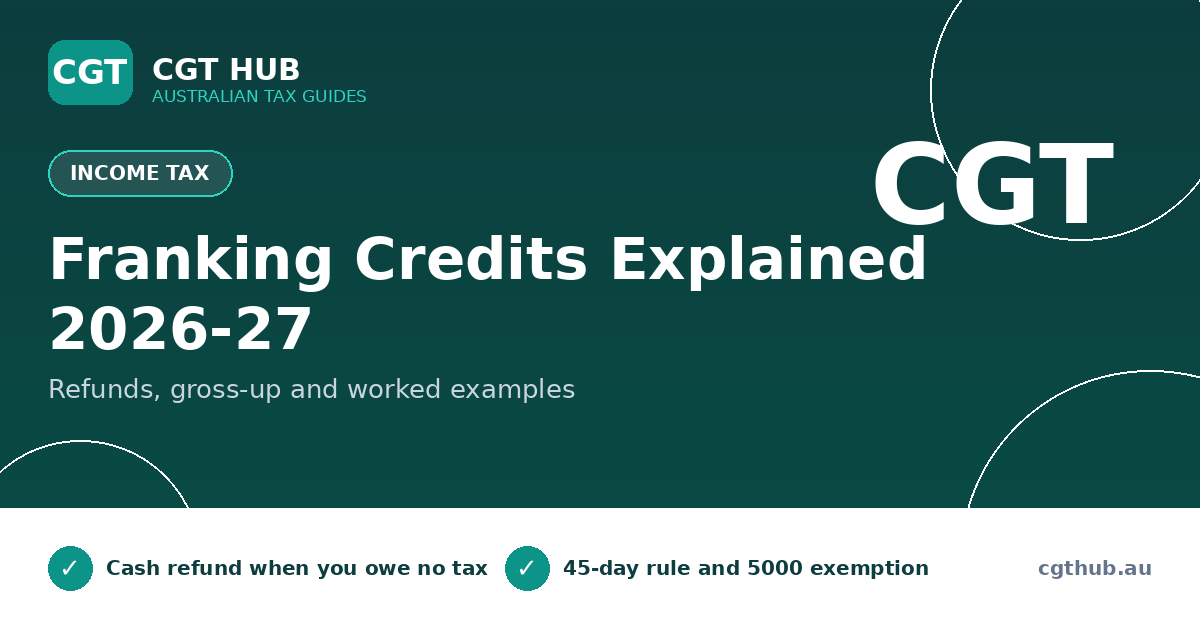
Quick answer: A franking credit is a receipt for company tax already paid. When an Australian company pays you a franked dividend, the tax it already paid on that profit comes with it as a credit — you declare the dividend grossed up by the credit, pay tax at your own marginal rate, and the credit comes off your bill. If the credit is bigger than your tax, the ATO refunds the difference in cash. In 2026-27 that refund is real money for retirees and low-income earners: a $7,000 fully franked dividend can come with a $3,000 cash refund if you owe no tax.
This guide explains how franking credits work in 2026-27, what a franked dividend is worth at every tax bracket, the 45-day holding rule, how to claim the refund — including without lodging a tax return — and the traps that quietly cost people money.
How franking credits work
Australia taxes company profits once, not twice. That’s the whole idea behind dividend imputation, introduced in 1987. A company pays tax on its profit — 30% for most large companies, 25% for base-rate entities — and when it distributes what’s left as a dividend, it can attach a franking credit equal to the tax already paid on that slice of profit.
Here’s the mechanics. Say a company taxed at 30% pays you a $70 fully franked dividend. The $70 is what’s left after the company paid $30 of tax on $100 of pre-tax profit. So the ATO treats you as if you received the full $100 and already paid $30 of tax on it:
- Franking credit = $70 × 30 ÷ 70 = $30
- Grossed-up dividend (what you declare as income) = $70 + $30 = $100
- You pay tax on $100 at your marginal rate, then subtract the $30 credit.
The formula works the same at either company rate: credit = franked dividend × company tax rate ÷ (1 − company tax rate). A $75 fully franked dividend from a company taxed at 25% carries a $25 credit, and you still declare $100. Same grossed-up income — but a smaller credit, which matters, as we’ll see below.
Fully franked vs partly franked vs unfranked
Fully franked means the company paid the full company tax rate on all the profit behind the dividend. Partly franked means only some of it — say 60% franked — carried credits, usually because some of the profit was earned overseas or the company hasn’t paid Australian tax on all of it. Unfranked means no credit at all: you simply pay tax on the cash at your marginal rate. Your dividend statement shows the franked amount, the unfranked amount and the franking credit separately — those three numbers are all the ATO needs.
What $1,000 of fully franked dividend is worth at every tax bracket
A $1,000 fully franked dividend from a 30% company carries a $428.57 credit, so you declare $1,428.57 of income. What you actually keep depends entirely on your marginal rate in 2026-27 — and note the last column, because the credit never touches the Medicare levy:
| Your marginal rate (2026-27) | Tax on the grossed-up $1,428.57 | Less franking credit | Medicare levy (2%) | You keep of the $1,000 |
|---|---|---|---|---|
| 0% (under $18,200) | $0 | −$428.57 | $0 | $1,428.57 |
| 15% ($18,201–$45,000) | $214.29 | −$428.57 | $28.57 | $1,185.71 |
| 30% ($45,001–$135,000) | $428.57 | −$428.57 | $28.57 | $971.43 |
| 37% ($135,001–$190,000) | $528.57 | −$428.57 | $28.57 | $871.43 |
| 45% (over $190,000) | $642.86 | −$428.57 | $28.57 | $757.14 |
Two things jump out. First, the 30% bracket is the break-even point: the credit exactly cancels the income tax, and only the 2% Medicare levy comes out. Second, at 0% and 15% you end up with more than the cash dividend — that’s the refund at work. The credit is a tax offset against income tax only; it never reduces the Medicare levy, and it doesn’t reduce HELP repayments either. Both are calculated on your income, which the gross-up has just increased.
Why some investors get cash refunds
Since 1 July 2000, excess franking credits have been refundable in cash. If your credits are bigger than the tax you owe, the ATO pays you the difference instead of just zeroing your bill. That’s why franked dividends are so valuable to retirees living on a tax-free super pension, and to low-income earners: they may owe no income tax at all, yet still receive a refund cheque for every dollar of franking credit.
It also means franking credits can never be “wasted” by having too little income — but they can’t be banked either. There is no carry-forward: in any given year, your credits either offset your tax or come back as a refund. Unused credits don’t roll into next year, because there’s nothing left to roll — the refund already paid them out.
Step-by-step: claiming your franking credits in 2026-27
Step 1 — Read your dividend statements
Every dividend or distribution statement shows the franked amount, unfranked amount and franking credit. Keep them all — you’ll need the figures from every company and fund that paid you during the year, including managed funds, whose annual AMIT statements pass franking credits through to you. The ATO also receives this data from share registries, so myTax usually pre-fills it — but check the pre-fill against your statements, especially for dividends paid late in June, which sometimes land in the wrong year.
Step 2 — Declare the grossed-up dividend
On your tax return, dividends go at item 11. You declare the cash dividend plus the franking credit as assessable income, and the credit itself as a tax offset. In practice myTax does the arithmetic once the pre-filled figures are confirmed. Remember the timing rule: you declare a dividend in the year it was paid or credited to you, as shown on the statement — not the year the statement happens to relate to.
Step 3 — If you don’t need to lodge a return
You can still get your refund. The ATO’s Refund of franking credits application (form NAT 4105) is for people who don’t need to lodge a tax return — you apply online through myGov linked to ATO online services, by phone, or by post. To use it you must be an Australian resident for tax purposes for the whole income year and your total dividend income must be $18,200 or less (or $416 or less if you were under 18 on 30 June). If you don’t meet all the criteria, you’ll need to lodge a tax return to claim the credits instead.
Step 4 — Watch for the automatic refund
During tax time 2026 the ATO started automatically refunding franking credits to eligible people, using information share registries report to it. You may be eligible if you’re over 60 on 30 June 2026, you held the same parcel of shares for the last two income years, you were a resident for the whole year, your refund is $5,460 or less, and the ATO has your current postal address. Refunds issue from mid-July, most finalised by August. If you qualify and don’t want the automatic refund, phone 13 28 65 to opt out — otherwise, you don’t need to apply at all.
The 45-day holding rule
You can’t buy shares the day before a dividend, collect the franking credits and sell the next day. To claim a credit you must be a “qualified person”, and the main test is the holding period rule: you must hold the shares at risk for at least 45 continuous days — 90 days for certain preference shares — not counting the day you bought or the day you sold. Days when your risk is materially reduced, for example because you’ve hedged the position with options, don’t count. A separate related-payments rule can also deny the credit if you’ve passed the benefit of the dividend on to someone else.
Most everyday investors never need to think about it, thanks to the $5,000 small shareholder exemption: if your total franking credit entitlement for the year is under $5,000, the holding period rule doesn’t apply to you. At a 30% company rate, $5,000 of credits is roughly $11,667 of fully franked dividends — a big portfolio. But the exemption has two catches. First, it’s on your total credits for the year, not per company — one large special dividend can push you over the line. Second, it’s for individuals only: super funds don’t get it, so an SMSF trustee should assume the 45-day rule applies to every parcel. If you fail the test, you lose the whole credit on that parcel — you still keep the cash dividend, just without the imputation benefit.
Worked example 1: Margaret’s $3,000 refund
Margaret is retired. Her super pension is tax-free, and she has no other taxable income. During 2026-27 she receives $7,000 of fully franked dividends from a large Australian company taxed at 30%.
- Franking credit: $7,000 × 30 ÷ 70 = $3,000
- Grossed-up income: $7,000 + $3,000 = $10,000 — below the $18,200 tax-free threshold, so her income tax is $0, and her income is below the Medicare levy low-income threshold, so no levy either.
- Refund: the full $3,000 credit comes back as cash.
Margaret keeps $7,000 + $3,000 = $10,000 from a $7,000 dividend. The refund is the entire point of franking credits for low-income shareholders — and it’s why the refund application exists for people who don’t lodge a return at all.
Worked example 2: James at $90,000 — the break-even
James earns a $90,000 salary and receives the same $7,000 fully franked dividend. His marginal rate is 30%.
- Grossed-up dividend: $10,000, taking his taxable income to $100,000.
- Extra income tax before the credit: 30% × $10,000 = $3,000 — exactly cancelled by his $3,000 franking credit. Income tax effect: $0.
- Extra Medicare levy: 2% × $10,000 = $200 — the credit can’t touch this.
James keeps $7,000 − $200 = $6,800. At the 30% bracket the credit does its job perfectly on income tax — but the gross-up quietly adds $200 of Medicare levy. People who say “franked dividends are tax-free at my rate” usually forget that $200.
Worked example 3: Priya at $220,000 — the top-up
Priya earns $220,000 and receives $14,000 of fully franked dividends from a 30% company.
- Franking credit: $14,000 × 30 ÷ 70 = $6,000; grossed-up dividend $20,000; taxable income $240,000.
- Extra tax on the grossed-up amount: 45% income tax + 2% Medicare = 47% × $20,000 = $9,400.
- Less the credit: $9,400 − $6,000 = $3,400 extra tax.
Priya keeps $14,000 − $3,400 = $10,600. Above the 30% company rate, the credit only partly covers the bill — but she’s still better off than with an unfranked dividend, where the same $14,000 would have cost her $6,580 in extra tax (47% × $14,000).
The 25% trap: same dividend, smaller credit
Not every company pays 30%. Base-rate entities — generally smaller companies — pay 25%, and their dividends carry a smaller credit for the same grossed-up income. Take a $7,500 fully franked dividend from a 25% company: the credit is $7,500 × 25 ÷ 75 = $2,500, and the grossed-up income is still $10,000. For James at the 30% bracket, the tax on that $10,000 is $3,000 but the credit is only $2,500 — so he pays a $500 top-up plus $200 Medicare, keeping $6,800 of his $7,500 dividend. Compare that with the 30% company, where he also kept $6,800 — but from a $7,000 dividend. Same dollars kept, yet a bigger cash dividend was needed to get there: the 25% franked dividend is simply worth less after tax. The lesson: two “fully franked” dividends are not equal. Check the company tax rate on the statement, not just the franking percentage.
Franking credits in super
Super funds claim franking credits through the fund’s tax return, and the maths is generous because fund tax rates are low. In accumulation phase the fund pays 15% tax, so a $7,000 fully franked dividend (a $3,000 credit on $10,000 grossed-up) costs $1,500 in tax and produces a $1,500 refund to the fund. In pension phase the fund pays 0% tax, so the whole $3,000 comes back. That’s why franked Australian shares are a staple of retirement-phase SMSFs — but remember, the fund gets no $5,000 small-shareholder exemption, so the 45-day rule applies to every parcel the fund holds.
7 common mistakes that cost real money
1. Forgetting the gross-up. The credit is not free money on top of the dividend — you declare the dividend plus the credit as income. People who budget on the cash dividend alone get a surprise at tax time, especially above the 30% bracket.
2. Assuming the credit covers the Medicare levy. It doesn’t. The levy is charged on your grossed-up taxable income, so franked dividends can actually increase your levy — and your HELP repayment, which is also calculated on a grossed-up income measure.
3. Tripping the 45-day rule over $5,000. The exemption is on total credits for the year. A special dividend that pushes you past $5,000 can suddenly make the holding period rule apply to parcels you bought just for the dividend.
4. Claiming New Zealand imputation credits. Only Australian franking credits qualify. NZ imputation credits shown on a statement from a New Zealand company can’t be claimed or refunded — a common error for dual-listed shares.
5. Thinking a dividend reinvestment plan avoids tax. Reinvested dividends are still income in the year they’re paid, franking credits included. The DRP just changes what happens to the cash, not the tax.
6. Buying just for the dividend. Chasing a franked dividend by buying before the ex-dividend date usually means buying at a price that already reflects the payout — the share price typically drops by roughly the dividend amount on the ex-date. The credit doesn’t make a bad purchase good.
7. Trusting the pre-fill blindly. myTax pre-fills dividend data from share registries, but late-June dividends and managed-fund distributions are the most common errors. Check the pre-fill against your statements before lodging — the ATO holds you responsible for the figures, not the registry.
Recent change: dividends funded by capital raisings
A November 2023 integrity measure stops companies attaching franking credits to dividends funded by capital raisings — the practice of raising new capital and immediately paying it back out as a “franked” dividend. Relatedly, listed companies can no longer distribute franked dividends through off-market share buybacks announced after 25 October 2022. Neither change affects ordinary dividends from ordinary profits, but if a company announces a capital raising alongside a special franked dividend, treat the franking with suspicion and check the statement when it arrives.
FAQ
I pay no income tax — do I still get the franking credit refund?
Yes. Excess franking credits have been refundable in cash since 1 July 2000. If you owe no tax, the whole credit comes back — apply through your tax return, or through the ATO’s refund of franking credits application (NAT 4105) if you don’t need to lodge one.
Do I have to lodge a tax return to claim franking credits?
Not necessarily. If you don’t need to lodge a return, are an Australian resident for the whole year, and your total dividend income is $18,200 or less, you can use the ATO’s refund application online via myGov, by phone or by post. During tax time 2026 the ATO also began automatically refunding eligible over-60s. Otherwise, claim through your tax return.
Can I claim franking credits from previous years?
Yes — it is not too late. You can order the NAT 4105 application for the relevant year and lodge it by post. You can only lodge refund applications for previous years by post, not online.
I reinvested my dividends through a DRP. Can I still claim?
Yes. A reinvested dividend is still a dividend: you declare the cash amount plus the franking credit in the year it was paid, and claim the credit exactly the same way. The reinvestment only affects what happens to the money afterwards.
Do franking credits reduce my Medicare levy or HELP repayment?
No. Franking credits are a tax offset against income tax only. The Medicare levy and HELP repayments are calculated on your income — which the gross-up has increased — so franked dividends can slightly increase both.
Can I use franking credits from New Zealand shares?
No. Only Australian franking credits qualify for the offset and refund. New Zealand imputation credits don’t count, even when they appear on the same statement as Australian franking credits.
The bottom line
Franking credits are the reason Australian shares punch above their weight in after-tax income: a $7,000 fully franked dividend is really $10,000 of pre-tax profit, and your tax rate — not the company’s — decides what you keep. Below 30% the ATO pays you the difference; at 30% the credit cancels the income tax and only the Medicare levy bites; above 30% you top up the gap. The two things to get right are the 45-day holding rule once your credits pass $5,000 and declaring the grossed-up amount, not just the cash. Get those right, check your myTax pre-fill against your statements, and franked dividends do exactly what the system was designed for: tax the profit once, at your rate. Run the numbers for your own income with our income tax calculator before you buy for the dividend.
Further reading: Tax on Dividends Australia 2026-27 · CGT on Shares Australia · Managed Funds Tax Australia 2026-27 · Income Tax Rates Australia 2026-27 · ATO: How to apply for a refund of franking credits · ATO: What is a refund of franking credits?