The short answer
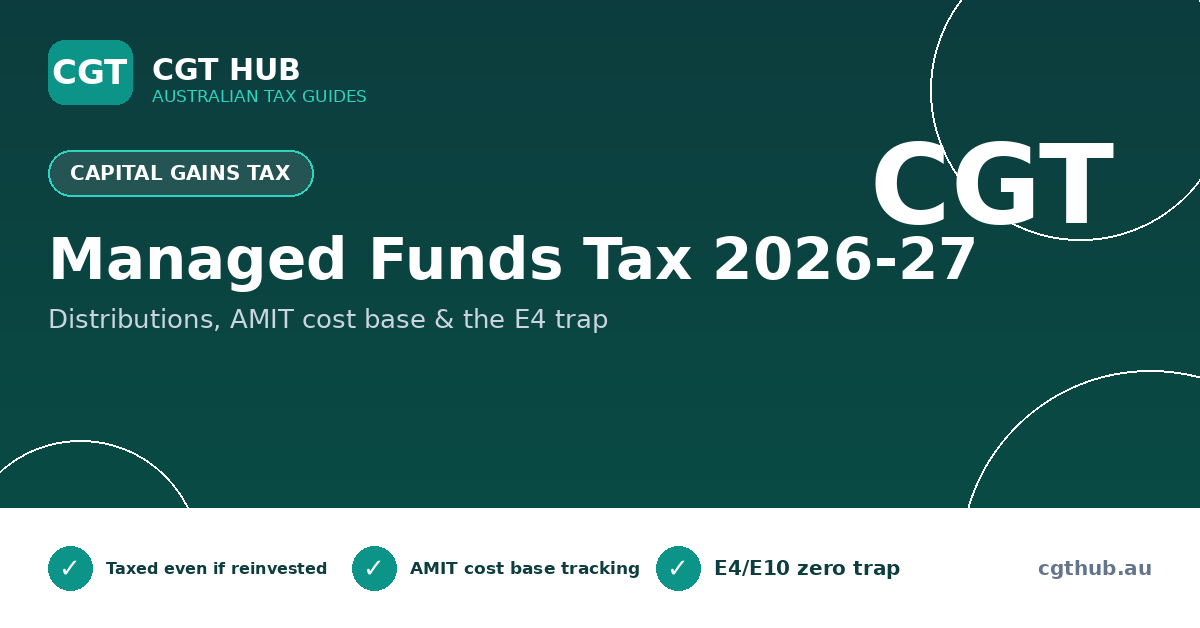
Quick answer: A managed fund does not pay tax itself. Every year it attributes its income and realised capital gains to you, and you pay tax on those amounts in your own return — whether the money arrived in your bank account or was reinvested. In 2026-27 the most common surprise is the gap between the two numbers: you can easily be taxed on $3,200 while only $2,500 reached you. The second surprise comes years later, when you sell: tax-deferred distributions quietly shrink your cost base, so the capital gain is bigger than you expect. Both are avoidable once you know where to look on your annual statement.
This guide walks through what a distribution actually contains, how the AMIT rules change your cost base each year, a full worked example with real 2026-27 figures, and the exact myTax steps to lodge it. It also covers the trap that catches long-term holders of property and infrastructure funds — and what the legislated 1 July 2027 CGT reform means for fund investors.
How a managed fund is taxed: the flow-through idea
When you buy units in a managed fund, you are buying into a trust. The trust earns interest, dividends and capital gains inside the fund, and at the end of the financial year it attributes a share of all of it to you. The fund itself pays no income tax on amounts it attributes to members. You do.
Three consequences follow from that one idea, and most of the confusion about managed fund tax comes from missing one of them:
- You are taxed every year, not just when you sell. The fund’s trading inside the year is attributed to you annually, whatever you did with your own units. Selling is a separate CGT event on top.
- Reinvested distributions are taxed exactly like cash ones. If you chose a distribution reinvestment plan, the distribution was still paid to you and then used to buy more units. That is legally what happened, and the tax bill is identical. The only difference is that the reinvested amount becomes the cost base of your new units.
- The cash you receive and the income you are taxed on are different numbers. A distribution can include amounts you are not taxed on yet (tax-deferred amounts), and it can exclude gains the fund made but kept. Your annual statement reconciles the two — if you read it.
That last point is the one that generates the most ATO Community questions every tax time. Someone receives $2,500 in cash and finds $3,200 of fund income on their prefill. Neither number is wrong. The rest of this guide explains why.
What is inside a distribution
Your annual distribution statement breaks the amount into components, and each component is taxed under its own rules. Here is what to expect on a typical Australian equities or diversified fund statement:
| Component | What it is | How it is taxed |
|---|---|---|
| Franked dividends | Dividends from Australian companies, with franking credits attached | Grossed up: dividend plus credit counts as income, then the credit offsets your tax |
| Unfranked dividends | Dividends without franking credits | Assessable in full at your marginal rate |
| Interest | Interest earned on the fund’s cash and fixed-interest holdings | Assessable in full |
| Capital gains | Gains the fund realised by selling assets during the year | Grossed up, then your 50% CGT discount applies if the fund held the asset 12+ months |
| Foreign income | Income from overseas holdings | Assessable, with a foreign income tax offset for tax already paid overseas |
| Tax-deferred amounts | Usually return of capital, or building allowances passed through from property holdings | Not taxed on receipt — but reduces your cost base (see the E4 trap below) |
| Tax-free and tax-exempt amounts | Small components on some statements | Not assessable; can reduce your reduced cost base |
The capital gains component deserves a closer look, because it trips people up. The gain reflects what the manager sold inside the fund during the year, not what happened to the unit price. Your units can fall in value and you can still be attributed a capital gain, because the fund sold winners while your units tracked the market down. And the reverse is true: a rising unit price with no internal sales produces no capital gain attribution at all.
Franking credits work the same way they do on shares you hold directly. If your fund attributes a $1,400 fully franked dividend, the attached credit is $600 (at the 30% company tax rate: $1,400 × 30/70). You declare $2,000 of income and claim the $600 as a tax offset. Our guide to tax on dividends works through the franking maths in full.
AMIT or not: which statement you get matters
Most large Australian managed funds — and almost all ETFs — have elected into the Attribution Managed Investment Trust (AMIT) regime. If your fund is an AMIT, your annual statement is called an AMMA statement (Attribution MIT Member Annual statement). If it is not, you get a standard distribution statement. The distinction matters because the cost base rules are different.
Under the AMIT rules, the trustee attributes an amount of assessable income to you, and you include the attributed amount in your return rather than the cash you received. The two amounts are then netted off, and the difference adjusts your cost base. When the income attributed to you is greater than the cash distribution, you have paid tax on income you have not received — so your cost base is increased to avoid double taxation when you sell. When the cash exceeds the attributed income, your cost base is decreased, because you received income you have not paid tax on.
The fund does this calculation for you. It appears on your AMMA statement as the AMIT cost base net amount — a single figure, positive or negative, that you apply to the cost base of your units at the end of each income year. You do not need to derive it from the components yourself, and you should not try: the ATO’s guidance on cost base adjustments for AMIT members says the trustee calculates it. Your job is to record it and carry it forward, year after year.
If your fund is not an AMIT, the older rules apply instead. Tax-deferred amounts reduce your cost base under CGT event E4, and if the cost base reaches zero, any further tax-deferred amounts become an immediate capital gain. The ATO’s Personal investors guide to capital gains tax, Part C: Distributions from managed funds works through both the AMIT and non-AMIT rules with its own worked examples. The AMIT equivalent is CGT event E10, triggered the same way when the AMIT cost base net amount drives your cost base to nil. Either way, the mechanism is the same: money you were not taxed on when you received it is collected later, through a bigger capital gain.
One practical check: look at your statement. If it says AMMA, the AMIT rules and E10 apply. If it is a standard distribution statement, E4 applies. Do not assume — the same fund manager can run AMIT and non-AMIT funds side by side.
Worked example: taxed on $3,200, received $2,500
Sarah earns a $95,000 salary and holds $60,000 of units in an Australian equities managed fund (an AMIT). Her 2026-27 AMMA statement shows the following. Her marginal tax rate is 30% (the 2026-27 bracket for $45,001–$135,000), plus the 2% Medicare levy — 32% on each extra dollar. Figures are the fund’s attributed amounts, not the cash she received.
| AMMA component | Amount | Assessable |
|---|---|---|
| Franked dividends | $1,400 + $600 franking credits | $2,000 |
| Unfranked dividends | $300 | $300 |
| Interest | $200 | $200 |
| Discounted capital gain (fund’s internal gains, $1,000 gross) | $1,000 gross | $500 after 50% discount |
| Foreign income (foreign tax paid $30) | $200 | $200 |
| Tax-deferred amount | $400 | $0 now — reduces cost base |
| Cash actually received | $2,500 | — |
| Total assessable income | — | $3,200 |
Now the tax bill:
- Tax on $3,200 at 30%: $960
- Less tax offsets: franking credits $600 + foreign income tax offset $30 = $630
- Income tax on the distribution: $960 − $630 = $330
- Plus Medicare levy, 2% of $3,200: $64
- Total extra tax: $394
Sarah received $2,500 in cash and owes $394 of tax on it — an effective rate of about 15.8% on the cash, because the franking credits did heavy lifting. If she had reinvested the whole distribution, the bill would be identical: $394, with no cash in hand to pay it from. That is the single most important planning point in this guide. Reinvested does not mean untaxed.
Before you sell any units, model the outcome first. Our CGT calculator lets you plug in the purchase price, sale price and your marginal rate and see the tax before you commit to the sale — including the 50% discount for assets held longer than 12 months. If you want the discount rules in detail, see our 50% CGT discount guide.
The cost base trap: tax-deferred distributions and CGT event E4
Tax-deferred amounts feel like free money. They arrive in your distribution, they are not taxed when you receive them, and nothing on your tax return mentions them. But they are not free. Every dollar of tax-deferred distribution reduces the cost base of your units. The tax is deferred, not forgiven — and for long-term holders of property funds, infrastructure trusts and REITs, where tax-deferred components are common because of building allowances and depreciation passed through from the trust, the bill can be large.
Here is how it plays out. Tom buys $20,000 of units in an unlisted property trust in 2021. The trust pays him $2,500 a year in tax-deferred distributions:
| Year | Tax-deferred received | Cost base after |
|---|---|---|
| 2021–22 | $2,500 | $17,500 |
| 2023–24 | $2,500 | $12,500 |
| 2025–26 | $2,500 | $7,500 |
| 2027–28 | $2,500 | $2,500 |
| 2028–29 (year 8) | $2,500 | $0 |
| 2029–30 (year 9) | $2,500 | $0 — and a $2,500 capital gain now |
Once the cost base hits zero, the mechanism flips. In year 9 the $2,500 tax-deferred distribution is no longer a cost base reduction — there is nothing left to reduce — so it becomes an immediate capital gain under CGT event E4 (or E10 for an AMIT). Held longer than 12 months, the 50% discount halves it to $1,250, which costs Tom $400 at his 32% marginal rate. And when Tom eventually sells, the gain is calculated against a nil cost base: sell for $30,000 and the whole $30,000 is a capital gain, halved to $15,000 by the discount.
Note what did not happen: Tom never made a capital loss from a non-assessable payment. The rules only ever reduce the cost base to zero and then convert the excess into a gain. The trap is not a loss — it is a much larger gain than expected, years after the money was spent.
Track your cost base every year — it pays real money
The AMIT cost base net amount is the figure most investors lose. It sits near the end of the AMMA statement, it is not part of the ATO prefill, and nothing in myTax asks you to enter it. But when you sell, it is the difference between paying tax on the right gain and paying tax on a gain you already paid tax on.
Take Sarah’s $60,000 parcel again. Say her AMMA statements show these cost base net amounts over three years — these are illustrative figures of the kind a fund reports:
| Year | AMIT cost base net amount | Cost base |
|---|---|---|
| Purchase | — | $60,000 |
| 2026–27 | +$850 | $60,850 |
| 2027–28 | −$300 | $60,550 |
| 2028–29 | +$1,100 | $61,650 |
If Sarah sells for $70,000, her capital gain is $70,000 − $61,650 = $8,350. Had she ignored the AMMA figures and used her original $60,000, the gain would be $10,000 — $1,650 more. After the 50% discount that is $825 of extra assessable income, or $264 of extra tax at her 32% rate, paid for no reason. Multiply that across a decade of statements and several funds, and the figure gets serious.
A simple spreadsheet is enough: one row per parcel (fund, purchase date, units, purchase price), and one column per year for the AMIT cost base net amount from each AMMA statement. Keep the statements themselves — the ATO can ask for them, and your accountant will want them. If you hold the same fund in multiple parcels bought at different times, track each parcel separately; the adjustment applies per parcel, and the 12-month discount clock runs per parcel too.
How to lodge it: myTax section 13 and question 18
Managed fund income goes in two places in myTax, and mixing them up is the most common lodgement error:
- Section 13 — Managed fund distributions. This is where the income components from your AMMA or distribution statement go: the franked amount, franking credit, TFN amounts withheld, assessable foreign income, foreign income tax offset, and the capital gains attributed by the fund (split into discounted and other). Follow the labels on your statement — the fund’s tax guide maps each line to a myTax label.
- Question 18 — Capital gains. This is where gains from your own sale of units go, plus the fund’s attributed gains flow through here as part of your net capital gain. Enter your current-year and carried-forward capital losses first, then gross gains; myTax applies the discount to the eligible remainder. Our capital loss carry-forward guide explains how losses from earlier years reduce this figure.
Two practical warnings. First, do not lodge the moment myTax opens. AMMA and managed fund data can be delayed into September or October — the ATO prefill is often incomplete for fund investors well after salary and bank interest have appeared. Lodging early with a missing AMMA means an amended return later. Second, prefill does not track your cost base. The ATO sees your trades and your distributions, but it cannot compute your cost base adjustments. That job is yours, and it is exactly the spreadsheet described above.
What changes on 1 July 2027
The 2026 Federal Budget legislated the biggest CGT change in 25 years, and it flows straight through to managed fund investors. From 1 July 2027, the 50% CGT discount ends for individuals, partnerships and trusts, and is replaced by CPI indexation of the cost base plus a 30% minimum tax on real capital gains. Gains accrued before 1 July 2027 keep the 50% discount, with assets valued at that date.
For managed funds this matters twice over. First, the fund’s own internal gains will be calculated under the new rules for the post-1-July-2027 portion, so the capital gain component on your AMMA statement will change character from 2027-28 onwards. Second, your own gain on selling units will be indexed rather than discounted for the post-reform portion. Super funds and companies are unaffected, and your main residence remains exempt. The full detail — including four worked examples under each system — is in our CGT reform 1 July 2027 guide. Nothing in this article’s 2026-27 figures changes: for the year you are lodging now, the 50% discount still applies in full.
Common mistakes
- Treating the cash received as the taxable amount. The assessable amount is what the fund attributed, not what hit your account. In Sarah’s example the gap was $700.
- Ignoring the AMIT cost base net amount. It is not in prefill and not in your return — but it decides your gain when you sell. Losing it means paying tax twice on the same income.
- Assuming reinvested means untaxed. A distribution reinvestment plan changes nothing about the tax. It only changes whether you have cash to pay it with.
- Entering the discounted gain instead of the gross gain. The fund attributes the gross capital gain; the discount is applied by you (or myTax) at question 18. Entering the already-discounted figure understates your gain — and the ATO’s data matching will notice.
- Lodging before the AMMA arrives. Fund statements land late July to September, sometimes October. Lodge on salary prefill alone and the fund income is missing.
- Selling without checking the cost base. Years of tax-deferred distributions can leave a cost base near zero. Check before you sell, not after — the E4/E10 gain cannot be undone.
Tips that save money
- Set money aside as distributions land. If your fund pays quarterly, put roughly a third of each distribution aside for tax — or ask your employer to vary your PAYG withholding upward so there is no lump sum at lodgement.
- Keep one spreadsheet per fund, per parcel. Purchase date, units, price, and the AMIT cost base net amount each year. Ten minutes a year; hundreds of dollars at sale.
- Check whether your fund is an AMIT before you assume the rules. AMMA statement means AMIT and E10; a standard statement means E4. The same manager can run both.
- Use losses deliberately. Capital losses you carry forward can offset capital gains attributed by your fund, not just gains from shares you sold yourself. Time a sale into a year when you have losses available.
- Read the fund’s tax guide, not just the statement. Every AMIT issues one with the AMMA statement, and it maps each line to the right myTax label. It is the single most useful document your fund sends you.
Frequently asked questions
I reinvested every distribution and received no cash. Do I still pay tax?
Yes. A reinvested distribution is taxed exactly as if you received the cash and used it to buy more units — because that is what happened. The reinvested amount becomes the cost base of the new units, and the tax bill is the same as if you had taken the cash.
Why was I taxed on more than I received?
Because the fund attributes income to you, and the attributed amount is what counts — not the cash. The fund may have realised capital gains it kept inside the fund, or attributed income it has not yet paid out. The difference is reconciled through your cost base, so you are not taxed twice: the AMIT cost base net amount increases your cost base by the income you were taxed on but did not receive.
Where does the AMMA cost base figure go in myTax?
Nowhere in the return itself. It is not a label you enter. You record it in your own cost base tracking and use it when you eventually sell the units, to work out the correct capital gain at question 18. That is precisely why so many people lose it.
Are tax-deferred distributions tax-free?
No. They are tax-deferred, which is a different thing. They reduce your cost base dollar for dollar, so the tax arrives later as a larger capital gain — or immediately as a gain under CGT event E4 (or E10 for an AMIT) once your cost base reaches zero.
Is a managed fund taxed differently from an ETF?
Almost always no. Most ETFs are themselves AMITs, so the same rules apply: an AMMA statement, attributed income, and annual cost base adjustments. The difference is practical, not legal — ETFs are listed so you can see the price daily, while unlisted managed funds price less often. Our ETF tax guide covers the listed side in detail.
What tax rate applies to my fund distributions?
Your marginal rate. Fund income is added to your other income, so a distribution can push you into a higher bracket. In 2026-27 the resident rates are 0% to $18,200, 15% to $45,000, 30% to $135,000, 37% to $190,000 and 45% above, plus the 2% Medicare levy. See our 2026-27 income tax rates guide for the full tables and worked examples.
Managed fund tax looks complicated from the outside, but it comes down to three habits: read the AMMA statement instead of the bank balance, record the cost base net amount every year, and check the cost base before you sell. Do those three and the fund does the rest — the tax bill holds no surprises, and the gain you declare when you sell is the gain you actually made.