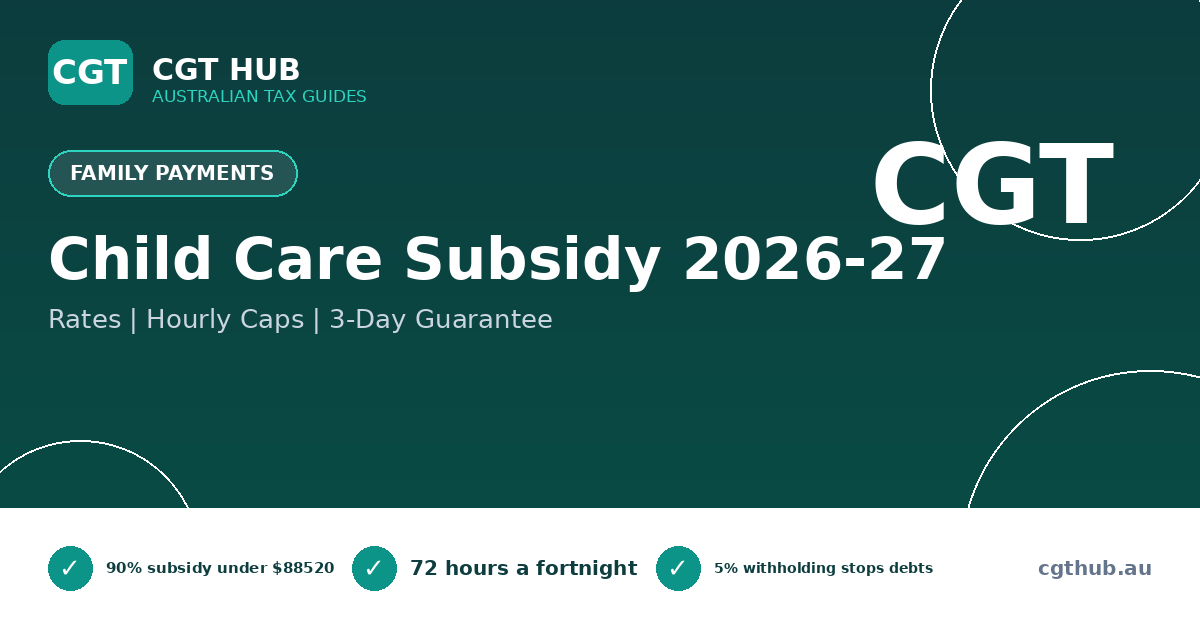
If you have a child in approved child care in Australia, the Child Care Subsidy (CCS) is probably the biggest piece of financial help you get all year – and the least understood. Here is the complete 2026-27 picture: an income test that changes every July, an hourly rate cap that limits what your percentage applies to, a new hours guarantee that replaced the old activity test in January 2026, and a 5% withholding that catches thousands of families off guard at tax time.
How Child Care Subsidy works
CCS is a government payment that covers part of your child care fees. It is paid directly to your provider, who reduces your bill – you only ever pay the gap. The amount depends on three things: your combined family income estimate (your CCS percentage), the type of care and its hourly rate cap (what your percentage applies to), and how many subsidised hours per fortnight your family can access (the 3-Day Guarantee).
To be eligible, you (or your partner) need at least 14% care of the child, you must be liable for the fees at an approved service, and you must meet the residency rules. Your child must meet immunisation requirements and generally be 13 or under and not in secondary school.
2026-27 CCS rates: income thresholds and subsidy percentages
Your CCS percentage comes from your family’s combined adjusted taxable income (ATI) estimate. The verified 2026-27 figures (effective 6 July 2026, per Services Australia’s CCS rates and thresholds):
| Combined family income | Standard CCS percentage |
|---|---|
| $0 to $88,520 | 90% (the maximum rate) |
| More than $88,520 and less than $538,520 | Between 90% and 0% – the rate falls 1% for every $5,000 of income above $88,520 |
| $538,520 or more | 0% – no CCS |
These thresholds are indexed to CPI each July. If you are comparing against something you read last year, be careful: the 2025-26 thresholds were lower, and several high-ranking articles still quote the old numbers. The figures above are the verified 2026-27 ones – using last year’s thresholds will give you the wrong percentage.
The rate is a formula, not bands
The “1% per $5,000” taper is a continuous formula, not stepped bands – the percentage is calculated continuously and rounded to two decimal places. A family income of $130,000 gives 90% – ($130,000 – $88,520) / $5,000 = 81.70%, not a round 82. It rarely changes your bill by more than cents, but it explains why an approved rate can look “odd”.
The higher rate for second and younger children
If you have more than one CCS-eligible child aged 5 or under in care, and family income is below $370,727, the second and younger children can get a higher CCS rate under a separate income test. The 2026-27 higher-rate tiers:
| Combined family income | Higher CCS percentage (2nd+ child) |
|---|---|
| $0 to $146,437 | 95% |
| More than $146,437 to below $191,437 | 95% down to 80% (1% per $3,000) |
| $191,437 to below $270,727 | 80% |
| $270,727 to below $360,727 | 80% down to 50% (1% per $3,000) |
| $360,727 to below $370,727 | 50% |
| $370,727 or more | No higher rate – all children use the standard rate |
Your eldest eligible child gets the standard rate; the younger ones get the higher rate. Note the age rule: only children aged 5 or under count for the higher rate.
2026-27 hourly rate caps
Your CCS percentage does not apply to your centre’s full fee – it applies to whichever is lower: the centre’s hourly fee or the government’s hourly rate cap for that type of care. Anything above the cap, you pay at 100%. The 2026-27 caps (from 6 July 2026):
| Care type | Cap – below school age | Cap – school age |
|---|---|---|
| Centre-based day care (long day care) | $15.19 / hour | $13.30 / hour |
| Outside school hours care (OSHC) | $15.19 / hour | $13.30 / hour |
| Family day care | $14.08 / hour | |
| In-home care | $41.31 / hour, per family (not per child) | |
This is the detail that causes the most “but I thought I got 90%” shock. Say your centre charges $185 a day for a 10-hour session – that is $18.50 an hour, well above the $15.19 cap. Your 90% subsidy applies to $15.19, and you wear the entire $3.31-an-hour difference yourself on top of your normal 10% gap. Always ask a prospective centre what its hourly fee is before you enrol.
The 3-Day Guarantee: how many hours you get
From 5 January 2026, the old activity test was replaced by the 3-Day Guarantee. Every CCS-eligible family now gets at least 72 hours of subsidised care per fortnight for each child (roughly three days a week), regardless of work, study or other activity. You can get 100 hours per fortnight per child if each parent has more than 48 hours of recognised participation per fortnight (paid work, study, training, volunteering – including commute time), if you care for an Aboriginal or Torres Strait Islander child, or if you have an exemption, exceptional circumstances or ACCS.
The guarantee changes nothing about how much subsidy you get – your percentage still comes from your income – but it removed the biggest access barrier for stay-at-home parents, casual workers and single-parent families. Hours above your subsidised hours are charged at full fee, and the guarantee does not guarantee a place – enrolment still depends on availability.
Worked example: the real dollars
Two parents, combined family income estimate of $120,000, one 2-year-old in centre-based day care. The centre charges $150 a day for a 10-hour session ($15.00 an hour – just under the $15.19 cap), three days a week.
Step 1 – the CCS percentage. $120,000 is in the taper zone: 90% – ($120,000 – $88,520) / $5,000 = 83.70%.
Step 2 – the hourly subsidy. $15.00 is under the $15.19 cap, so the subsidy is calculated on the full $15.00. Hourly CCS = 83.70% x $15.00 = $12.555. Daily CCS = 10 x $12.555 = $125.55.
Step 3 – the gap fee. $150.00 – $125.55 = $24.45 per day, or $73.35 a week.
Step 4 – hours and the withholding. Three 10-hour days a week = 60 hours a fortnight – comfortably inside the 72-hour guarantee. Fortnightly: fees $900, CCS $753.30, gap $146.70. But Services Australia withholds 5% of your CCS as a buffer, so what you actually pay is $184.37 out of pocket per fortnight while care is running. The withheld $37.67 a fortnight is released after end-of-year reconciliation – if your income estimate was right.
The 5% withholding and the balancing trap
Because CCS is paid during the year based on an estimate of your annual income, Services Australia reconciles – “balances” – your account after the financial year ends, once your actual income is known. If your estimate was too high, you get a top-up. If it was too low, you received more subsidy than you were entitled to – and you get a debt.
The default 5% withholding is meant to soften this, but it only covers a modest underestimate. Suppose the family above estimated $100,000 but actually earned $150,000 – a $50,000 miss, the kind that happens with a new job, a big bonus or a booming side business:
- At $100,000 estimated: CCS rate = 87.70%, daily subsidy = $131.55
- At $150,000 actual: CCS rate = 77.70%, entitled daily subsidy = $116.55
- Overpaid: $15.00 a day. Over 250 care days in a year = $3,750 overpaid
- 5% withheld during the year: 5% x $131.55 x 250 days = $1,643.75 – which offsets the debt
- Reconciliation debt: roughly $2,106
In this example the 5% buffer absorbs roughly a $20,000 underestimate – comfortable, but nowhere near $50,000. Every $5,000 of income you under-state costs you about 1% of your CCS rate for the whole year.
Two things that catch people out at balancing time: you (and your partner) must lodge tax returns – if you do not lodge, balancing cannot happen and your CCS is cancelled with a debt raised. And you can increase your withholding – if your income is variable (casual shifts, commission, freelance), raise it from 5% to 10% or 15% in your Centrelink online account. It costs cash flow during the year but buys a much bigger buffer against a debt.
Common mistakes families make
- Setting the income estimate once and forgetting it. A pay rise, a new job, overtime or a partner returning to work mid-year all change your CCS percentage. Update the estimate the week your circumstances change, not at tax time. If you are unsure where your combined ATI will land, our income tax calculator can help you model it.
- Ignoring the annual “confirm your details” message. Each year Services Australia asks you to confirm your family details so CCS can continue. Miss it and your CCS stops – you pay full fees until it is reinstated.
- Not confirming the enrolment in Centrelink. Your centre lodges the enrolment, but CCS is not paid until you confirm it in your Centrelink account.
- Thinking “72 hours guaranteed” means free care. The guarantee is about hours, not dollars. Gap fees and the hourly cap still apply.
- Claiming too late. A CCS claim can only be backdated 28 days from when you submit it. Start care without a claim and anything beyond 28 days is full-fee, with no way to recover it.
Tips to get the most from CCS
- Keep your income estimate current – review it every quarter if your income moves around, and any time a parent changes jobs or hours.
- Consider raising your withholding to 10-15% if your income is unpredictable. It is the cheapest insurance against a balancing debt.
- Lodge tax returns on time – balancing cannot finish until both parents’ returns are processed.
- Compare centres on the hourly fee, not the daily fee. A $150 day over 10 hours ($15.00/hr) is fully subsidised; a $165 day over 9 hours ($18.33/hr) is not.
Shared care and separated parents
If you are separated, both parents can claim CCS for the same child, provided each parent has at least 14% care of the child and each is liable for child care fees. Each parent makes their own claim and is assessed on their own family situation – their own income estimate, and their own (plus any new partner’s) activity. The two households can legitimately receive different CCS percentages for the same child. If only one of you pays the fees, only the fee-liable parent claims.
CCS during parental leave
Taking parental leave does not cancel your CCS. You can keep your child’s enrolment and subsidy while on paid or unpaid parental leave, as long as you still meet the eligibility basics. Under the 3-Day Guarantee, the old problem of “no work hours, no subsidised hours” has largely gone away anyway.
The part families miss: parental leave often drops your family income for the year – which can push your CCS percentage up. Update your income estimate in Centrelink; you could move from, say, a 70% rate to an 80% rate for the leave year. And if you are receiving Paid Parental Leave, its tax treatment matters for your adjusted taxable income – our guide to Paid Parental Leave and tax in 2026-27 explains the interaction.
Additional Child Care Subsidy (ACCS)
On top of standard CCS, the Additional Child Care Subsidy gives extra help to families who need it. It comes in four types:
- Child wellbeing – where a child is at risk of serious abuse or neglect; 100% of the fee up to 120% of the hourly rate cap, up to 100 hours a fortnight, activity-exempt.
- Grandparent carers – for grandparents on income support who are the principal carers; same generous terms.
- Temporary financial hardship – 100% of the fee up to 120% of the cap, 100 hours a fortnight, up to 13 weeks per event.
- Transition to work – 95% of the fee up to the cap for families moving from income support into work.
ACCS is not subject to the 5% withholding or reconciliation. If any of these situations sound like yours, talk to your provider or Centrelink.
Frequently asked questions
I am not working. Do I still get CCS hours?
Yes. Since 5 January 2026 the 3-Day Guarantee replaced the old activity test: every CCS-eligible family gets at least 72 subsidised hours per fortnight per child, whatever their work or study situation. The 100-hour level needs more than 48 hours of recognised activity per fortnight from each parent, a First Nations child, an exemption, or ACCS.
My income changed mid-year. What should I do?
Update your family income estimate in your Centrelink online account straight away. If your income went up and you do nothing, you will likely face a debt at balancing. If it went down, updating it raises your CCS percentage and cuts your gap fees from that point on. Do not wait until tax time.
How far back can I backdate a CCS claim?
A maximum of 28 days before you made an effective claim. Start care six weeks before claiming and the first two weeks are full-fee, with no way to recover them. Back payments are reimbursed to you directly, not to your centre.
We share custody. Who gets the subsidy?
Each parent who has at least 14% care and is liable for the fees claims separately and is assessed on their own income and circumstances. If only one parent pays the fees, only that parent claims.
What is the 5% withholding, and can I change it?
Services Australia holds back 5% of your CCS each fortnight as a buffer against overpayment, released after reconciliation if your estimate was accurate. You can raise it to 10% or 15% in your myGov/Centrelink account – worth doing if your income is casual, seasonal or commission-based.
Does CCS affect my tax return?
CCS itself is not taxable income. But your tax return drives balancing: Services Australia uses your actual adjusted taxable income to reconcile what you were paid against what you were entitled to. That is why both parents must lodge – even if one earned nothing. See our 2026-27 income tax rates guide and how to lodge a tax return guide.
The bottom line
The Child Care Subsidy in 2026-27 is more generous than most families realise – 90% up to $88,520 of family income, an hourly cap of $15.19 for long day care, 72 guaranteed hours a fortnight even if nobody is working, and a higher 95% rate for younger siblings in multi-child families. The two numbers that matter most are your income estimate and your centre’s hourly fee. Keep the first one honest and current, and check the second against the cap before you sign anything.
Rates and thresholds are for the 2026-27 CCS year (from 6 July 2026), verified against Services Australia’s CCS rates and thresholds and the Department of Education’s 3-Day Guarantee guidance. Your actual entitlement is assessed by Services Australia.