Quick answer: yes — Paid Parental Leave is taxable income in Australia. Every dollar of Parental Leave Pay lands in your taxable income for the year, and the ATO taxes it at your marginal rate like ordinary wages. The part that catches people out isn’t the rule itself — it’s the 15% flat tax Services Australia withholds by default when the payment comes directly from them. That 15% is just a withholding guess, not your tax rate. Depending on what else you earned that year, it can leave you with a surprise refund… or a surprise bill of several thousand dollars. Below: the 2026-27 rates, both payment paths, and the maths in real dollars.
How Parental Leave Pay works in 2026-27
Parental Leave Pay (PPL) is the Australian Government payment for parents of a newborn or newly adopted child, administered by Services Australia. For children born or adopted on or after 1 July 2026, the scheme reached its full size:
| 2026-27 detail | Figure (before tax) |
|---|---|
| Daily rate | $200.94 (the national minimum wage) |
| Weekly equivalent (5-day week) | $1,004.70 |
| Fortnightly | $2,009.40 |
| Maximum entitlement | 130 days (26 weeks) |
| Full entitlement, total | $26,122.20 |
| Reserved for your partner | 20 days — use it or lose it ($4,018.80) |
| Superannuation on PPL | 12% paid by the ATO after the financial year (~$3,135 on the full entitlement) |
The rate follows the minimum wage each 1 July, so leave straddling 30 June is paid at two daily rates. Days are flexible — blocks or single days, including weekends, any time before your child’s second birthday. An income test also applies (the published individual threshold is $186,487 — indexed, so confirm the current figure on Services Australia), plus a work test of 330 hours in 10 of the 13 months before the birth.
The two ways the money reaches you — and why it matters for tax
There are two payment paths, and they withhold tax differently:
- Through your employer. If you’ve been with your employer 12+ months and take a block of 8+ weeks, they may have to pass the government payment through payroll. Services Australia reimburses them — but for you it arrives like ordinary wages, with PAYG withheld at your normal payroll rate.
- Directly from Services Australia. If the employer path doesn’t apply, Services Australia pays you directly — and withholds a flat 15% from every payment unless you ask for a different rate.
Either way, the payment is taxable. The only difference is the withholding mechanics — and as the worked examples below show, that difference is where the surprises live.
How the tax on PPL is actually worked out
Think of it in two separate steps, because confusing them is the #1 mistake:
Step 1 — withholding (the guess). Tax taken from each payment before it reaches you: either your employer’s payroll tables or Services Australia’s flat 15%. Not your tax bill — a prepayment credited against it.
Step 2 — your actual liability (the truth). At tax time, the ATO adds your PPL to everything else you earned and taxes the total at the 2026-27 marginal rates: 0% to $18,200, then 15% to $45,000, 30% to $135,000, 37% to $190,000 and 45% above — plus the 2% Medicare levy where it applies.
Crucially, your PPL stacks on top of your other income. It doesn’t get its own concessional rate — the last dollar of PPL is taxed at whatever marginal rate your total income puts you in. That’s why the same $26,122 of PPL can produce a refund for one parent and a $4,000+ bill for another.
On your return, PPL is usually pre-filled in myTax — via Single Touch Payroll if it came through your employer, or a payment summary from Services Australia if it came direct. Check it’s there; don’t assume.
Worked example 1: PPL as your only income — the refund surprise
Meet Priya. She takes the full 130 days in 2026-27 and has no other income that year. Here’s her position:
- Gross PPL: 130 × $200.94 = $26,122.20
- Tax withheld (15% flat): $26,122.20 × 15% = $3,918.33
- Actual income tax: ($26,122.20 − $18,200) × 15% = $1,188.33
- Medicare levy: $0 — $26,122 sits under the 2026-27 single low-income threshold of $28,011
- Result: a refund of about $2,730
Why the refund? The 15% withholding ignores the $18,200 tax-free threshold — it taxes the first dollar, while the ATO taxes only dollars above $18,200. If PPL is most or all of your year’s income, the flat withholding over-withholds and the difference comes back. (Exception: a HECS/HELP debt can divert the refund — see below.)
Worked example 2: salary plus PPL — the shortfall bill
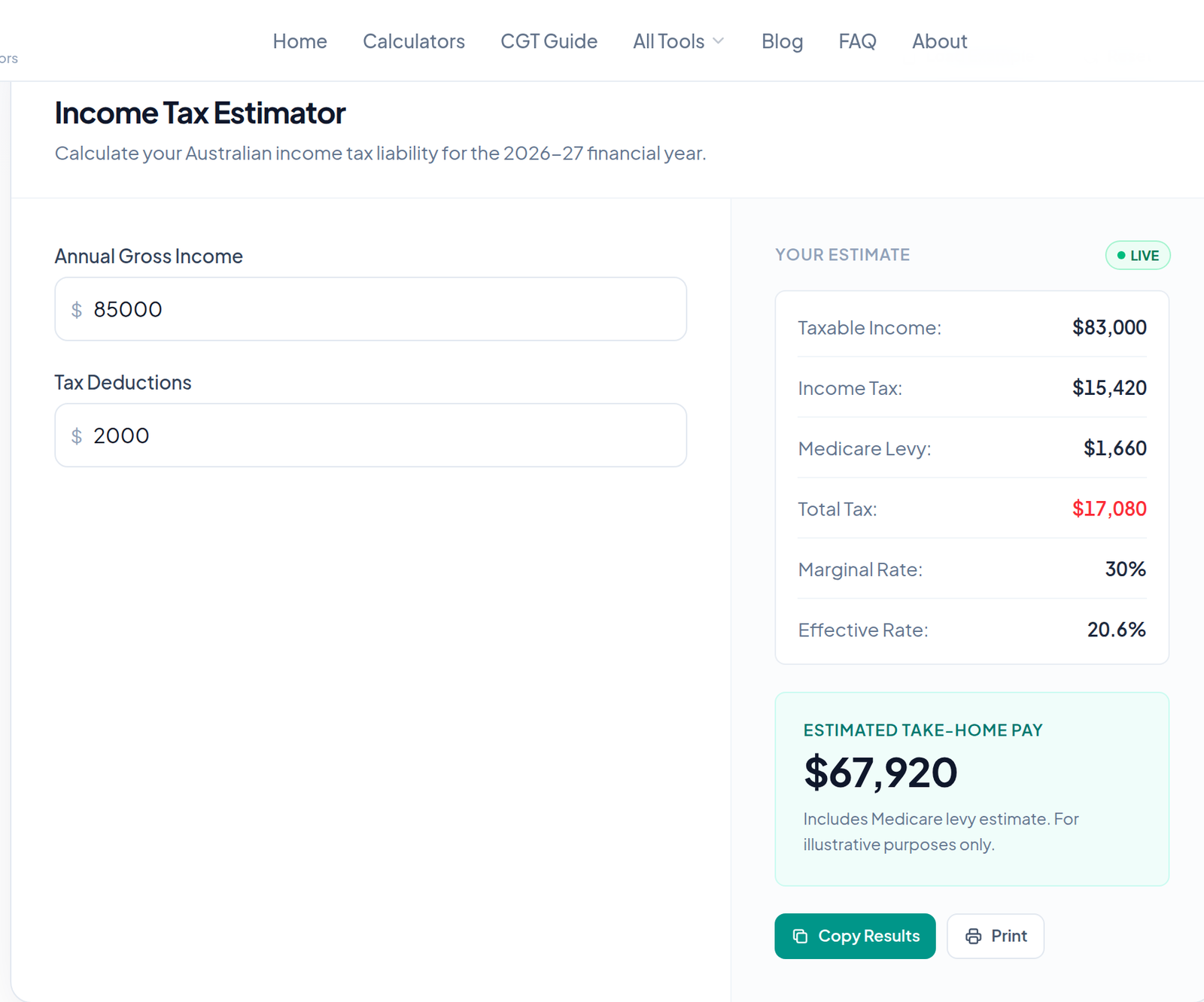
Now meet Daniel. Across 2026-27 he earned $85,000 all up — part salary, part Parental Leave Pay — and claims $2,000 of work-related deductions. Run it through our income tax calculator (screenshot below):
- Taxable income: $85,000 − $2,000 = $83,000
- Income tax: $4,020 + ($83,000 − $45,000) × 30% = $15,420
- Medicare levy: 2% × $83,000 = $1,660
- Total liability: $17,080
Now the withholding sting. Say $26,122 of Daniel’s $85,000 was PPL paid directly by Services Australia, with only the default 15% withheld: $3,918. But that PPL stacks on top of his salary at his 30% marginal rate — the real tax on the PPL portion is $7,837 of income tax plus $522 of Medicare levy = $8,359.
Shortfall on the PPL alone: roughly $4,441. His employer’s PAYG withholding on the salary was roughly right; the entire bill comes from the under-withheld PPL. This is the single most common PPL tax shock, and it’s entirely predictable once you see the stacking.
The HECS/HELP sting nobody warns you about
Here’s the trap that turns even Example 1’s refund into a bill. Parental Leave Pay counts as repayment income for HECS/HELP purposes — it sits inside your taxable income, which is the base the ATO uses for compulsory student-loan repayments. And the 15% Services Australia withholds does not cover HELP at all.
The real-world version: a parent on maternity leave earns less than usual, expects a refund, then discovers the ATO applied $3,000 of it to their student debt — with a bill on top — because PPL pushed their repayment income over the threshold. If you have a HELP debt, check your TFN declaration has the HELP box ticked, and consider raising the withholding rate on your PPL via myGov. Our HECS/HELP repayment guide has the current thresholds and rates.
Super is now paid on your PPL — the details that matter
For children born or adopted from 1 July 2025, the ATO pays a 12% superannuation contribution on your Parental Leave Pay — the Paid Parental Leave Super Contribution (PPLSC). On the full 130-day entitlement that’s 12% × $26,122.20 ≈ $3,135 extra in your super. The fine print:
- Timing: it’s paid after the financial year ends. PPL paid in 2026-27 won’t land in your fund until after 30 June 2027 — don’t go looking for it in December.
- Tax treatment: it’s a concessional contribution, taxed at 15% inside your fund — same as employer SG.
- It counts toward your $32,500 concessional cap. Usually irrelevant while you’re on leave (employer SG drops too), but heavy salary-sacrificers should allow for the ~$3,135 in the year the fund receives it.
- It’s not counted as income for Centrelink, family assistance or child support purposes.
- It needs your TFN. If your super fund doesn’t have your tax file number, or your name and address don’t match across Services Australia, the ATO and your fund, the contribution can go astray. Check it in myGov (ATO online → Super).
The interaction checklist: everywhere else PPL lands
PPL doesn’t just affect your income tax return. Because it’s ordinary taxable income, it flows into every income-tested calculation in the system:
| Calculation | How PPL affects it |
|---|---|
| Medicare levy (2%) | Applies to your total taxable income including PPL. Under the low-income thresholds (singles $28,011 in 2026-27) you may pay nothing — but the PPL still counts toward the threshold test. |
| Medicare levy surcharge | PPL counts in your income for surcharge purposes. Only bites if your total pushes you over $105,000 (singles) without hospital cover. |
| HECS/HELP repayments | PPL is part of your repayment income. Can trigger or increase a compulsory repayment the 15% withholding never covered. |
| Child Care Subsidy & Family Tax Benefit | You must include PPL in your family assistance income estimate — Services Australia says so explicitly. Underestimating means a reconciliation debt at balancing time. |
| Income support payments | PPL counts as income for income-support calculations (unlike FTB itself, which isn’t taxable). |
| Super contribution (PPLSC) | Deliberately excluded — the 12% super top-up is not counted as income for Centrelink or family assistance. |
Six mistakes that cost parents money
1. Assuming PPL is tax-free. It’s the most common myth — and yes, some websites still claim it. Parental Leave Pay is assessable income, full stop. The ATO’s withholding law was specifically amended to cover it.
2. Treating the 15% withheld as your tax rate. It’s a default prepayment. Your actual rate is your marginal rate on total yearly income — which for anyone who worked part of the year is almost certainly higher than 15%.
3. Forgetting the stacking. PPL doesn’t get taxed in isolation at some gentle rate. It piles on top of your salary, and every dollar of it can be taxed at your top marginal rate.
4. The HECS blind spot. The 15% withholding covers income tax only. If you have a student debt, the compulsory HELP repayment is a separate impost the withholding never anticipated.
5. Leaving PPL out of the CCS/FTB income estimate. Family assistance is reconciled against actual income at year end. An estimate that “forgot” $26,000 of PPL becomes a debt notice.
6. Thinking employer-paid and government-paid PPL are taxed differently. They’re not — both are taxable. Only the withholding method differs (normal payroll rates vs flat 15%). The end liability is identical.
Five tips to get the numbers right
1. Vary the withholding rate if you’ll have other income. Once your Centrelink record is linked to myGov, you can change the 15% deduction online. If Daniel from Example 2 had raised his to 32%, the $4,441 bill would never have arrived.
2. Time your days across 30 June deliberately. PPL is taxed in the financial year it’s paid, and days can spread over two years. Loading more days into the lower-income year genuinely cuts the tax — just note the daily rate changes each 1 July.
3. Lump sum or weekly makes no difference to the total. Whether Services Australia pays you weekly or your employer passes on a lump sum, your liability is driven by total income for the year, not the payment pattern. (Which year it lands in is what matters — see tip 2.)
4. Match your details everywhere for the super contribution. Name, address and TFN need to agree across Services Australia, the ATO and your super fund, or the 12% PPLSC can miss your account. Check myGov after 30 June.
5. If PPL is your main income, expect money back — and check the pre-fill. As Example 1 shows, the flat 15% over-withholds when you have little other income. Make sure the PPL appears correctly in myTax before you lodge; a missing pre-fill is your mistake to catch, not the ATO’s.
One more timing note for planners: if you’re weighing extra income from a second job against leave days in the same year, remember both stack at your marginal rate — model the combined figure, not each in isolation.
Frequently asked questions
Centrelink only withholds 15% — is that my actual tax rate, or will I owe more?
It’s just a default withholding, not your tax rate. PPL is taxed at your marginal rate on total yearly income. If you earned salary as well, 15% almost certainly under-withholds — Example 2 shows a ~$4,441 shortfall on exactly this pattern. Request a higher rate through myGov.
Is government PPL treated differently from my employer’s paid parental leave for tax?
No. Both are taxable income. The only difference is withholding: government-paid PPL via Services Australia has 15% withheld by default; employer-paid (or employer-passed-through) PPL goes through normal payroll withholding like ordinary wages. Both are declared on your tax return and end up taxed identically.
If I take my PPL as a lump sum instead of weekly payments, do I pay more tax?
No — your total tax follows total income for the year, not the payment pattern. Weekly, fortnightly or lump sum all reconcile to the same liability. What does matter is which financial year the money lands in.
Will Paid Parental Leave trigger a HECS/HELP repayment?
It can. PPL forms part of your repayment income, so it can push you over the compulsory repayment threshold (or increase the repayment rate) even in a year you earned less than usual. The 15% Services Australia withholds doesn’t cover HELP — this is the classic surprise where an expected refund gets diverted to a student debt with a bill on top.
Do I need to include PPL in my income estimate for Family Tax Benefit or the Child Care Subsidy?
Yes. Services Australia requires PPL to be included in your taxable-income estimate for family assistance, and it counts as income in CCS calculations. If your estimate is too low, you’ll face a reconciliation debt when payments are balanced at year end — update the estimate as soon as your PPL starts.
When is the super paid on my PPL, and how do I check it arrived?
The ATO pays the 12% super contribution after the financial year the PPL was paid in — so for 2026-27 PPL, expect it after 30 June 2027. Check myGov (ATO online services → Super) and your fund’s transaction list for an ATO-sourced contribution. If it’s missing, check the timing first, then that your TFN and details match across Services Australia, the ATO and your fund.
The bottom line
Paid Parental Leave is taxable income — that part is simple. Everything expensive about it comes from the gap between the 15% withheld and your actual marginal rate. If PPL dominates your year, that gap hands you a refund (around $2,730 on the full entitlement with no other income). If you also worked, the same gap hands you a bill (around $4,400 when PPL stacks at 30%). Add the HECS overlay, the family-assistance estimates and the super timing, and you have the complete picture — in numbers your return will actually match.
Verification: rates and rules checked against Services Australia’s tax-deduction guidance (15% default withholding, changeable via myGov), Services Australia’s Parental Leave Pay pages (PPL is taxable; include it in family assistance estimates), the ATO’s withholding provisions for parental leave pay (s 12-110, Sch 1 Taxation Administration Act), and the 2026-27 payment figures ($200.94/day, 130 days, 12% PPLSC). Brackets per the 2026-27 income tax rates; Medicare thresholds per the 2026-27 Medicare levy guide; concessional cap per the 2026-27 super caps guide. Rates change — confirm before acting. Not personal tax advice.