If you are a dentist, dental hygienist, oral health therapist or dental prosthetist, your tax return probably has more in it than most occupations. Registration, indemnity insurance, CPD, loupes and travel between clinics are all real out-of-pocket costs — and most of them are deductible, provided you paid for them yourself, you were not reimbursed, and they directly relate to earning your income. The traps are just as specific: your own dental treatment is not deductible, your first registration is not deductible, and a $1,850 pair of loupes cannot be claimed in full in year one. This guide works through the full claim list for 2026–27, with real figures and a worked example.
The three rules, and the big 2026–27 change
The ATO occupation guides apply the same three golden rules to every occupation: you must have spent the money and not been reimbursed, the expense must directly relate to earning your income, and you must have a record to prove it. Dentists trip up most often on the second rule, because so much of a dentist’s spending sits close to the line between work and private life. A conference that keeps your current skills up to date is work. A course that qualifies you for a new specialisation is generally not — that is the cost of getting a new job, not doing your current one. Your scrubs are work clothing. The suit you wear to the practice Christmas party is not, even if you only ever wear it to work events.
The big change for 2026–27 is the new standard deduction of up to $1,000 for work-related expenses, which the ATO applies when you lodge your return. It changes the decision every dentist has to make: if your itemised claims add up to less than $1,000, take the standard amount and save yourself the record-keeping. If they add up to more — and for most practising dentists they add up to far more — itemise, and claim the bigger number. You cannot claim both. The worked example below shows a dentist whose itemised claims beat the standard deduction by $7,886, worth an extra $3,076 in tax saved.
What dentists can claim
Registration, insurance and memberships
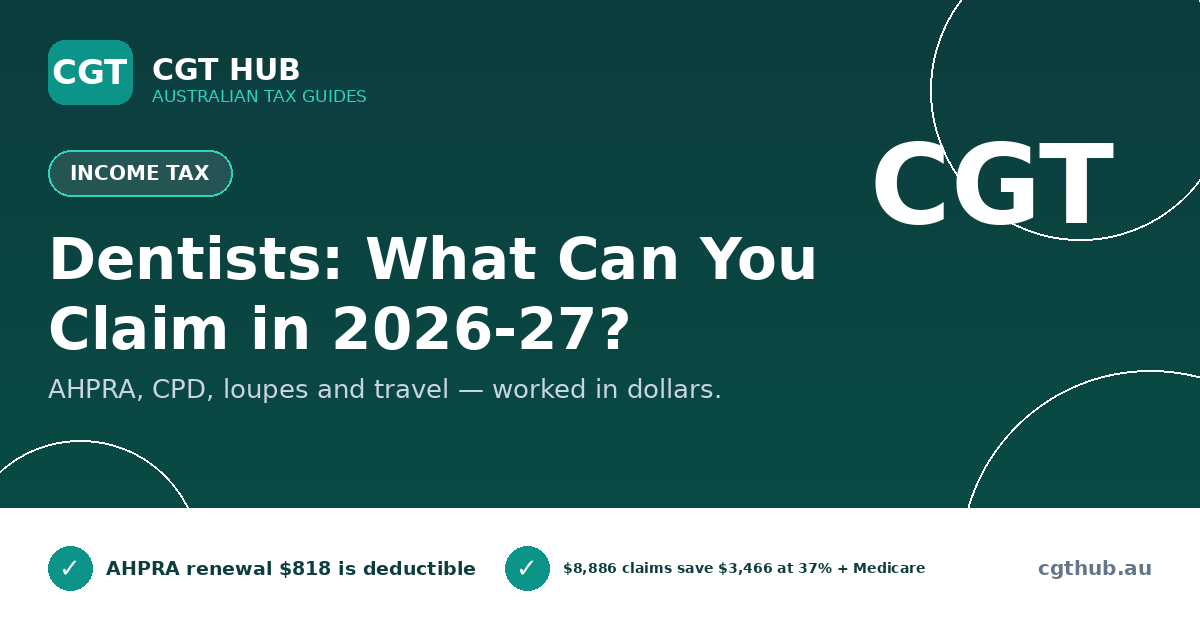
Your annual AHPRA renewal is deductible. The Dental Board of Australia rate for dentists and specialists was $818 in 2025/26 (hygienists, therapists and oral health therapists paid $256), and the renewal notice you actually pay is the figure to claim — check it, because fees are indexed each year. What is not deductible is your initial registration: the cost of entering the profession is a private, capital-type cost in the ATO’s eyes, no matter how large the bill. The same split applies to qualifications generally — getting registered is not deductible, staying registered is.
Professional indemnity insurance you pay for yourself is deductible, as are memberships of professional bodies such as the Australian Dental Association and subscriptions to clinical journals, provided they relate to your current work. If your practice pays your indemnity or your ADA membership and you are not out of pocket, there is nothing to claim — and claiming it anyway is one of the easiest errors for the ATO’s data matching to spot, because the practice has already deducted the same cost.
CPD, courses and conferences
Continuing professional development that maintains or improves the skills you use in your current role is deductible: course fees, conference registration, textbooks and materials, and the travel to get there. A hands-on endodontics workshop, a radiography refresher, a sedation update — all deductible, including flights and accommodation where you travel away overnight for the event. Two conditions matter. First, if a course is really about qualifying you for a different role — the classic example is a general dentist doing a full specialist orthodontics program — the fees are generally not deductible. Second, if you tack private days onto a conference trip, apportion the travel: claim the work days, not the holiday. A Cairns conference with three extra days on the reef is a part-claim, and the ATO expects the split to be honest.
Instruments, loupes and equipment
Small clinical items you buy yourself are deductible in full if they cost $300 or less: hand instruments, burs, a basic curing light accessory, a replacement handpiece component under the threshold. The $300 rule is the one dentists most often get wrong, because the item that defines modern dentistry — loupes — almost always costs more. A $1,850 pair of loupes is not an immediate deduction. It is depreciated over its effective life, so on a five-year life you would claim roughly $370 in the first year, not $1,850. Claiming the full amount in year one overstates your deduction by $1,480, and it is exactly the kind of round, large claim that draws a review letter. The same applies to a chairside computer, an intraoral camera or any item over $300: depreciate it, keep the invoice, and note the work-use percentage if it is ever used privately.
Uniforms, PPE and laundry
Scrubs, lab coats and other occupation-specific clothing are deductible, as is protective gear: lead aprons, protective eyewear, face shields and gloves you buy yourself. Laundry for that clothing is deductible too — keep a reasonable diary or use a sensible per-load estimate rather than inventing a number. What fails is conventional clothing: the smart shirt and trousers you wear under your lab coat, ordinary shoes, and grooming costs are private, even if your practice expects a professional appearance. The ATO made this point bluntly in a 2026 warning to tax professionals: dental expenses, grooming and personal appearance costs are private expenses, even where an employer expects a certain standard of appearance.
Car travel between clinics
This is often the largest single claim for dentists who work across two or three practices. Travel between two separate workplaces on the same day is deductible; travel from home to your usual practice is not, even if you live a long way away or are on call. The cents-per-kilometre method is the simple path: for 2026–27 the rate is 91 cents per kilometre, up to 5,000 work kilometres, with no logbook required — but you do need to be able to show how you worked out the kilometres. The logbook method can beat it if you drive a lot and your actual running costs are high, but it requires a 12-week logbook and a full year of running-cost records. For most multi-practice dentists, cents per kilometre wins on simplicity and is hard to beat below 5,000 kilometres.
Phone, internet and home admin
The work-related portion of your phone and internet is deductible — apportion it honestly rather than claiming the whole bill. If you do practice admin from home, the fixed-rate method for working from home is 70 cents per hour for the hours you actually work, covering energy, internet and phone, but it cannot be combined with separate claims for the same costs. Dentists rarely rack up large home-office hours, so this is usually a small line, not a headline claim.
2026–27 rates that drive the numbers
Resident tax rates for 2026–27 are: nil up to $18,200, 15% from $18,201 to $45,000 (down from 16% last year), 30% from $45,001 to $135,000, 37% from $135,001 to $190,000, and 45% above $190,000, plus the 2% Medicare levy on top. That means a deduction is worth your marginal rate plus 2%: 32 cents in the dollar at a $68,000 income, 39 cents at $145,000, and 47 cents above $190,000. Every dollar of legitimate claim matters more the higher your income — which is precisely why high-earning dentists should itemise carefully rather than defaulting to the $1,000 standard deduction.
Run the numbers first with the income tax calculator to see which bracket your taxable income actually lands in after deductions — a claim that pulls you below $135,000 is worth 32 cents in the dollar on the portion below the threshold, not 39, and that changes the saving.
Worked example: Dr Sarah, employed dentist on $145,000
Sarah works four days a week across two practices in Brisbane. She is an employee, paid a salary, and her practices do not reimburse the costs below. Her 2026–27 claims:
| Expense | Claim |
|---|---|
| AHPRA annual renewal | $818 |
| ADA membership | $650 |
| CPD course and conference travel | $2,400 |
| Loupes, $1,850 — first-year depreciation on a 5-year life | $370 |
| Small hand instruments (each under $300) | $280 |
| Scrubs and lab coats | $340 |
| Laundry of work clothing | $150 |
| Car travel between clinics: 3,800 km × 91c | $3,458 |
| Work portion of phone and internet | $420 |
| Total itemised deductions | $8,886 |
Her taxable income falls from $145,000 to $136,114, still in the 37% bracket, so every dollar of deduction saves 37 cents of tax plus 2 cents of Medicare levy: $8,886 × 39% = $3,466 saved. Against the $1,000 standard deduction, itemising wins by $7,886 of deductions, worth an extra $3,076. Had Sarah claimed her loupes in full in year one, she would have overstated her deductions by $1,480 and her saving by $577 — a small amount that is nonetheless exactly the kind of error that costs more in amended returns and penalties than it ever saved.
The contrast case is worth seeing too. A part-time hygienist on $68,000 with $2,150 of genuine claims — renewal, membership, scrubs, a CPD day and some between-clinic travel — still beats the standard deduction: the extra $1,150 of deductions saves $368 at 32 cents in the dollar. But a dentist whose employer reimburses everything and who has only $400 of unreimbursed costs should take the $1,000 standard deduction and stop. Itemising $400 when the standard amount is $1,000 leaves $600 of deductions — $192 at 32% — on the table for no reason.
Six mistakes that cost dentists money
1. Claiming your own dental treatment. Your own check-ups, fillings, orthodontics and whitening are private expenses. The ATO’s guidance on dental expenses is explicit on this, and it applies even though you work in dentistry. The only narrow exception is a treatment with a direct, demonstrable connection to earning your income — a standard the ATO itself describes as very limited. Do not claim it.
2. Claiming the first registration. Renewals yes, initial registration no. The same applies to the first ADC assessment or overseas-qualification costs for migrant dentists: getting into the profession is not deductible.
3. Claiming home-to-work travel. Driving from home to your main practice is private, however long the drive. Only travel between workplaces, between two jobs on the same day, or to a genuinely different work location (a remote clinic day, a conference) counts. Carrying bulky equipment can create a narrow exception, but a laptop bag and a set of loupes are not bulky equipment.
4. Expensing loupes and equipment over $300 in full. Depreciate them. Keep the invoice with the purchase date, because the effective life — and therefore the first-year claim — runs from when you start using the item, not from when you ordered it.
5. Claiming a new-qualification course as CPD. A course that maintains your current skills is deductible; a course that opens a new income-earning activity generally is not. If you are unsure which side a course falls on, that is a question for a registered tax agent before you lodge, not after.
6. Double-claiming reimbursed costs. If the practice pays your indemnity, your CPD or your registration, you cannot claim it again. Check your payslip and your practice agreement before you lodge — reimbursement is the single most common reason legitimate-looking claims get disallowed.
Employee, contractor or service agreement?
Many dentists work under service agreements rather than as employees, and the tax picture changes. A contractor dentist typically claims a wider range of costs — rooms and facilities fees, practice software, accounting fees, and a share of administrative costs — but cannot claim what the practice bears, and income-splitting through a company or trust is constrained by the personal services income rules where more than half your income comes from your own personal effort. Contractor dentists should also note that dental services are generally GST-free, which changes the GST side of the practice accounts even though it does not change the deduction rules. If your structure involves a service entity, a trust or a company, get advice on PSI and Division 7A before restructuring — the deduction list in this guide is for the individual return, not the entity.
Keeping records without the headache
Keep receipts for everything over the small-claims thresholds, a diary or calendar note for between-clinic travel (dates, practices, kilometres), and your CPD certificates with the course description — the description is what proves a course maintained your current skills rather than qualifying you for something new. The myDeductions tool in the ATO app will hold photos of receipts through the year, which beats a shoebox in June. Keep records for five years from lodgement. And remember the comparison that matters most in 2026–27: total your itemised claims, compare them with $1,000, and claim the bigger number — but only the bigger number, with records to back it.
FAQ: the questions dentists actually ask
Can I claim my AHPRA registration? Your annual renewal, yes — $818 for dentists and specialists in 2025/26, indexed annually. Your initial registration, no.
Can I claim my loupes in full? Only if they cost $300 or less. A typical $1,500–$2,500 pair is depreciated over its effective life — roughly $370 a year on a $1,850 pair over five years.
Can I claim travel between two practices? Yes, on the same day, at 91 cents per kilometre up to 5,000 kilometres under the cents-per-kilometre method, or by logbook if that gives a bigger, provable claim. Home to your first practice is not claimable.
Can I claim my own dental work? No. Personal dental and medical expenses are private, including check-ups, fillings and cosmetic work, even for dentists.
Is the $1,000 standard deduction automatic? It is applied when you lodge your 2026–27 return if you claim work-related expenses, but it replaces itemised claims rather than adding to them. Itemise only if your genuine claims exceed $1,000.
Can a contractor dentist claim more than an employee? Usually yes — rooms fees, software and practice costs the employee never bears — but PSI rules limit income splitting, and only costs you actually bear and are not reimbursed count. Structure advice is worth paying for before you change how you practise.
Dentists have one of the strongest deduction profiles of any occupation, because registration, indemnity, CPD and multi-practice travel are all genuine, recurring, unreimbursed costs. The value is in claiming them precisely: renewals not initial registration, depreciation not instant write-off for loupes, between-clinic travel not home-to-work, and the itemised total only when it beats the $1,000 standard deduction. For the full checklist across all occupations, see the tax deductions checklist, and for the closest comparisons, doctors’ deductions, nurses’ deductions, the car expenses guide and the $1,000 standard deduction guide. If your situation involves a service agreement, a company or a trust, a registered tax agent is worth the fee.