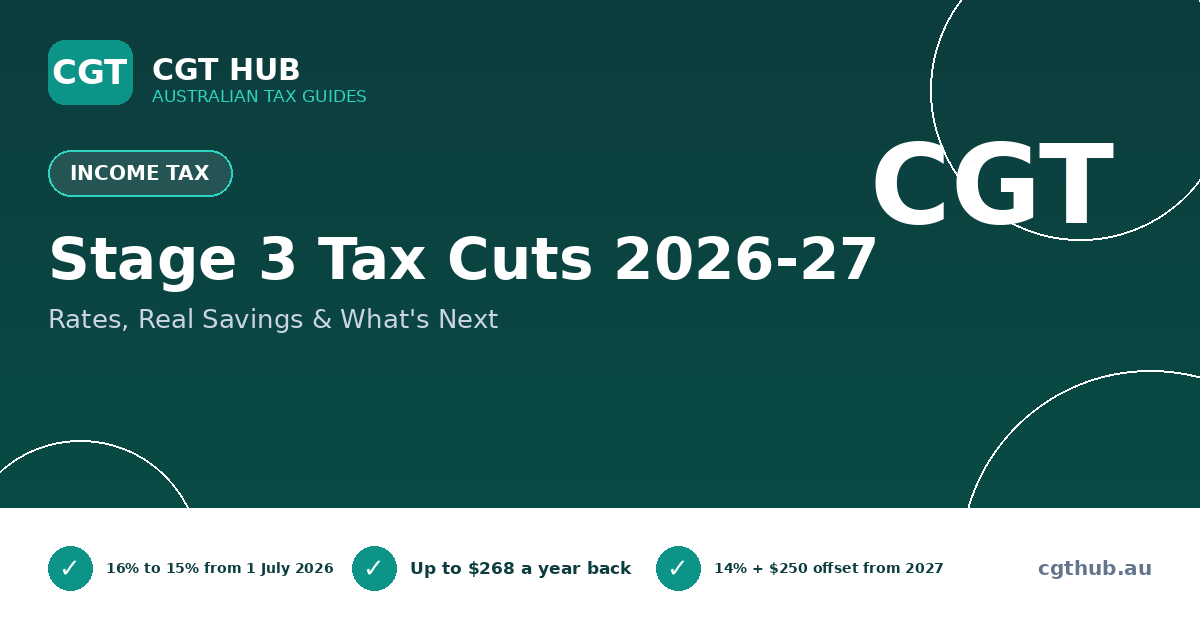
Quick answer: From 1 July 2026, Australia’s second tax bracket — income between $18,201 and $45,000 — is taxed at 15% instead of 16%. That one-percentage-point cut is the latest chapter of the Stage 3 tax cuts story, and it’s worth up to $268 a year for anyone earning $45,000 or more (another $268 comes in July 2027, when the rate drops to 14%). It’s automatic through your employer’s payroll — no forms, no claims. But the headlines skip the parts that actually affect your wallet: the Medicare levy hasn’t changed, your tax refund won’t get bigger, and this year’s Budget added a $1,000 standard work deduction that sits right alongside the rate cut.
Most explainers repeat the same bracket table and stop there. This guide works through the full history (what Stage 3 originally was, what changed in 2024, and what’s changed again now), shows the exact dollar maths at incomes from $30,000 to $200,000, and answers the questions people keep asking on forums every July: why isn’t my refund bigger, and why does the person on $200,000 get the same $268 as the person on $45,000?
Stage 3 tax cuts: the three rounds so far
“Stage 3” gets thrown around like it’s one event. It’s actually been three distinct rounds of cuts, and knowing which is which stops most of the confusion.
Round 1 — the original 2018 plan. The Morrison government legislated a three-stage personal tax plan, with Stage 3 scheduled for 1 July 2024: a single 30% rate from $45,001 to $200,000 and 45% above it, with the 37% bracket gone entirely.
Round 2 — the 2024 “cost of living” rework. The Albanese government redesigned Stage 3 before it started: the 19% rate fell to 16%, 32.5% fell to 30%, the 37% threshold moved from $120,000 to $135,000, and the 45% threshold from $180,000 to $190,000. Around three million lower earners who would have got nothing under the original plan got a cut.
Round 3 — the 2026/2027 top-up. In the 2025 Budget, the government legislated two further cuts to the second bracket only (the Treasury Laws Amendment (More Cost of Living Relief) Act 2025): 16% → 15% from 1 July 2026 and 15% → 14% from 1 July 2027. Every other rate and threshold stays exactly where the 2024 rework put them.
That’s the complete story. When someone says “Stage 3 tax cuts” in 2026, they usually mean all of this stacked together — but the only thing that changed this July is one bracket’s one percentage point.
Sources: Prime Minister’s office — new cost of living tax cuts; ATO — tax rates for Australian residents
The official 2026-27 rates (ATO-verified)
Here are the resident individual income tax rates that apply for the full 2026-27 income year (1 July 2026 – 30 June 2027), straight from the ATO’s published table:
| Taxable income | Tax on this income |
|---|---|
| $0 – $18,200 | Nil |
| $18,201 – $45,000 | 15c for each $1 over $18,200 |
| $45,001 – $135,000 | $4,020 plus 30c for each $1 over $45,000 |
| $135,001 – $190,000 | $31,020 plus 37c for each $1 over $135,000 |
| $190,001 and over | $51,370 plus 45c for each $1 over $190,000 |
Three things worth noticing, because guides routinely fumble them:
- The 2% Medicare levy sits on top. These are income tax rates only. The levy is unchanged in 2026-27, so your total marginal rate on the second bracket is effectively 17% (15% tax + 2% levy).
- Nothing else moved. Thresholds, the 30/37/45% rates, the $18,200 tax-free threshold — all identical to 2025-26. The tax-free threshold hasn’t been indexed since 2012-13, which is why bracket creep keeps doing its quiet work underneath every cut.
- Low Income Tax Offset (LITO) is unchanged — still up to $700, phasing out between $37,500 and $66,667. The bigger Low and Middle Income Tax Offset (LMITO) ended on 30 June 2022 and is not coming back.
Where your $268 actually comes from
The arithmetic is simple once you see that only one slice of income changed price. Take the full $26,800 slice ($45,000 − $18,200): in 2025-26 it was taxed at 16% ($4,288); in 2026-27 at 15% ($4,020). The difference: $268. Fill the whole slice and you get the full $268; fill part of it and you get 1% of your part — 1% of ($30,000 − $18,200) = $118.
And this answers the $200,000-earner question: the cut only repriced that one slice. Everything above $45,000 is taxed at the same rates as last year, so a $200,000 earner saves exactly the same $268 from this round as a $45,000 earner. From July 2027, the same logic doubles it: another 1% of $26,800 = another $268, for a cumulative $536 a year versus 2025-26 settings.
Run your own income through our income tax calculator and compare with the full 2026-27 table in our income tax rates guide.
Worked examples: your real saving at $30k to $200k
Income tax only here (Medicare levy unchanged year-on-year, so it cancels out of the comparison). Resident, no offsets, no HELP debt:
| Taxable income | 2025-26 tax | 2026-27 tax | You save | ≈ per week |
|---|---|---|---|---|
| $30,000 | $1,888 | $1,770 | $118 | $2.27 |
| $45,000 | $4,288 | $4,020 | $268 | $5.15 |
| $60,000 | $8,788 | $8,520 | $268 | $5.15 |
| $80,000 | $14,788 | $14,520 | $268 | $5.15 |
| $100,000 | $20,788 | $20,520 | $268 | $5.15 |
| $120,000 | $26,788 | $26,520 | $268 | $5.15 |
| $150,000 | $36,638 | $36,370 | $268 | $5.15 |
| $200,000 | $56,138 | $55,870 | $268 | $5.15 |
Check one line by hand — $80,000: 2026-27 tax = $4,020 + 30% × ($80,000 − $45,000) = $4,020 + $10,500 = $14,520. In 2025-26 the same sum started from $4,288 instead of $4,020, giving $14,788. The gap: $268. Every bracket above $45,000 carries the identical $268 saving because the arithmetic above $45,000 didn’t change at all.
The three rounds stacked: compare a $79,000 earner (roughly average full-time earnings) against the pre-Stage-3 2023-24 settings: 2023-24 tax = $5,092 + 32.5% × $34,000 = $16,142; 2026-27 tax = $4,020 + 30% × $34,000 = $14,220. Combined saving across all three rounds: $1,922 a year — about $37 a week. The government’s published estimate puts the average-earner cut at a bit over $2,200 a year in 2026-27, depending on the exact income and offset assumptions used.
What the headlines don’t tell you
1. Your tax refund will not get bigger
This is the number-one confusion, and it recurs every July. The cut flows through PAYG withholding: your employer withholds slightly less tax each payday, so your take-home pay rises by about $5.15 a week from your first full pay in July. By the time you lodge your return, the cut has already been delivered — there’s nothing extra waiting in the refund. If you were expecting a bigger refund, you’ll be disappointed; check your payslips instead.
2. The Medicare levy didn’t move
The 2% levy applies to your taxable income, and neither the rate nor (for most people) the outcome changed. On an $80,000 income that’s still $1,600 a year. So the “$268 saving” is a pure income-tax figure — your total tax bill (income tax + levy) falls by $268, not by $268-plus-levy. Our Medicare levy surcharge guide covers the thresholds that did change this year (the low-income levy thresholds rose from 1 July 2025).
3. LITO quietly shapes the low end
The Low Income Tax Offset is unchanged — up to $700, full amount under $37,500, phasing out to zero at $66,667. It stacks with the rate cut, so a $30,000 earner pays $1,770 − $700 = $1,070 in income tax (before the levy). The rate cut and LITO don’t interfere with each other; both just reduce the same bill. One caution: if your income is under about $22,867, LITO plus the tax-free threshold already wipes your income tax to zero — the rate cut gives you nothing further, because you can’t cut tax you don’t pay.
4. Three groups miss out entirely
- Non-residents and working holiday makers don’t get the $18,200 tax-free threshold or the 15% bracket — they’re taxed from the first dollar (30% to $135,000), so this cut doesn’t touch them.
- Income under $18,200 — no tax payable, no saving.
- HELP/HECS repayments are untouched. The cut reduces your income tax, but HELP repayment rates are a separate schedule calculated on repayment income. A common forum hope — “does the cut lower my HELP repayment?” — no, it doesn’t.
5. The 2026 Budget added two more pieces you should know
The rate cut didn’t arrive alone. In the same 2026-27 year:
- A $1,000 standard work-expense deduction — legislated for 2026-27, no receipts required. Claim the flat $1,000 or your actual work expenses if they’re higher (with records), not both. If you usually claim less than $1,000, this is free money at tax time. If you claim more, keep your receipts and ignore it. It was legislated for the 2026-27 year — don’t assume it automatically continues into later years without checking. See our 2026-27 deductions checklist for how it fits with the rest of your claims.
- A $250 Working Australians Tax Offset from 1 July 2027 — applied automatically through your tax return, lifting the effective tax-free threshold for workers. It lands the same year the second bracket drops to 14%.
Common mistakes people make with the tax cuts
- Confusing marginal and effective rates. Nobody pays “30%” on their whole income. An $80,000 earner pays $14,520 in income tax — an effective rate of 18.15%. Each rate only prices the slice of income inside its bracket.
- Assuming the employer updated payroll. The ATO’s withholding schedules were updated for 1 July 2026, but payroll software and outsourced providers don’t always apply updates on day one. Compare a June payslip with a July one — the tax withheld line should have dropped slightly. If it didn’t, you’ll still get the benefit at tax time, but your cash flow won’t reflect it until the fix.
- Forgetting the cut applies to taxable income, not salary. Deductions (work expenses, donations, personal super contributions) and salary sacrifice reduce your taxable income first; the brackets then apply to what’s left. Someone salary sacrificing $10,000 of an $80,000 salary is taxed as if on $70,000 — the cut still applies, just to the lower figure. Our salary sacrifice guide has the full 2026-27 numbers.
- Thinking “Stage 3” is finished. One more legislated cut is still coming: 15% → 14% on 1 July 2027, worth another $268 a year. Budget plans and salary negotiations for next year should assume 2027-28 rates, not 2026-27’s.
- Ignoring bracket creep. The $18,200 tax-free threshold hasn’t moved since 2012-13. Every pay rise pushes more of your income into higher brackets, quietly eroding the value of cuts like this one. That’s not an argument against the cut — it’s the reason the cut exists.
Tips: making the most of the 2026-27 settings
- Audit your first July payslip. The withholding line should be ~$5/fortnight lower than June’s for a full-time earner. If it isn’t, ask payroll — the money is yours either way, but sooner is better than at tax time.
- Take the $1,000 standard deduction if your claims are small. If your work expenses are a few hundred dollars of phone, laundry and union fees, the no-receipts $1,000 beats itemising. If they’re over $1,000, itemise as usual.
- Salary sacrifice still stacks. The rate cut lowers the tax on your remaining income; salary sacrifice lowers the income the rates apply to. They multiply, they don’t cancel. Just watch the $30,000 concessional cap (plus the new Division 293 settings for high balances).
- Plan for July 2027 now. If you’re modelling a mortgage, a salary package or a business budget into next financial year, use the 14% second-bracket rate and the $250 offset — not this year’s figures.
- Don’t “do nothing” if you’re not on PAYG. Sole traders and investors don’t get withholding adjustments — the cut only shows up when you lodge (or via varied PAYG instalments). Adjust your instalment expectations so you’re not overpaying through the year.
FAQ: the questions readers actually ask
Do I need to do anything to get the tax cut?
No. If you’re an employee, your employer’s payroll applies the new withholding schedules automatically. If you’re self-employed or an investor, it flows through your 2026-27 tax return (or your PAYG instalments if you vary them). There is no form to fill in and nothing to claim.
Will my tax refund be bigger this year?
Almost certainly not because of this. The cut was delivered gradually through smaller withholding across the year, so your refund reflects your final wash-up, not a bonus. The people who see a visibly bigger refund are usually those whose circumstances changed — more deductions, less income, or withholding that ran too high.
I earn $200,000. Why do I only save $268?
Because this round only repriced one slice of income ($18,201–$45,000), and you fill that slice exactly the same way a $45,000 earner does. Everything you earn above $45,000 is taxed at rates that didn’t change in this round. You benefited more from the 2024 round (the 32.5%→30% drop and the $135,000 threshold), which is where high earners’ savings sit.
What happens on 1 July 2027?
Two things: the second-bracket rate drops again from 15% to 14% (another up-to-$268 a year versus 2026-27), and the new $250 Working Australians Tax Offset starts flowing through tax returns. Combined, that’s up to $536 + $250 in annual relief versus 2025-26 settings for a full-bracket earner.
I’m a working holiday maker / non-resident. Do I get the cut?
No. The 15% bracket and the $18,200 tax-free threshold are for Australian residents for tax purposes. Non-residents are taxed from the first dollar at 30% (to $135,000), and working holiday makers have their own schedule — the July 2026 cut doesn’t apply to either.
Does the cut reduce my HELP/HECS repayment?
No. HELP repayments use a separate repayment-income schedule with its own rates and thresholds — the income-tax rate cut doesn’t change it. Your compulsory repayment is calculated on repayment income (which includes reportable super and fringe benefits), independent of the 15% bracket.
The bottom line
The Stage 3 story is now three rounds deep: the 2024 rework that gave everyone a cut, the July 2026 top-up worth up to $268 a year, and the July 2027 follow-through that doubles it and adds a $250 offset. For 2026-27 itself, the change is deliberately small — one percentage point on one bracket, delivered automatically through your pay. Its real value shows up when you stack it: about $1,900+ a year for an average earner versus the pre-Stage-3 world, plus the $1,000 standard deduction if your work expenses are modest.
Check your July payslip, take the standard deduction if it beats your receipts, and model next year on the 14% rate — that’s the practical version of everything above.