Self-Education Tax Deduction 2026-27: What You Can Claim
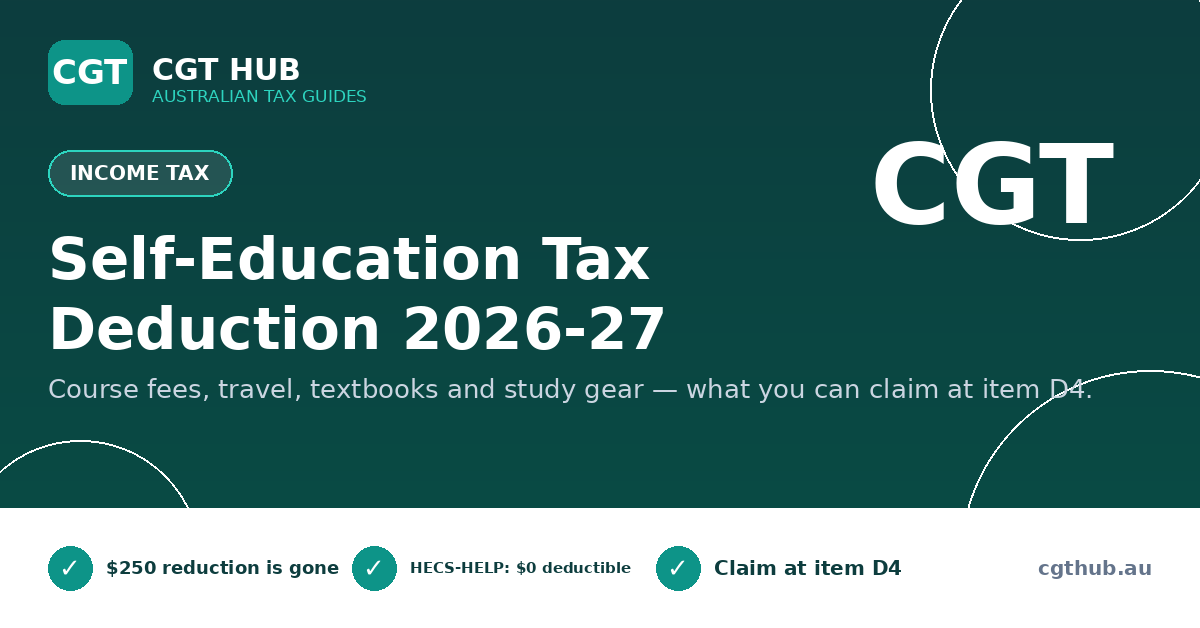
Quick answer: If you’re working and paying for study that maintains or improves the skills you need for your current job — or is likely to increase your income from it — you can deduct the cost at item D4 of your 2026-27 tax return. Course fees, textbooks, travel to class, study equipment and even loan interest can all be deductible. But fees on a HECS-HELP (Commonwealth supported) place are never deductible, and the old $250 reduction no longer applies to any expense incurred from 1 July 2022 onwards.
The two tests the ATO applies
The ATO doesn’t care where you study or whether the course leads to a formal qualification. A TAFE certificate, a university degree, an industry short course, a work conference or even a self-paced online program can all qualify. What matters is the connection between the study and the income you were earning when you incurred the expense.
Your self-education has a sufficient connection to your employment income if it either:
- maintains or improves the specific skills or knowledge you need for the work you were doing at the time — for example, an enrolled nurse doing a postgraduate certificate in critical care, or an electrician completing updated licensing training; or
- leads to, or is likely to lead to, an increase in income from your current employment activities — for example, a junior accountant studying for a CPA designation that carries a pay rise in their existing role.
The flip side is just as important. You can’t claim self-education expenses if:
- the study is designed to get you a job, a new job, or income from a new income-earning activity (the classic career-change course);
- the connection to your current work is only general — a casual retail worker studying photography full-time, for instance;
- you incurred the expense when you weren’t employed at all.
That last point catches people out. If you quit your job in March, enrolled in a course in April and started a new role in July, the April expenses relate to a period when you weren’t earning income — they’re not deductible, even if the course is directly relevant to the new job.
The $250 reduction is gone — stop subtracting it
For years, self-education claims carried an annoying quirk: the first $250 of expenses was not deductible. That rule applied only to expenses incurred before 1 July 2022. It is gone for 2026-27.
Plenty of older guides (and some current ones that haven’t been updated) still mention the $250 reduction without making this clear. If you’re preparing your 2026-27 return, do not subtract $250 from your self-education claim. Every deductible dollar counts in full.
What you can claim — the full list
Once the connection test is met, the deductible expenses are broader than most people realise:
Tuition, course, conference and seminar fees
Course fees for a full-fee-paying place are deductible. This includes fees you pay with the help of a FEE-HELP loan — the deduction is for the fees incurred (when the debt legally arises, usually at census date), not for the loan repayments you make later. Student services and amenities fees and student union fees on a full-fee enrolment are also claimable.
General study costs
Textbooks, trade and professional journals, stationery, printing and postage, and the work-related portion of your internet and phone bills. If you study from home, you can claim home office running costs (electricity, internet) on a reasonable basis — keep a 4-week diary to establish the pattern. Home office occupancy expenses (rent, mortgage interest, rates) are not claimable for study at home.
Depreciating assets
Computers, desks, chairs, calculators, bookshelves and other study equipment. The $300 rule applies: an asset costing $300 or less (used wholly for study) is immediately deductible in the year you buy it; anything over $300 is claimed over its effective life. For example, a $1,500 laptop used 80% for study has $1,200 of deductible value spread over its 3-year effective life — $400 a year. Apportion honestly: the private-use slice is never deductible.
Car and other transport
Travel between work and your place of education is deductible, as is travel from home to your place of education when you then go on to work. The trip from your place of education back home is private travel — you can’t claim it. Parking fees at your place of study are claimable. Keep a logbook or diary for car claims.
Accommodation and meals (overnight only)
If your self-education requires you to travel and stay away from home for one or more nights — a regional conference, an interstate intensive — accommodation and meal costs are deductible. Day-to-day meals while commuting to evening classes are not.
Interest on borrowings
Interest on a loan you took out to pay for deductible self-education is deductible each year you incur it. Repayments of the loan principal are not — same principle as FEE-HELP: the deduction is for the study cost, not for paying off debt.
What you can’t claim
- HECS-HELP fees — tuition for a Commonwealth supported place is never deductible, even if you pay upfront and even if the course is directly related to your job. Specific legislation denies it outright.
- HELP and other study-loan repayments — HECS-HELP, FEE-HELP, VET Student Loans, Student Start-up Loans and Australian Apprenticeship Support Loans repayments are never deductible.
- Employer-paid or reimbursed costs — if your employer met the cost, it’s not your deduction.
- Childcare, general living costs and courses of pure personal interest.
The HECS-HELP trap: a $12,000 worked comparison
This is the single most expensive misunderstanding in self-education. Take Maya, a registered nurse earning $85,000, doing a $12,000 postgraduate nursing qualification directly related to her current role.
Scenario A — Commonwealth supported place (HECS-HELP): $12,000 of fees. Deduction: $0. The law denies it completely, regardless of how work-related the course is.
Scenario B — full-fee place: $12,000 of fees. Deductible in full at D4 (connection test easily met). At her 30% marginal rate plus 2% Medicare levy, that’s roughly $3,840 back at tax time.
Same nurse, same course, same job — a $3,840 difference decided entirely by the enrolment type. Always check your fee statement: Commonwealth supported (HECS-HELP) means no deduction; full-fee means a potential deduction.
Step-by-step: how to claim at tax time
- Confirm the connection. Write down, in one or two sentences, how the course maintained or improved the skills for the job you held when you incurred each expense. If you can’t, the claim is shaky.
- Gather every expense. Fees, textbooks, stationery, travel, parking, equipment, internet apportionment, interest. If your total work-related expense claim exceeds $300, you need written evidence (receipts) — keep them regardless.
- Put course expenses at item D4. That’s the “work-related self-education expenses” label in myTax. Costs for attending seminars, conferences, education workshops and training courses that are sufficiently connected to your work go at item D5 (other work-related expenses) — a split most guides never mention.
- Apportion mixed-use costs. Laptop, phone, internet, car — claim only the study/work-related percentage, with a diary or logbook to back it up.
- Check the year. Fees are incurred when the legal obligation arises (usually census date), not when you pay them off. A semester starting in February 2027 with census in March 2027 belongs in your 2026-27 return.
Worked example: $7,030 of study costs on an $85,000 salary
Daniel is a high-school teacher earning $85,000 in 2026-27. He completes a work-related postgraduate education unit (full-fee, $6,200), spends $450 on textbooks and stationery, and $380 on travel and parking getting to evening classes. Total D4 claim: $7,030.
First, his tax with no deduction, using the 2026-27 resident brackets (0% to $18,200; 15% to $45,000; 30% to $135,000):
- 15% × ($45,000 − $18,200) = $4,020
- 30% × ($85,000 − $45,000) = $12,000
- Income tax: $16,020, plus 2% Medicare levy ($1,700) = $17,720
With the $7,030 deduction, taxable income falls to $77,970:
- 15% × $26,800 = $4,020
- 30% × ($77,970 − $45,000) = $9,891
- Income tax: $13,911, plus Medicare levy 2% × $77,970 = $1,559 = $15,470
Tax saving: about $2,250. Notice the deduction also shrinks the Medicare levy by $141 — a bonus most calculators don’t spell out. Run your own numbers through our income tax calculator with the deduction entered to see your exact position.
Common mistakes that cost people money
- Claiming HECS-HELP fees. The most common error — and the one the ATO specifically legislates against. Upfront-paid CSP fees are equally non-deductible.
- Still subtracting $250. The reduction ended for expenses incurred from 1 July 2022. Don’t give the ATO a free $250.
- Claiming the career-change course. Studying to become something new — nursing to physiotherapy, retail to real estate — fails the connection test no matter how sincere the effort.
- Claiming study costs incurred while unemployed. Timing matters: the expense must connect to income you were earning when you incurred it.
- Putting everything at D4. Conference and seminar costs belong at D5. Wrong label, right amount is usually harmless — but get it right anyway.
- No apportionment diary. Claiming 100% of the laptop, phone and internet with no usage record is exactly what gets claims adjusted on review.
- Forgetting the census-date timing. Claiming next year’s semester fees in this year’s return because you “paid early” — the deduction year follows the liability, not the payment.
Tips to maximise a legitimate claim
- Prepay before 30 June where it helps. If you’re in a higher bracket this year than next, bringing forward deductible course fees (incurring the liability before 30 June) can be worth real money — get advice first.
- Bundle the small stuff. Textbooks, stationery, printing, professional journals and parking add up. A $6,200 course fee plus $830 of “small” costs is a $7,030 claim, not a $6,200 one.
- Track travel from day one. A simple diary of class trips (dates, kilometres, parking receipts) is all the ATO wants.
- Keep the enrolment paperwork. Your fee statement proves full-fee vs Commonwealth supported status — the document that decides whether thousands are deductible or not.
- Don’t forget loan interest. If you borrowed to pay deductible fees, the interest each year is its own deduction.
Frequently asked questions
Can I claim my HECS-HELP uni fees if the degree relates to my job?
No. Tuition fees for a Commonwealth supported place are never deductible — even if you pay them upfront and even if the course is directly related to your current employment. Specific tax legislation denies the deduction. HELP loan repayments are also never deductible.
I paid my course fees upfront instead of using HELP. Can I claim them?
If you were in a full-fee-paying place (not Commonwealth supported) and the course meets the connection test for your current job, yes — the upfront fees are deductible at D4. Keep the receipt and the fee statement showing full-fee status.
Does the $250 reduction still apply?
No — not for any expense incurred from 1 July 2022 onwards. The first-$250 reduction applied only to pre-1 July 2022 expenses. For 2026-27, claim every deductible dollar.
Can I claim a course that helps me change careers?
No. Study designed to get you a new job or move into a new field fails the ATO’s connection test, even if you’re currently employed. The course must relate to the work you were doing when you incurred the cost.
I studied while on parental leave. Can I claim it?
Generally no for expenses incurred while you weren’t employed. The deduction requires a connection to income-earning activities at the time the expense was incurred. Expenses incurred after you return to work, for study connected to that role, are a different story.
Are MBA fees tax deductible?
Sometimes — it’s the classic fault line. An MBA is more likely deductible if you already work in management and the subjects deepen your existing responsibilities. If the MBA is a pivot into a new career, or your pre-study role is unrelated to management, the claim will usually fail. Mixed courses may need to be apportioned subject by subject.
The bottom line
Self-education is one of the most valuable — and most misunderstood — deductions available to Australian employees. The rules reward study that deepens your current career and punish nothing except sloppy boundaries: career-change courses, HECS-HELP fees and unemployed-period study are out; everything genuinely connected to your current job is in, with no $250 haircut anymore.
If you’re spending thousands on work-related study this year, the difference between a careful D4 claim and no claim can be thousands back at tax time — our worked teacher saved about $2,250 on a $7,030 claim. Just make sure the enrolment type, the timing and the connection test are all on your side before you lodge. For the broader picture of what else you can claim, see our 2026-27 tax deductions checklist and our guide to how much tax you’d pay on a $100k salary.