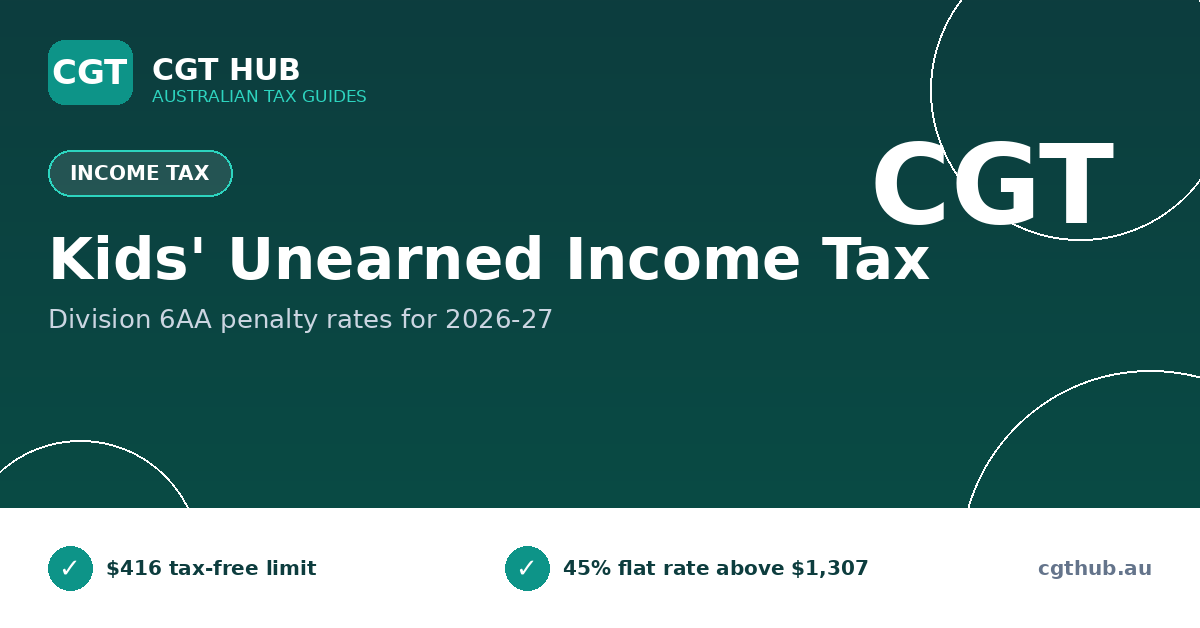
The short version: If your child is under 18 at 30 June and earns unearned income — bank interest, dividends, rent, or a family trust distribution — Division 6AA punishes it in 2026-27: nothing on the first $416, then 66% on every dollar from $417 to $1,307, then a flat 45% on the whole amount above $1,307. A $2,000 trust distribution to a 15-year-old costs $900 in tax. But income your child actually earns — a part-time job, their own business — is taxed at normal adult rates with the full $18,200 tax-free threshold.
Why the ATO taxes kids’ investment income so harshly
Division 6AA exists for one reason: to stop parents splitting income with their children. Without it, a parent on the 45% marginal rate could park shares in each child’s name and have the dividends taxed at next to nothing. The law’s answer is brutal by design — penalty rates so high that income-splitting through minors isn’t worth it.
The definitions are narrow, and they matter:
- Minor means under 18 at 30 June of the income year — not when the income was earned. A child who turns 18 in May is taxed as an adult for the whole year.
- Eligible (unearned) income is investment and passive income: bank interest, dividends, rent, royalties, most family trust distributions.
- Excepted income is taxed at ordinary adult rates — the escape hatch.
- Excepted person is a minor who escapes Division 6AA entirely — e.g. a full-time young worker, or a child with a disability.
One surprise: when a minor is presently entitled to trust income, it’s generally the trustee who is assessed and pays the tax on the child’s behalf (section 98). The bill lands with the trustee, not with a tax return in the child’s name.
The 2026-27 penalty rates (resident minors)
These are the Division 6AA rates for 2026-27, verified against the ATO’s trust tax return instructions. They apply to a child’s eligible (unearned) income only:
| Unearned income | Tax rate |
|---|---|
| $0 – $416 | Nil |
| $417 – $1,307 | Nil + 66 cents for every dollar over $416 |
| $1,308 and above | 45 cents in the dollar on the entire amount |
Two things to notice. First, the low income tax offset (LITO) cannot be used to reduce tax on a minor’s unearned income — the effective tax-free limit really is $416. Second, above $1,307 the 45% applies to the entire amount, not just the slice over the threshold — which is what makes the examples below so stark.
A note on a number you’ll see floating around: some older articles quote 47% as the penalty rate. That’s a leftover from the 2014–2017 Temporary Budget Repair Levy years, when the top marginal rate was temporarily 47% and Division 6AA tracked it. The 2026-27 rate is 45%. (Separately, 47% is also the rate banks withhold on interest when no TFN is provided — which is where a lot of the confusion comes from.)
The other rate table: excepted income
Excepted income is taxed at ordinary adult rates — the full $18,200 tax-free threshold, the normal marginal brackets, and access to offsets like LITO. For 2026-27 that means:
| Taxable (excepted) income | Tax rate |
|---|---|
| $0 – $18,200 | Nil |
| $18,201 – $45,000 | 16c for each $1 over $18,200 |
| $45,001 – $135,000 | $4,288 + 30c for each $1 over $45,000 |
| $135,001 – $190,000 | $31,288 + 37c for each $1 over $135,000 |
| $190,001 and over | $51,638 + 45c for each $1 over $190,000 |
So the same child can face two completely different tax treatments in the same year: their Saturday job taxed like an adult’s, their savings-account interest punished at 66% or 45%. Getting the classification right is everything.
Who counts as an “excepted person”?
An excepted person skips Division 6AA entirely — all of their income, including unearned income, is taxed at adult rates. A minor qualifies if, broadly, they:
- work full-time (or worked full-time for at least three months during the year and intend to keep working full-time rather than return to full-time study);
- receive a disability support pension or rehabilitation allowance, or someone receives a carer allowance to look after them;
- are permanently blind, or have a disability likely to last permanently or for an extended period;
- receive a double orphan pension with little or no financial support from relatives; or
- are unable to work full-time because of a permanent mental or physical disability, with little or no family support.
For most families, the full-time-worker category is the relevant one: a 17-year-old who left school and works full-time is taxed as an adult on everything. A full-time student with a casual job is not — the job income is excepted, but their investment income still cops penalty rates.
What counts as excepted income?
Even if your child isn’t an excepted person, individual types of income can still be excepted and taxed at adult rates. The list is specific:
- Employment and business income — wages, salary, and income from the child’s own business or an active partnership. This is the big one: your teenager’s part-time job is safe.
- Taxable pensions and payments from Centrelink or the Department of Veterans’ Affairs.
- Compensation, superannuation and pension fund benefits — including workers compensation and payouts for personal injury.
- Income from a deceased person’s estate — including distributions from a testamentary trust, provided the income comes from genuine estate assets (see the 2020 reform warning below).
- Income from property transferred because of someone’s death or a family breakdown, and damages for personal injury the child suffered.
- Net capital gains from disposing of any of the property above, and income from investing any of the amounts above.
The pattern is clear: income the child genuinely earned, or received because of death, disability, injury or family breakdown, gets adult treatment. Income that smells like a parent parking investments in a child’s name gets punished.
Worked example 1: $2,000 trust distribution to a 15-year-old
This is the scenario family-trust owners ask about most. The trustee distributes $2,000 of ordinary trust income to a 15-year-old — a standard discretionary distribution, so it’s eligible (unearned) income:
- Eligible income: $2,000 — above $1,307, so 45% applies to the entire amount.
- Tax = 0.45 × $2,000 = $900.
The trustee is assessed and pays the $900 on the child’s behalf. The child keeps $1,100 of the $2,000.
Compare: the same $2,000 to a parent on the 30% marginal rate costs $600 in tax. Distributing to the minor cost an extra $300. (Our earlier family trust guide used an indicative “~$914” for this scenario — the verified 2026-27 figure is exactly $900.) Income-splitting with minors doesn’t just fail to save tax; it destroys it.
Worked example 2: $8,000 bank interest to a 12-year-old
Grandparents put a large sum in a savings account in 12-year-old Mia’s name, and it earns $8,000 interest in 2026-27. Bank interest is unearned income, and Mia isn’t an excepted person: tax = 0.45 × $8,000 = $3,600. Mia keeps $4,400 of her $8,000 — nearly half the return vanishes. In a parent’s account on the 30% rate, the tax would have been $2,400. (See our bank interest tax guide for the adult side.)
A smaller version of the same trap: $1,000 of bank interest. The first $416 is tax-free, the remaining $584 taxed at 66%: 0.66 × $584 = $385.44.
Worked example 3: the part-time job that’s perfectly safe
Sixteen-year-old Jack earns $5,000 from his weekend retail job and $600 interest on savings. The wages are excepted income — under the $18,200 threshold, tax is nil. The $600 interest is eligible income: ($600 − $416) × 66% = $121.44. Total tax: about $121.
This is the answer to the most common parent worry: no, your teenager’s part-time job does not get taxed at 66%. Employment income is excepted. Only the investment income is punished.
Worked example 4: the $416 sweet spot
Here’s the one piece of genuinely good news. Because the first $416 of unearned income is tax-free, many trustees distribute exactly $416 per minor child each year. Watch what it does to a $10,000 trust distribution when the alternative is a parent on the 30% marginal rate:
- All $10,000 to the parent: 0.30 × $10,000 = $3,000 tax.
- $416 to the child + $9,584 to the parent: $0 on the child’s share + 0.30 × $9,584 = $2,875.20 tax.
Total saving: about $125, completely legally. It’s not life-changing, but across several children and several years it adds up — and it’s the one minor-distribution strategy the law permits. Make sure the distribution is real: properly documented, and the child genuinely receives it.
The “cliff” at $1,307 is basically a myth
Parents sometimes stress about the jump between the 66% band and the 45%-of-everything band. At $1,307, tax is 0.66 × ($1,307 − $416) = $588.06. At $1,308, it’s 0.45 × $1,308 = $588.60. The “cliff” is 54 cents — the bands were designed to join smoothly.
Testamentary trusts: the exception with a 2020 sting in the tail
Distributions from a testamentary trust (created under someone’s will) are the big exception: income a minor receives is excepted trust income, taxed at adult rates with the full $18,200 threshold. A $20,000 distribution to a 14-year-old grandchild from a genuine estate trust means ($20,000 − $18,200) × 16% = $288, and the low income tax offset (up to $700) wipes that out — $0 tax. The same $20,000 from a family trust would cost $9,000.
But a 2020 law change closed the loophole people were driving trucks through. Since 1 July 2019, only income from genuine estate assets (or assets representing them) counts as excepted trust income. If the trustee injects new, unrelated assets to manufacture more “excepted” income for the kids, Division 6AA catches it at penalty rates. Testamentary trusts still work beautifully — you just can’t top them up with non-estate wealth and expect the concession.
Common mistakes parents make
1. Assuming the $18,200 tax-free threshold applies to everything. It only applies to excepted income (and excepted persons). For unearned income, the real threshold is $416.
2. Distributing big trust amounts to minors to “split” income. As Example 1 showed, $2,000 to a 15-year-old costs $900 versus $600 to a 30%-rate adult. Above $416, splitting with kids almost always loses.
3. Quoting the 47% rate. It’s 45% in 2026-27. The 47% figure is either a decade-old leftover or confusion with the 47% TFN withholding rate.
4. Forgetting who pays. For trust distributions, the trustee is assessed under section 98 and pays the Div 6AA tax. Don’t wait for a bill addressed to your child.
5. Topping up testamentary trusts with non-estate assets. Post-2020, injected assets don’t generate excepted income. Get advice before adding property to a testamentary trust.
6. Not giving the bank the child’s TFN or date of birth. For under-16s: interest under $120 a year — no withholding; $120 to $420 — no withholding if the bank has the child’s TFN or date of birth; $420 or more with no TFN — the bank withholds 47%. For 16 and 17-year-olds the $120 threshold applies. Joint accounts with a parent lose the concessional under-16 thresholds entirely.
7. Expecting the low income tax offset to help. LITO can’t reduce tax on a minor’s unearned income — the $416 limit is hard.
Practical tips
- Use the $416 rule deliberately. If your family trust has minor beneficiaries, a $416 annual distribution each is the tax-free sweet spot — document it properly.
- Model before you distribute. Run the trustee’s distribution scenarios through our income tax calculator before 30 June — a five-minute check can save hundreds per child.
- Encourage actual work. A teenager’s wages are excepted income with the full adult threshold. Shifting a child’s savings into… well, a job, is the best tax shelter going.
- Think about super for working teens. A child with genuine employment income may be eligible for the government’s super co-contribution — up to $500 a year. See our super co-contribution guide.
- Keep the paperwork. If the ATO queries whether income was excepted, contemporaneous records (payslips, estate documents, trust resolutions) decide it.
- Lodge when required. If a child’s unearned income exceeds $416, or tax was withheld because no TFN was given, lodge a return for the child — you can claim back over-withheld amounts and franking credits.
Frequently asked questions
Is the penalty rate 45% or 47%?
45% in 2026-27. The 47% figure dates from the 2014–2017 Temporary Budget Repair Levy era, when the top marginal rate (and therefore the Division 6AA rate) was temporarily 47%. The other 47% you’ll meet is the TFN withholding rate banks apply when no TFN is quoted — a different rule.
Does my teenager’s part-time job get taxed at 66%?
No. Employment income is excepted income, taxed at normal adult rates with the full $18,200 tax-free threshold. A teen earning $8,000 from a casual job pays no tax on it. Only unearned income — interest, dividends, trust distributions — faces penalty rates.
Do I need to lodge a tax return for my child?
It depends. On a family trust distribution, the trustee is generally assessed and pays — no child return needed. If the child directly earned over $416 in unearned income, or had tax withheld because no TFN was provided, lodge a return in the child’s name (there’s no minimum age for a TFN) to square it up and claim any refund.
Can I distribute $416 to each of my kids every year?
Yes — the standard, legitimate strategy. The first $416 of a minor’s unearned income is tax-free each year. Make it genuine: a proper trustee resolution before 30 June, and the money must actually go to (or be genuinely held for) the child.
My child turns 18 during the year — do the penalty rates still apply?
No. A “minor” for Division 6AA is someone under 18 at 30 June. Turn 18 in March and you’re taxed at adult rates for the whole year.
Does a testamentary trust really let my grandkids use the $18,200 threshold?
Yes — for income from genuine estate assets. Each minor beneficiary is taxed at adult rates on excepted trust income, so the $18,200 threshold applies per child. But since the 2020 reform, assets injected into the trust that are unrelated to the deceased estate don’t get this treatment.
Bringing it together
Division 6AA is one of the few places in Australian tax law where the punishment so obviously fits the crime: $416 tax-free, then 66%, then 45% on the lot. The practical rules are simple. Don’t park investments in your children’s names and expect adult tax treatment. Don’t distribute meaningful trust amounts to minors and call it splitting. Do use the $416 annual distribution, do get your working teenager’s wages classified correctly, and do understand the testamentary trust exception — with its post-2020 limits — if estate planning is on the table. And model the distribution before 30 June, because once the trustee’s resolution is signed, the $900 on that $2,000 is locked in.