Quick answer: do you pay GST when selling property?
If you’re selling your own established home or an investment property you’ve held for years, the answer is almost always no — those sales are “input taxed,” which means no GST is charged and no GST credits can be claimed. But if you’re a developer, builder, substantial renovator, or subdivider selling in the course of a property enterprise, GST very likely applies — and getting the margin scheme right can be worth tens of thousands of dollars.
The rules catch more people than you’d think. A single mum-and-dad flip, a knockdown-rebuild, or a backyard subdivision can drag you into the GST net even if you don’t think of yourself as a developer. Here’s how it actually works, with real 2026-27 numbers.
The three ways GST treats a property sale
Every property sale falls into one of three GST buckets. Knowing which bucket you’re in decides everything else.
| Sale type | GST treatment | What it means |
|---|---|---|
| Established home or investment property | Input taxed | No GST on the sale; no GST credits on sale costs |
| Residential rent (long-term) | Input taxed | No GST on rent; no credits on rental expenses |
| New residential premises, sold by the creator | Taxable — 10% GST | GST included in the sale price, reported on your BAS |
| Commercial property (sale or lease) | Taxable — 10% GST | GST on the price; buyer may claim a credit |
| Tenanted business sold as a going concern | GST-free | No GST at all, if the strict conditions are met |
| Vacant land sold in a property enterprise | Taxable — 10% GST | Never “residential premises,” so never input taxed |
| Farmland (conditions met) | GST-free | Farmed 5+ years and buyer keeps farming |
The most important row for ordinary owners is the first one: sell your established house, pay no GST. But watch the fine print — who is selling matters just as much as what is being sold.
First question: are you “carrying on an enterprise”?
GST only applies to sales made in the course of an enterprise by a GST-registered entity. A private homeowner selling the family home is not carrying on an enterprise, whatever the price.
The trap is that even a single transaction can be an enterprise if it’s a profit-making undertaking. Buy an old house intending to knock it down, build two townhouses and sell them? That’s an enterprise from day one — your intention at acquisition is what counts. And if your projected turnover hits the $75,000 GST registration threshold, registration isn’t optional.
This is where one-off flippers get stung. A common real-world case: someone buys a property, subdivides, builds, sells one dwelling — a genuine one-off, never done before — and assumes GST doesn’t apply. Under the ATO’s enterprise test it usually does, and the GST lands on the full sale price. If you bought with a profit-making plan, talk to an accountant before you sell, not after settlement.
New residential premises and the 5-year rule
A sale of “new residential premises” is taxable. Under the GST law, premises are new if they:
- have never been sold as residential premises before (first sale after construction);
- were created through substantial renovations; or
- were built to replace a demolished building on the same land.
Crucially, the sale must be by the entity that created them. Buy a brand-new apartment from a developer and resell it a year later — you’re selling existing residential premises (input taxed, no GST), because you didn’t create it.
The “new” label also expires. New premises stop being new once they’ve been continuously rented out for at least 5 years since creation. Sell after that and it’s input taxed, like any established home. Some developers deliberately build, rent for 5+ years, then sell GST-free — but there’s a cost: while the property is rented as residential accommodation (an input-taxed supply), you can’t claim input tax credits on the construction costs. It’s a genuine trade-off, not a free loophole.
What counts as a “substantial renovation”?
Gut a house and rebuild its interior, and the result counts as new residential premises — a later sale is taxable. But the bar is high. The ATO’s ruling (GSTR 2003/3) says a renovation is substantial only when all, or substantially all, of the building is removed or replaced — essentially a new building inside the existing shell.
Expensive cosmetic work doesn’t qualify. A $120,000 kitchen-and-bathroom makeover on a $900,000 house is not a substantial renovation if the rest of the building is untouched. Paint, carpet, new appliances — none of it restarts the clock. This distinction matters: get it wrong and you either pay GST you didn’t owe, or fail to charge it when you should have.
A renovator’s numbers: buy at $600,000, spend $350,000 on a genuine full gut-and-rebuild, sell for $1.1 million. Standard GST would be 1/11 of $1.1m = $100,000. Under the margin scheme it can be as low as 1/11 of ($1.1m − $950k) = $13,636 — a saving of over $86,000. That gap is why the renovation question deserves proper advice.
The margin scheme: GST on the profit, not the price
The margin scheme is the single most valuable concession in property GST. Instead of paying 1/11 of the full sale price, you pay 1/11 of the margin — broadly, the sale price minus what you originally paid for the property.
How it works in dollars
Take a straightforward development: land bought for $400,000, build cost $500,000, sold for $1.3 million.
- Standard method: 1/11 × $1,300,000 = $118,182 GST
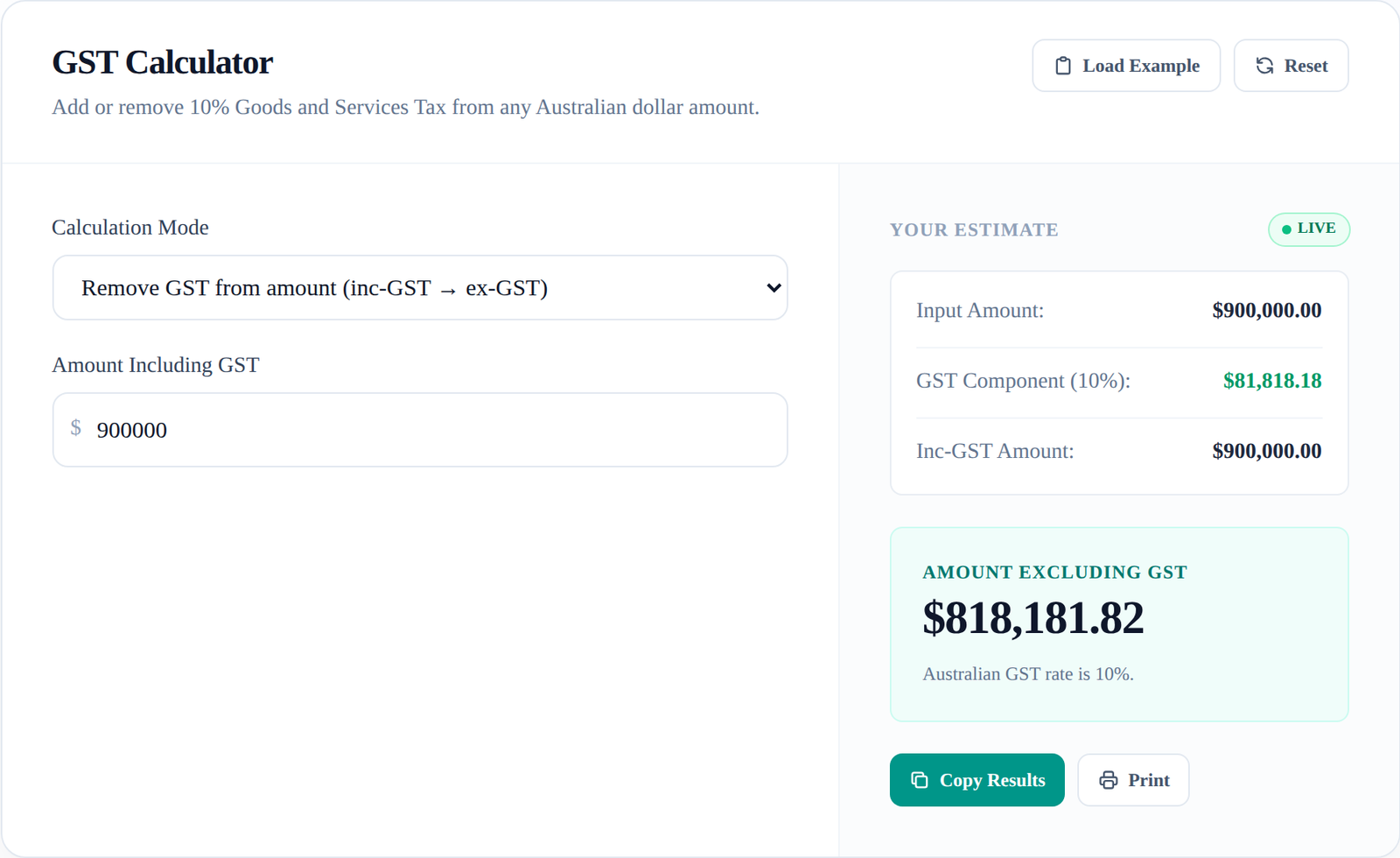
- Margin scheme: 1/11 × ($1,300,000 − $400,000) = $81,818 GST
That’s a $36,364 saving on one project. For mum-and-dad scale the effect can be even starker: buy an old Queenslander for $1 million, knock it down, sell the vacant land with a development approval for $1.1 million. Standard GST: $100,000. Margin scheme: 1/11 × $100,000 = $9,091. One clause in the contract — a $90,909 difference.
The eligibility chain (this is where people get burned)
You can’t just choose the margin scheme at sale time. The ATO’s rules (section 75-5) block it when:
- you bought the property as a fully taxable supply and the margin scheme wasn’t used on that purchase;
- you claimed input tax credits when you bought it;
- you weren’t GST-registered (or required to be) at the time of sale; or
- you inherited it from someone who wasn’t eligible to use the scheme.
Read that first point twice. If you buy land where the seller charged full GST and you later sell, you are locked out of the margin scheme on your sale. Developers buying vacant residential land should insist the margin scheme applies to their purchase, or they can’t use it on the developed sale. Check this before contracts are signed — after settlement it’s too late.
There’s a second non-negotiable: both buyer and seller must agree in writing to use the margin scheme before settlement. Most standard contracts have a tick box for it. Without that written agreement, no margin scheme — even if every other condition is met.
One more trade-off: when you sell under the margin scheme, the buyer cannot claim an input tax credit for the GST in the price, and you must not show a GST amount on the tax invoice. For a homebuyer that doesn’t matter; for a GST-registered commercial buyer it can — which is why the margin scheme isn’t automatically the right choice on commercial deals.
The two ways to calculate the margin
For property acquired after 1 July 2000, the consideration method applies: margin = sale price minus the actual price you paid (including settlement adjustments). For property acquired before 1 July 2000, the valuation method applies: margin = sale price minus a professional valuation as at 1 July 2000, done by a qualified valuer.
GST at settlement: the buyer pays the ATO directly
Since 1 July 2018, buyers of new residential premises or potential residential land withhold the GST from the purchase price and pay it straight to the ATO at settlement. This surprises people — here’s exactly how it works.
How much is withheld?
- 1/11 of the contract price — standard taxable sale
- 7% of the contract price — sale under the margin scheme
- 10% of the GST-exclusive market value — sales between associates for less than market value
It’s not an extra cost on top
The withheld amount comes out of the money that would otherwise go to the seller. On a $1.1 million purchase with standard GST treatment: the buyer withholds $100,000 for the ATO and the seller receives $890,000 at settlement (plus the deposit already paid). The buyer doesn’t pay $1.1m plus $100,000. Your conveyancer handles the split — the contract includes a supplier notification stating the withholding amount, and the buyer’s representative lodges it with the ATO.
The vendor’s BAS — and the cash-flow gap
Being withheld doesn’t end the vendor’s obligations. The supplier still reports the sale on their BAS and gets a credit for the withheld amount. And here’s the wrinkle developers feel: the withheld amount is often more than the actual GST owed.
The ATO’s own example: John buys land for $500,000, builds for $365,000 (claiming $33,181 in GST credits along the way), and sells the finished house for $900,000 under the margin scheme. Margin = $400,000, so actual GST = $36,363. But the buyer withholds 7% of $900,000 = $63,000. John reports $36,363 on his BAS, the $63,000 credit is offset, and he gets a $26,637 refund — but only when the BAS is processed. That timing gap needs to be in the project’s cash-flow plan.
Commercial property: GST, plus the going-concern escape hatch
Selling commercial property — offices, retail, industrial — is a taxable supply: 10% GST on the price. The contract must state clearly whether the price is GST-inclusive or GST-exclusive-plus-GST, because that single clause decides who funds the $100k+ swing. The buyer, if GST-registered, claims the GST as an input tax credit, so for business-to-business deals the GST is often close to cash-flow neutral.
The big exemption is the going concern: sell a tenanted commercial property as a functioning business and the sale is GST-free. All of these must hold:
- both parties are GST-registered (or required to be);
- the contract states in writing that it’s a going concern; and
- everything necessary for the continued operation of the enterprise is supplied.
And a genuine trap from the ATO’s rulings: the owner of an enterprise that consists solely of leasing property cannot sell it as a going concern to the lessee. When the lease merges with the freehold on sale, the lease covenants — one of the “things necessary” for the enterprise — disappear. A landlord selling the building to their own tenant expecting GST-free treatment can get a nasty surprise.
Subdivisions and vacant land
Vacant land is never “residential premises,” so it’s never input taxed — if you sell it in the course of an enterprise, it’s taxable. And subdividing to sell is one of the classic one-off “enterprises” that catches private owners: buy, subdivide, sell the lots for a profit, and you’re in the GST system whether you planned to be or not. (For the income-tax side of subdividing, see our CGT on subdivided land guide.)
Under the margin scheme, subdivided lots use a reasonable apportionment of the original purchase price. A typical example: a developer buys an 1,800m² block for $216,000, subdivides into two 450m² lots and one 900m² lot. Apportioned by area, the 900m² lot cost $108,000. Sell it for $156,000 and the margin-scheme GST is 1/11 × $48,000 = $4,363.64 — versus $15,600 under the standard method.
Claiming GST credits on development costs
If you’re registered and making taxable supplies, you claim GST credits on construction and development costs through your BAS as you go — materials, contractors, consultants. That’s a major cash-flow help during a build.
But the credits follow the use of the property. Decide mid-project to hold and rent instead of selling, and the supply becomes input taxed (residential rent) — credits claimed may need to be repaid through an increasing adjustment. Mixed projects (sell some lots, hold others) get partial credits in proportion. This is the dual-purpose trap: the rent-then-sell “5-year plan” only works if the change to purely rental use is complete, and you forgo the construction credits for the rental period.
Common mistakes that cost real money
- Assuming one flip means no GST. Intention at acquisition can make a single transaction an enterprise. The $75,000 registration threshold is about turnover, not about being “a developer.”
- Buying without securing the margin scheme. If your purchase was fully taxable with no margin scheme, you can’t use it on your sale. Check the chain before exchange, not after.
- Forgetting the written margin-scheme agreement. No tick in the contract, no margin scheme — the ATO won’t backdate your intention.
- Treating the withholding as an extra cost. Buyers: it’s deducted from the seller’s proceeds, not added to your price. Sellers: budget for the BAS timing gap on any over-withholding.
- Claiming the margin scheme makes the buyer happy. A GST-registered commercial buyer loses their input tax credit under the margin scheme — on some deals the standard method is the better commercial outcome.
- The going-concern shortcut with your own tenant. Selling a leased property to the lessee isn’t a going concern under the ATO’s view — the lease covenants merge and the exemption fails.
Tips: keeping the GST bill (and the paperwork) under control
- Model both methods before you sign anything. Run the standard 1/11 vs margin-scheme numbers on every project — the saving is often five figures, and eligibility depends on how you bought.
- Get the contract wording right. Margin-scheme election, GST-inclusive vs plus-GST pricing, and the supplier notification for withholding — all three live in the contract. A conveyancer experienced in development sales earns their fee here.
- Plan for the settlement withholding in your cash flow. On a $900,000 margin-scheme sale, $63,000 leaves at settlement and only returns via the BAS. Finance the gap.
- Keep every tax invoice. GST credits on a build are claimed invoice by invoice. The ATO’s data-matching on property development is active — “close enough” isn’t a record-keeping system.
- Revisit purpose changes immediately. The moment a sell-project becomes a hold-project, your GST credit position changes. Don’t discover it at BAS time.
- Remember the buyer-side stamp duty effect. Because the margin scheme reduces the GST embedded in the price, it can also reduce the dutiable value for the buyer’s stamp duty — a genuine selling point in negotiations.
Frequently asked questions
Do I pay GST when selling my house in Australia?
No — selling an established home is input taxed, so there’s no GST on the sale. GST only enters the picture for new residential premises sold by the creator, substantial renovations, commercial property, or land sold in a property enterprise.
Is GST added on top of the property price?
No. For taxable property sales the price is GST-inclusive — the 10% is inside the contract price, not on top of it. And under the GST-at-settlement rules, the buyer withholds the GST component from the balance paid to the seller and remits it to the ATO directly.
What is the GST margin scheme in simple terms?
Instead of paying GST on the full sale price (1/11), you pay GST on just your margin — the sale price minus what you paid for the property (1/11 of the difference). Both parties must agree in writing before settlement, and you must have been eligible based on how you acquired the property.
How much GST is withheld at settlement?
Since 1 July 2018: 1/11 of the contract price for a standard taxable sale, 7% of the contract price where the margin scheme applies, or 10% of the GST-exclusive market value for associate/undervalue sales. The seller reports the sale on their BAS and receives a credit for the withheld amount.
Can I use the margin scheme if I bought the property from a developer who charged full GST?
No. If your purchase was a fully taxable supply and the margin scheme wasn’t applied to it, you cannot use the margin scheme when you sell. This is the most common eligibility trap — always check the acquisition history before relying on the margin scheme.
Does the 5-year rule let developers avoid GST by renting first?
Only with real costs. New premises stop being “new” after 5 years of continuous residential rental, making a later sale input taxed — but you can’t claim GST credits on construction costs during the rental period, and the change to purely rental use must be genuine and complete. It’s a strategy, not a loophole.
The bottom line
GST on property sales is a game of categories: input taxed for established homes, taxable for new and commercial property, GST-free for genuine going concerns. The money is in the details most guides gloss over — the enterprise test that catches one-off flippers, the purchase-chain rule that decides margin-scheme eligibility, the settlement-day withholding mechanics, and the BAS timing gap on the refund. Model the numbers both ways, get the contract clauses right, and keep every invoice. On a typical development the difference between the standard method and the margin scheme is the difference between a good project and a great one.
Sources: ATO — GST at settlement; ATO — Margin scheme eligibility; ATO — Calculating the GST payable. Also see our GST for small business guide, CGT on property guide, 6-year rule explained, CGT cost base guide, and the GST calculator.