Mum hands over $400,000 so a flat can be built on your property for her to live in. Everyone’s heard a version of this story — and then someone asks: does the tax office treat that $400,000 as a taxable capital gain?
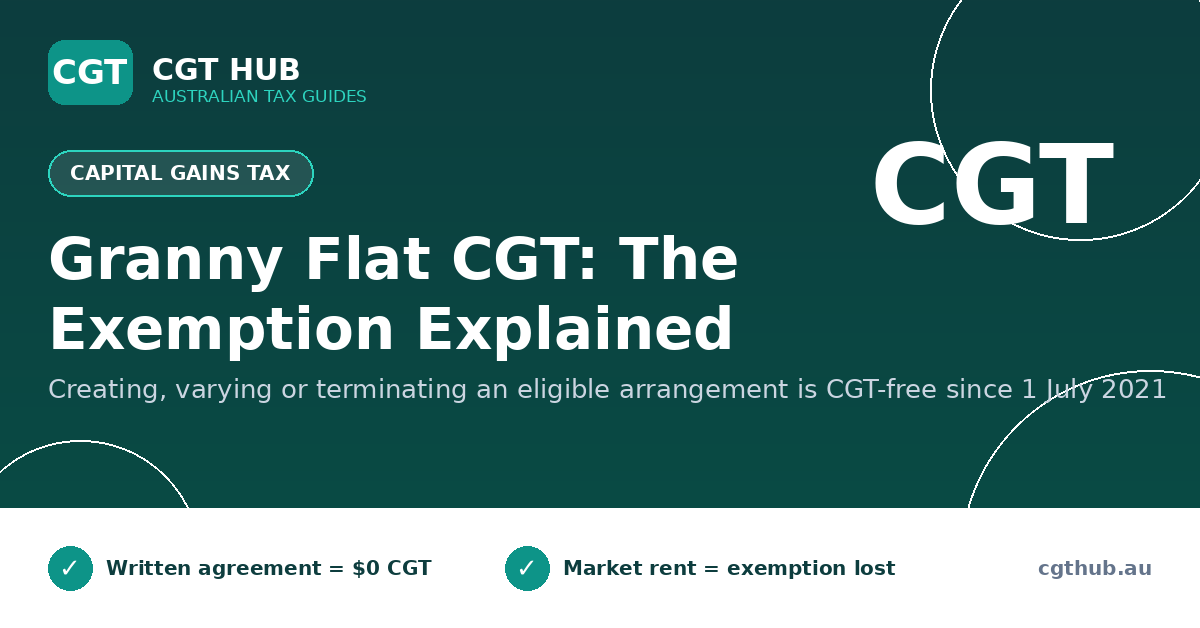
The short answer: no CGT applies, as long as the arrangement meets the ATO’s granny flat rules. Since 1 July 2021, creating, varying or terminating an eligible granny flat arrangement is exempt from CGT. Get any of the conditions wrong, though, and the owner can face a five- or six-figure capital gain on what was meant to be a family favour. This guide walks through the rules, the traps, and two worked examples with real numbers.
What counts as a granny flat arrangement (for tax purposes)?
Forget the building itself. For tax purposes, a granny flat arrangement is a written agreement that gives an individual the right to occupy a property for life. It doesn’t have to be a literal granny flat out the back — the interest can be over part or all of the property, and it can be any dwelling, including the owner’s own home. What matters is the lifetime right to occupy, granted under a written, binding agreement that isn’t commercial in nature.
This matters because, without a special exemption, handing someone a lifetime right to occupy your property is a CGT event — specifically CGT event D1, the creation of a contractual or other right. The ATO recognised this was a cruel trap for families caring for ageing parents, so the exemption was introduced from 1 July 2021.
The CGT exemption: four conditions, all of them mandatory
A granny flat arrangement is exempt from CGT only if every one of these is true:
| Condition | What it means in practice |
|---|---|
| Owner is an individual | The property owner or owners must be individuals — not a company or a trust. |
| Eligible granny flat interest | One or more individuals hold a lifetime right to occupy under the arrangement, and they are pension age or need daily assistance (see below). |
| Written and binding agreement | The arrangement must be in writing and show the parties intend to be legally bound. A handshake doesn’t count. |
| Not commercial in nature | Contributing to household costs like electricity and water is fine; paying market-rate rent is not. |
The exemption covers only the creation, variation and termination of the arrangement. It is not a blanket shield around the property. The ATO is explicit: CGT events that sit outside the arrangement follow the normal CGT rules.
Who is “eligible” for a granny flat interest?
The person getting the lifetime right must meet one of two tests at the time the arrangement is entered into:
- Pension age. They have reached the qualifying age for the Age Pension. For anyone born on or after 1 January 1957, that age is 67 — and it applies equally to men and women. (Older birth cohorts have lower thresholds; the transition from 65 to 67 completed on 1 July 2023.)
- Disability. They need, and are likely to continue needing for the next 12 months, assistance to carry out most day-to-day activities because of a disability. Employment or a chance of recovery doesn’t disqualify them.
Note the subtlety: the test is about being of pension age, not about actually receiving the pension. And the right covers the dwelling plus adjacent land and structures, up to a 2-hectare limit.
What the exemption covers — and what it doesn’t
| Event | CGT treatment |
|---|---|
| Creating the arrangement (parent pays to build) | Exempt — CGT event D1 doesn’t happen. |
| Varying the arrangement (e.g. changing who pays for repairs) | Exempt. |
| Terminating the arrangement (parent moves into aged care) | Exempt. |
| Parent sells shares to fund the build | Taxable. The share sale isn’t part of the arrangement — normal CGT applies. |
| Owner later sells the whole property | Normal CGT rules. The main residence exemption still works as usual (see below). |
| Owner rents the “granny flat” out at market rent | Taxable. This is now a commercial arrangement — the exemption doesn’t apply. |
Step-by-step: getting the exemption right
- Check eligibility. Confirm the person receiving the lifetime right is of pension age (67 for anyone born on/after 1 January 1957) or meets the disability test.
- Put it in writing. A written, binding agreement naming both parties, the property, and the lifetime right to occupy. Have it witnessed or drafted by a solicitor — this is the single most common failure point.
- Keep it non-commercial. The parent can chip in for power, water and maintenance, but don’t set anything resembling market rent. Also make sure the owner is an individual, not a trust or company.
- Sort Centrelink separately. Services Australia assesses the granny flat interest for the assets test under its own rules — tax exemption and Centrelink treatment are two different systems. Don’t assume one follows the other.
- Keep records. File the signed agreement, the build invoices, and any payments. If the ATO ever asks, this paper trail is your proof.
Worked example 1: an eligible arrangement — $450,000 contribution
Margaret, 71, gives her daughter Sandra $450,000 to build an attached flat on Sandra’s Sydney property, where Margaret will live for the rest of her life. They sign a written, binding agreement. Sandra owns the property as an individual, Margaret pays $150 a fortnight toward electricity and water, and legal fees for the agreement are $2,000.
Without the exemption: Sandra has created a contractual right in exchange for $450,000 — CGT event D1. Her capital gain would be the $450,000 capital proceeds less her $2,000 incidental costs: $448,000. Sandra has owned the property for more than 12 months, so the 50% CGT discount would apply, leaving $224,000 added to her taxable income. On top of a $110,000 salary in 2026-27, that extra income sits squarely in the 45% bracket plus the 2% Medicare levy — a marginal hit of roughly $105,000 in extra tax, all from helping her mum.
With the exemption: all four conditions are met — individual owner, eligible interest (Margaret is 71), written agreement, non-commercial. CGT event D1 doesn’t happen. Capital gain: $0.
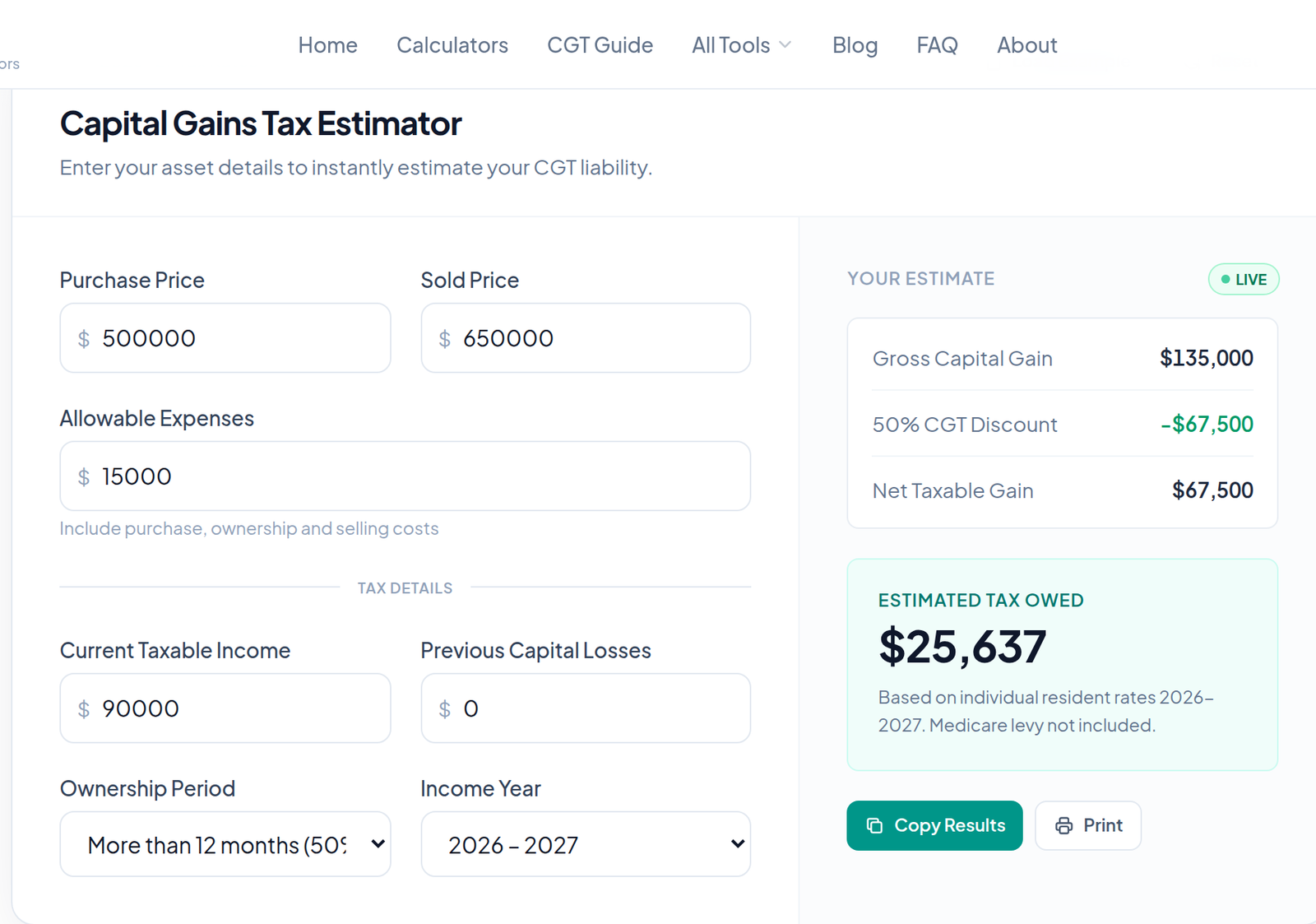
The numbers above are illustrative — your marginal rate, other income and cost base will differ — but they show why getting the paperwork right matters. Run your own figures on our CGT calculator to see the scale.
Worked example 2: verbal agreement plus market rent — the exemption fails
Now flip the facts. Tom, 68, gives his son James $300,000 to build a granny flat on James’s investment property. There’s no written agreement — “we’re family, we trust each other” — and when Tom later moves into residential aged care, James rents the flat out at $420 a week, which is market rent for the area.
Two things have gone wrong. First, without a written and binding agreement, the arrangement fails the exemption conditions from day one — CGT event D1 happened when the $300,000 changed hands. Second, renting the flat at market rent makes the arrangement commercial in nature, which independently kills the exemption.
The rough maths: James created a right for $300,000 in capital proceeds. After the 50% discount (property held over 12 months), about $150,000 lands in his taxable income — worth roughly $67,000+ in extra tax at top marginal rates. A one-page agreement would have cost a fraction of that.
This is also where family gifts can create a second problem: handing property interests to relatives without the exemption can trigger CGT at market value even when no money changes hands. See our guide to CGT on gifting property to family for the full picture.
Common mistakes families make
- No written agreement. The single biggest trap. A verbal family understanding is not a “written and binding arrangement”, and the ATO has no discretion to waive this.
- Charging market rent. Any payment that looks like rent at market rates makes the arrangement commercial. Modest contributions to bills are fine.
- Owner is a trust or company. The exemption requires the owner to be an individual. If the property sits in a family trust, the exemption is unavailable.
- Assuming Centrelink and the ATO agree. Services Australia values the granny flat interest for the assets test separately. Tax-exempt doesn’t mean pension-exempt.
- Thinking the exemption covers the eventual sale. When the property is sold later, the main residence exemption and normal CGT on property rules decide the outcome — the granny flat history doesn’t change that.
- Selling assets to fund the build. If mum sells shares or an investment property to raise the contribution money, that sale is a normal CGT event — the proceeds’ use doesn’t make it exempt.
Tips for setting one up cleanly
- Get a solicitor to draft the agreement, even for a simple family setup. One page, properly witnessed, beats a handshake every time.
- Spell out what happens if the arrangement ends — for example, if the parent moves into aged care — so the termination is clearly covered by the same exemption.
- If the parent is under pension age and relying on the disability test, get the medical evidence documented at the time, not years later.
- Talk to Services Australia before signing if the parent receives or may apply for the Age Pension — the granny flat interest affects the assets test.
- Keep the build invoices and payment records with the agreement; your cost base records matter too. See our guide to CGT cost base rules.
How this affects the main residence exemption
Good news: creating a granny flat arrangement over your main residence doesn’t dent your main residence exemption. The ATO treats the arrangement as a right to occupy the property, not a right to the property itself, so the full exemption survives. If you sell the home years later, the normal main residence rules apply — read our main residence exemption guide for the details.
Frequently asked questions
Does CGT apply when my parent pays me to build a granny flat?
No — as long as the arrangement meets all four exemption conditions (individual owner, eligible interest, written binding agreement, non-commercial), no CGT event happens when the arrangement is created. This has been the rule since 1 July 2021.
What is a “reverse” granny flat arrangement?
It’s when the younger generation builds on the parents’ property — for example, you build a $300,000 transportable on your parents’ rural land and live in it. The CGT exemption works exactly the same way, provided the conditions are met: the owners (your parents) are individuals, you hold an eligible interest, the agreement is written and binding, and it’s non-commercial. The ATO has confirmed this in its community guidance.
Do I need a lawyer, or can we write the agreement ourselves?
The law doesn’t require a solicitor — it requires the arrangement to be in writing and to show the parties intend to be legally bound. In practice, a solicitor-drafted agreement is cheap insurance: it removes any argument about whether your document qualifies.
What happens when the arrangement ends — for example, if mum moves into aged care?
Terminating the arrangement is also covered by the exemption, so no CGT arises on termination. If the property is later sold, normal CGT rules apply to the sale itself.
Can the parent still get the Age Pension with a granny flat interest?
Maybe — but it’s a separate assessment. Services Australia values the granny flat interest for the assets test under social security law, which is independent of the tax exemption. Get Centrelink advice before signing.
What if we never wrote anything down?
Then you don’t have a granny flat arrangement in the tax law’s eyes, and the CGT exemption doesn’t apply. Creating the right to occupy is CGT event D1, and the owner may face a capital gain based on the money received. Get an agreement put in place and seek tax advice on the position so far.
Final word
The granny flat CGT exemption is one of the more generous provisions in the tax law: it lets families care for ageing parents without a tax bill landing on the gesture. But it is a checklist exemption — individual owner, eligible interest, written binding agreement, non-commercial — and missing any single item turns a $0 outcome into a five- or six-figure one. Get the agreement signed, keep it genuine, and the tax side takes care of itself.