Do you pay tax on Airbnb income in Australia?
Yes — every dollar of it. Whether you rent out a spare bedroom for a few weekends or run a full-time holiday let, the Australian Taxation Office treats short-term rental income exactly like ordinary rental income: it’s assessable, it goes in your tax return, and the ATO probably already knows the amount before you lodge. Since 1 July 2023, platforms like Airbnb, Stayz and Booking.com have reported host income directly to the ATO twice a year under the Sharing Economy Reporting Regime.
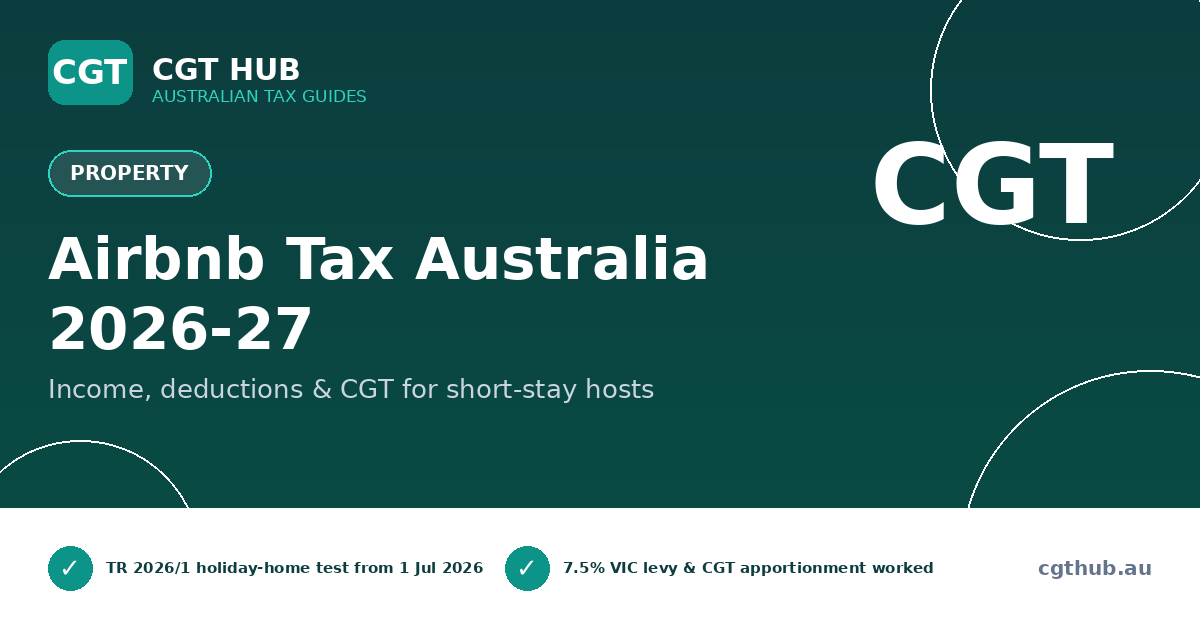
And the rules just got tougher. From 1 July 2026, new ATO guidance (Taxation Ruling TR 2026/1 and compliance guidelines PCG 2026/2 and PCG 2026/3) overhauled how holiday homes and short-term rentals are assessed. If your property doubles as a holiday home, you can now only claim ownership expenses like mortgage interest and council rates if the place is mainly used to produce rental income. Block it out every Christmas for your own family and those big deductions can disappear entirely — not apportioned, denied.
This guide covers how Airbnb income is taxed in 2026–27: what counts as income, what you can claim, the area-and-time apportionment formula, the new holiday-home rules, GST, Victoria’s 7.5% short stay levy, and the capital gains tax bill waiting when you sell — each with worked numbers.
What counts as Airbnb income
You must declare the gross amount — not the payout that lands in your bank account after Airbnb takes its cut. That includes:
- Nightly rates and any weekly or monthly amounts guests pay
- Cleaning fees charged to guests (assessable income, even if you pass every cent to your cleaner)
- The platform’s guest service fee where it forms part of the booking price
- Bond money you keep for damage, insurance payouts for lost rent, and reimbursements from guests
Declaring only the net payout is one of the most common errors the ATO flags. Its guidance is explicit: report the gross rent paid by the tenant, not the amount you receive after fees are deducted. The platform commission is deductible separately, so you end up in the right place — but only if you get both sides right.
Income is reported in the year the guest pays it, which can differ from when your managing agent or Airbnb releases it to you. A guest who books and pays in June 2027 for a July stay creates 2026–27 income, not 2027–28.
The Sharing Economy Reporting Regime
Since 1 July 2023, short-term accommodation platforms have been required to report host activity to the ATO twice yearly: by 31 January for the July–December half and by 31 July for the January–June half. Each report includes the host’s name, TFN or ABN, total income, number of transactions and the property address. The ATO’s data-matching program then checks those figures against what appears in your tax return, and its media releases are blunt that discrepancies get followed up. The ATO is also writing to taxpayers whose rental income looks significantly lower than the expenses they’ve claimed over multiple years — a letter no host wants to receive.
Deductions: what Airbnb hosts can claim
The same expenses available to long-term landlords are available to short-term hosts, with one big difference: almost everything must be apportioned between income-producing use and private use. You can claim the portion of these expenses that relates to earning rental income:
- Interest on the loan used to buy the property
- Council rates, water charges and land tax
- Building, contents and public liability insurance
- Cleaning costs after a guest stays, linen and laundry
- Repairs and maintenance (not improvements)
- Platform commissions and booking fees — 100% deductible, no apportionment needed
- Advertising, professional photography for your listing, pest control, gardening
- Utilities — electricity, gas, internet — for the rental period
Costs spread over several years: depreciation of furniture and appliances (Division 40), capital works like a new deck or renovation (Division 43 at 2.5% a year), and borrowing expenses. Note that any Division 43 and Division 40 amounts you claim reduce your cost base for CGT later — deductions now, a bigger capital gain on sale (see our investment property depreciation guide).
You cannot claim the private-use portion of any expense, acquisition and disposal costs of the property itself, or — unchanged since 1 July 2019 — holding costs on vacant land.
The apportionment formula: area × time
When you rent out part of your home, the ATO requires a two-step calculation. First the area-based method: (your room’s square metres + half the shared areas) ÷ total square metres. Then the time-based method: days the space produced income ÷ 365. Multiply the two percentages together and apply the result to your annual shared expenses.
If you rent out your whole home occasionally — say while you’re travelling — only the time-based step applies.
Worked example: Maya’s spare room
Maya rents her spare bedroom on Airbnb. The room is 12 square metres, the shared living areas are 60 square metres, and the house is 140 square metres in total.
- Area: (12 + 60 ÷ 2) ÷ 140 = 42 ÷ 140 = 30%
- Time: rented for 140 days → 140 ÷ 365 = 38.4%
- Combined: 30% × 38.4% = 11.5%
Maya’s annual shared expenses — interest, rates, insurance, electricity and internet — total $24,000. Her deductible share is 11.5% × $24,000 = $2,760. She also paid $890 in Airbnb host service fees, which are 100% deductible, giving her total rental deductions of $3,650.
One trap: listing the room all year doesn’t mean 365 income days. The ATO counts only days the room was actually rented (or genuinely held for rent) — an empty, unlisted spare room is treated as private use of your home, not as available-for-rent days.
New from 1 July 2026: the “mainly” test (TR 2026/1)
This is the change most holiday-home hosts still haven’t priced in. From 1 July 2026, if your property doubles as a holiday home, you can only claim ownership and use expenses — interest, council and water rates, body corporate fees, repairs and maintenance, capital works, decline in value — if the home is mainly used (or held mainly for use) to produce rental income.
If it fails that test, those expenses are denied entirely — not apportioned down, gone. The only deductions that survive are expenses directly tied to letting it out: advertising, booking or commission fees, and cleaning after a guest stays.
How does the ATO decide what “mainly” means? It looks at how the property is used, how long it was dedicated to income-producing use, how much time you and your family used it, and — crucially — whether it was available during peak demand periods such as school holidays, public holidays and Christmas. A property that is blocked out every Christmas for the owner’s family looks, to the ATO, like a private holiday home that happens to be rented, not a rental that happens to be used privately. If the property passes the test but has some minor private use (a week or two in the off-season), ownership expenses remain claimable but must be apportioned for those private days.
Worked example: Chris’s Noosa unit
Chris owns a Noosa unit with annual ownership costs of $31,000 (interest $22,000, body corporate $5,500, rates and insurance $3,500). He rents it on Airbnb for 90 days and uses it himself — and for family — for 6 weeks, including every Christmas and Easter.
Because the unit is blocked out through every peak period, the ATO is likely to treat it as mainly a private holiday home. Result: $0 of the $31,000 ownership costs are deductible. Chris can still claim his advertising, Airbnb commissions and post-stay cleaning — perhaps $2,000 — but the big-ticket deductions vanish, while the full $18,000 of rental income stays assessable.
Contrast this with the same unit listed and genuinely available all year — including Christmas — at market rates, rented 90 days and used privately for two quiet off-season weeks. Then the ownership costs are claimable, apportioned for the two private weeks. The difference between the two scenarios is roughly $9,000–$11,000 of deductions on a $31,000 cost base, depending on Chris’s marginal rate. Peak-period availability is now a tax strategy, not just a pricing one.
GST: you almost certainly don’t have it
Residential rent in Australia is input-taxed (effectively GST-free). That means standard Airbnb hosting of a residential property attracts no GST — and you cannot claim GST credits on your hosting expenses — even if your turnover exceeds the $75,000 GST registration threshold. The threshold simply doesn’t bite on input-taxed supplies.
The exception is commercial residential premises: hotel-style operations such as serviced apartments, motels or bed-and-breakfast accommodation run as an enterprise, where GST can apply. The ATO’s own line is that it is rare for someone to be carrying on a business merely by renting out a property, so this won’t capture ordinary hosts. If you’re running multiple whole properties with hotel-style services, get advice — that’s the fact pattern where the exception lives.
Note: Victoria’s short stay levy is a state levy, not GST — the two have nothing to do with each other.
Victoria’s 7.5% short stay levy
Since 1 January 2025, Victoria charges a short stay levy of 7.5% of the total booking fee on any stay of fewer than 28 continuous days. The “total booking fee” is broad: it includes cleaning fees, GST and service charges (credit card fees are excluded).
| How you take bookings | Who pays the levy |
|---|---|
| Through a platform (Airbnb, Stayz, Booking.com) | The platform — it collects 7.5% from the guest and remits it. Your payout is unaffected. |
| Direct bookings (your own website, repeat guests) | You — you must register with the State Revenue Office and lodge returns. |
The levy doesn’t apply to stays of 28 days or more, or to a short stay in someone’s principal place of residence — if you list your own home while you’re away on holidays, those guest stays are exempt. But it does apply to a granny flat on the same land as your PPR, a private room in a house that isn’t anyone’s PPR, and tiny homes.
For direct-book hosts, the compliance mechanics matter: properties earning up to $75,000 in short-stay revenue lodge an annual statement (the first was due 30 January 2026); above that, quarterly returns. The ACT has also introduced a short stay levy (reported as 5% in early 2026). No other state or territory had one as of early 2026 — but councils are circling, so check your local rules before you list.
The key tax point: the levy is collected from the guest on platform bookings, so it doesn’t reduce your assessable income — but it does make your listing 7.5% more expensive to the guest, which is a pricing and occupancy consideration, not a deduction.
CGT when you sell: the partial exemption
Every deduction you claim while hosting chips away at your main residence exemption. The formula mirrors the apportionment above: the percentage of floor area rented × the percentage of ownership days it produced income gives the share of the capital gain exposed to CGT.
Worked example: Priya’s spare room
Priya rents out 25% of her home’s floor area on Airbnb for 3 of the 10 years she owns the property, then sells for a $300,000 gain.
- Exposed share: 25% × (3 ÷ 10) = 7.5%
- Taxable gain before discount: 7.5% × $300,000 = $22,500
- 50% CGT discount (held more than 12 months): $22,500 → $11,250 assessable
- Tax at a 30% marginal rate plus Medicare levy: roughly $3,600
Three years of hosting revenue, one $3,600 tax bill on sale — most hosts never model this. And remember the Division 43 and Division 40 deductions claimed along the way reduce your cost base, pushing the gain higher.
Two important nuances. First, the 6-year rule (treating a former home as your main residence for up to 6 years of absence) applies to whole-home absences — it doesn’t rescue a spare room rented while you were living there. Second, from 1 July 2027 the CGT discount rules change: the contract date — not settlement — determines which regime applies, so if a sale is on the horizon, timing the contract matters more than ever. See our CGT reform guide for the dollar-for-dollar comparisons.
Common mistakes the ATO is actively hunting
- Claiming 100% of expenses on a property you use yourself. The ATO’s top short-term rental complaint. Deductions are limited to days rented or genuinely available for rent — and from 1 July 2026, the TR 2026/1 “mainly” test can wipe out ownership expenses entirely.
- Declaring net payouts instead of gross income. Airbnb’s data feed shows the gross. Your return should match it.
- Friends and family at mate’s rates. If you let family stay for free or at a reduced rate, your deductions for those periods are capped at the rent actually received — you can’t manufacture a loss on a $50-a-night “rental” of a $300-a-night property.
- Leaving platform income off entirely. The data-matching program means undeclared Airbnb income is one of the easiest things the ATO finds.
- Assuming the 6-year rule covers Airbnb use. It covers moving out — not hosting from the spare room while you live there, and not holiday-home private use.
- Claiming “genuinely available” days that weren’t. Listing at above-market rates, refusing most enquiries, or blocking peak periods all signal the property wasn’t genuinely available — and deductions get limited to actual rental days.
Record-keeping: what to keep
The ATO expects contemporaneous records, not reconstructions at tax time. Keep:
- Monthly platform statements showing gross income, fees and payouts
- Your booking calendar — including blocked-out personal-use periods
- Receipts for every deductible expense, with private/business splits noted
- Floor-area measurements for the rented space and shared areas
- Evidence of market-rate pricing (comparable listings) for periods you claim as “available for rent”
- A simple diary of days the property was rented, available, or used privately
Frequently asked questions
I only hosted for one weekend — do I really have to declare it?
Yes. There is no minimum threshold, no “occasional use” exemption, and no “I thought it was a hobby” defence. All rental income is assessable regardless of how rarely you host.
Do I declare the gross booking amount or what Airbnb pays me?
The gross amount the guest pays — including cleaning fees and the guest service fee — then claim the platform’s commission as a separate 100% deduction. Your return’s income figure should reconcile with what Airbnb reports to the ATO.
Do I need to register for GST if my Airbnb earns over $75,000?
Almost certainly not. Residential rent is input-taxed, so the $75,000 threshold doesn’t trigger GST registration for ordinary hosts — but it also means you can’t claim GST credits on expenses. The exception is genuinely commercial, hotel-style operations.
Can I claim a full year of interest if my holiday home was listed all year but only booked 60 days?
No. At best you apportion to the 60 rental days plus any days it was genuinely available at market rates. From 1 July 2026, if the property is mainly a private holiday home under TR 2026/1, the interest isn’t deductible at all.
Will Airbnb’ing my spare room destroy my main residence exemption?
It erodes it in proportion to the area rented and the days rented — it doesn’t destroy the whole exemption. But the 6-year rule won’t help: it only applies when you’ve moved out of the entire home.
Is Victoria’s short stay levy an extra tax I have to pay?
Not on platform bookings — Airbnb collects it from the guest and your payout is unchanged. You only handle it yourself on direct bookings, where SRO registration and returns are required.
The bottom line
Short-term rental tax in 2026–27 comes down to three numbers: what came in (gross), what fraction of the property and the year produced it (area × time), and whether your holiday home is genuinely, mainly, a rental (the TR 2026/1 test). Get those right and Airbnb income is straightforward; get them wrong and you’re either leaving deductions unclaimed or inviting an ATO letter armed with your own platform data. Run your numbers through our income tax calculator and CGT calculator, and if the property doubles as a holiday home, review your peak-period availability before you lodge — under the new rules, it’s a tax decision.
Related reading: rental income tax, main residence exemption, the 6-year rule, negative gearing.